10 Ways to Make Better Decisions in Ministry
Church leaders make better decisions by clarifying values, seeking wise counsel, using proven decision-making frameworks, and grounding choices in both data and prayer. Strong ministry leadership isn’t about having all the answers—it’s about humility, discernment, and disciplined thinking.




If there’s one thing that will improve your leadership in ministry, it’s making better decisions. So, how do we make better decisions in leadership? The most accurate and painful answer is that we make better decisions by learning from bad decisions.
I find it ironic that the wisest man of all time wrote more than anyone else about seeking counsel. Based on the example of Solomon, wisdom is not knowing the answer to every question or knowing what to do in every scenario. True wisdom is humility. It is the willingness and ability to listen to others and pursue feedback.
If this understanding of wisdom is true, here are a few important strategies to help us as church leaders to make better decisions.
10 Tools to Make Better Decisions in Ministry
Let Your Values Drive Decisions
In my opinion, the most effective and consistent way to make informed decisions is to let your values guide your decision-making. If you have taken the time to define your personal and organizational values, you can let those values drive your decisions.
The alternative is a system where leaders make decisions based on personal preference, which leads to opinion-based decisions and creates cultural problems in your staff. So, as you attempt to make good leadership decisions, ask yourself how your organizational values come into play.
Use The Eisenhower Matrix
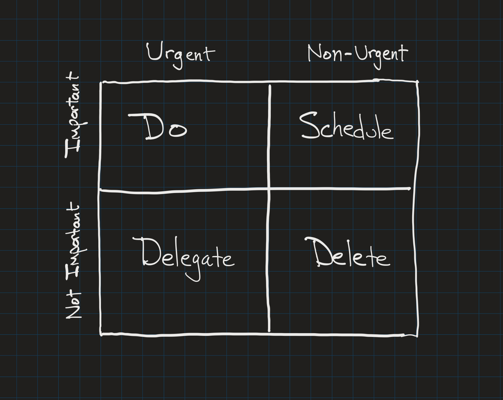
Aside from the interstate highway system, one of the legacies of President Eisenhower’s presidency is the Eisenhower Matrix. The idea is to prioritize your tasks and opportunities based on two factors: urgency and importance.
Based on these two factors, you can decide whether you need to do the task now, schedule it for later, hand it off to someone else, or drop it.
Below is an example of the matrix that I drew on my iPad. If you or someone you lead is struggling to prioritize tasks effectively, this can be a very helpful decision-making tool.
Make a Pros and Cons List
My dad is the ultimate pros and cons list guy. He drilled this into me throughout my teenage and young adult years.
I’m telling you, he lives by the pros and cons list. Yes, it’s simple. Yes, it’s cliché. Yes, it’s obvious. Yes, it’s effective. It might sound overly simplistic, but a pros and cons list is a great tool for making effective decisions in ministry.
Use the Action Priority Matrix
This tool is very helpful when making personal or team decisions about whether or not to pursue a project. The idea here is to evaluate a potential action based on two factors: impact and effort.
An action that is low effort and high impact is low low-hanging fruit—a quick win. An action that is high effort and high impact is a major project. An action that is low effort and low impact is a fill-in project for when you aren’t busy and have time.
Lastly, an action that is high effort and low impact is a thankless project. You’ll put in a ton of effort, and nobody will care.
Here are a few examples:
- Launching a new campus: High effort and High impact
- Live-streaming your worship service: Low effort and High impact
- Email: Low effort and Low impact
- A one-time video project for your midweek Bible study that takes 40 hours to produce: High effort and Low Impact
Here’s another drawing from my iPad.

I find the action priority matrix to be incredibly helpful in determining which and how many projects our church staff should pursue at any given time.
Try 4 Helpful Lists
Another valuable tool is an evaluation tool called 4 Helpful Lists. We use this tool to evaluate events, programs, ministries, and even the church as a whole. The lists are actually answers to 4 questions:
- What was right?
- What was wrong?
- What was confusing?
- What was missing?
This tool works best with a team, group, or staff as a review exercise. Taking the time to fully engage this tool at key moments during the ministry season can help identify stress points in the ministry, possibly creating new initiatives and simple solutions to complex problems.
Our senior-level staff uses this tool four times a year to evaluate where we are as a church and where we need to go. When it comes to making good decisions, I highly recommend 4 Helpful Lists.
Do a SWOT Analysis
SWOT analysis is not new, but if you’re unfamiliar, here’s what SWOT stands for:
- Strengths (what are the pros of this idea?)
- Weaknesses (what are the cons of this idea?)
- Opportunities (what new opportunities would come out of this idea?)
- Threats (what bad outcomes could result from implementing this idea?)
This tool is a lot like 4 Helpful Lists in that it is simply a listing of observations around 4 categories. The difference is that we use 4 Helpful Lists as a post-op exercise, while a SWOT analysis is helpful before launching a new initiative.
For example, this past year, we very nearly launched a new ministry for 5th and 6th-grade students. We have many compelling reasons for making this ministry a reality. However, when we took the time to carefully engage in a SWOT analysis, we came to see that we just aren’t ready to pull it off right now.
We face significant challenges for which we currently lack effective solutions. In this case, a SWOT analysis protected us from making a good decision at the wrong time, which, of course, is better described as a bad decision.
Map Out a Risk/Opportunity Matrix
Sometimes, there are multiple good ideas on the table, and the issue is that we can only pursue one or two of them effectively. There just aren’t resources, time, or people to implement more. So, in scenarios like this, how do you choose which ideas to implement?
We often use a Risk/Opportunity matrix to decide.

First, draw the Risk/Opportunity matrix. Then, plot each idea or possible initiative on the matrix. The only rules are that each idea must be plotted on one of the lines. This usually takes a while and leads to debate among the team. The process of arguing whether an idea is high or low risk can be quite valuable.

Once every idea is plotted, label the four zones of the matrix. You’ll notice that the bottom left is not a zone because it’s low opportunity and low risk…as in pointless.

Here’s a quick description of the zones:
- Danger: Ideas plotted here are high risk and low reward. In other words, you’d have to be crazy.
- Ho-Hum: These ideas won’t impact your organization much. They are probably not worth investing in.
- Entrepreneurial: High opportunity and high risk. These are often great ideas that must be managed well. To give you context, when we are considering launching a new campus, this is where they are plotted because if we manage a new campus launch poorly, it’s really bad. If it’s plotted here, don’t wing it!
- Gold: Low risk and High opportunity. Why aren’t you already doing this? Get on it!
Often, leadership involves choosing one of ten good ideas to focus on for now. The Risk/Opportunity Matrix can help us choose the right one.
Create Scoreboards
My boss always says, “Facts are our friends. We don’t have to like them, but they are our friends.”
He’s right. You can’t argue with data, and good data is often essential for making good decisions. What I’ve learned is to never make important decisions without data. Now, I always create a scoreboard and track the data in question.
For example, last year we made a major shift in our student ministry. For years, we had employed a strategy of meeting in homes every other week. In some ways, it was amazing, and in others, it was a logistical nightmare.
Instead of making the decision on whether to continue this strategy based on intuition, we tracked attendance between the nights when we met together and the nights when we met at homes.
What we found was that over three years, our attendance was down 10-15% on the nights where we met in homes. That’s solid data. I didn’t like it, but it gave me the clarity needed to make a good decision.

If you have a big decision to make, create a scoreboard. Instead of saying, “I think this is what’s going on here,” figure out what data you need to know and create a scoreboard around that data point. This practice will also help you pitch your idea with more credibility with key stakeholders. Trust me, board members love good data.
Ask the Right Questions
To make wiser decisions across the board, there are three questions to ask yourself:
- Who is Coaching You? In order to stay on the path of wisdom, we all need a mentor. We all need a coach. Let’s be the kind of leaders who don’t mind if seeking coaching or mentoring looks like an admission of weakness.
- Who is Your Sounding Board? I’ve learned the hard way that "we" make better decisions than "me.” What I’m talking about is the leader asking for input from a variety of sources, listening carefully, and then making a decision based on the input of others.
- Who Has Permission? Who in your life have you given permission to ask you uncomfortable questions? Who have you given permission to question your motivation, your line of thinking, or your sensitivity to others?
Make Space
The last principle for good decision making is the least natural for me–making space to really think through a decision.
One of my mentors has a phrase. He says, “I need to give that a good think.” In other words, he wants to contemplate and reflect on the impact of a decision. For me, this often looks like going for a walk.
The question is, do you have enough space in your life to really think through decisions? Do you need to cut back on a few things?
Do you need to say no to a few opportunities so that you have the space to think and pray through decisions? These are all key factors in good leadership decisions.
Wrap Up
So much of leadership is decision-making. Quite simply, good leaders consistently make good decisions, while poor leaders consistently make poor ones.
Sign Up for Product Updates

Tithely provides the tools you need to engage with your church online, stay connected, increase generosity, and simplify the lives of your staff.
With tools like text and email messaging, custom church apps and websites, church management software, digital giving, and so much more… it’s no wonder why over 53,000 churches in 50 countries trust Tithely to help run their church.
If there’s one thing that will improve your leadership in ministry, it’s making better decisions. So, how do we make better decisions in leadership? The most accurate and painful answer is that we make better decisions by learning from bad decisions.
I find it ironic that the wisest man of all time wrote more than anyone else about seeking counsel. Based on the example of Solomon, wisdom is not knowing the answer to every question or knowing what to do in every scenario. True wisdom is humility. It is the willingness and ability to listen to others and pursue feedback.
If this understanding of wisdom is true, here are a few important strategies to help us as church leaders to make better decisions.
10 Tools to Make Better Decisions in Ministry
Let Your Values Drive Decisions
In my opinion, the most effective and consistent way to make informed decisions is to let your values guide your decision-making. If you have taken the time to define your personal and organizational values, you can let those values drive your decisions.
The alternative is a system where leaders make decisions based on personal preference, which leads to opinion-based decisions and creates cultural problems in your staff. So, as you attempt to make good leadership decisions, ask yourself how your organizational values come into play.
Use The Eisenhower Matrix
Aside from the interstate highway system, one of the legacies of President Eisenhower’s presidency is the Eisenhower Matrix. The idea is to prioritize your tasks and opportunities based on two factors: urgency and importance.
Based on these two factors, you can decide whether you need to do the task now, schedule it for later, hand it off to someone else, or drop it.
Below is an example of the matrix that I drew on my iPad. If you or someone you lead is struggling to prioritize tasks effectively, this can be a very helpful decision-making tool.
Make a Pros and Cons List
My dad is the ultimate pros and cons list guy. He drilled this into me throughout my teenage and young adult years.
I’m telling you, he lives by the pros and cons list. Yes, it’s simple. Yes, it’s cliché. Yes, it’s obvious. Yes, it’s effective. It might sound overly simplistic, but a pros and cons list is a great tool for making effective decisions in ministry.
Use the Action Priority Matrix
This tool is very helpful when making personal or team decisions about whether or not to pursue a project. The idea here is to evaluate a potential action based on two factors: impact and effort.
An action that is low effort and high impact is low low-hanging fruit—a quick win. An action that is high effort and high impact is a major project. An action that is low effort and low impact is a fill-in project for when you aren’t busy and have time.
Lastly, an action that is high effort and low impact is a thankless project. You’ll put in a ton of effort, and nobody will care.
Here are a few examples:
- Launching a new campus: High effort and High impact
- Live-streaming your worship service: Low effort and High impact
- Email: Low effort and Low impact
- A one-time video project for your midweek Bible study that takes 40 hours to produce: High effort and Low Impact
Here’s another drawing from my iPad.
I find the action priority matrix to be incredibly helpful in determining which and how many projects our church staff should pursue at any given time.
Try 4 Helpful Lists
Another valuable tool is an evaluation tool called 4 Helpful Lists. We use this tool to evaluate events, programs, ministries, and even the church as a whole. The lists are actually answers to 4 questions:
- What was right?
- What was wrong?
- What was confusing?
- What was missing?
This tool works best with a team, group, or staff as a review exercise. Taking the time to fully engage this tool at key moments during the ministry season can help identify stress points in the ministry, possibly creating new initiatives and simple solutions to complex problems.
Our senior-level staff uses this tool four times a year to evaluate where we are as a church and where we need to go. When it comes to making good decisions, I highly recommend 4 Helpful Lists.
Do a SWOT Analysis
SWOT analysis is not new, but if you’re unfamiliar, here’s what SWOT stands for:
- Strengths (what are the pros of this idea?)
- Weaknesses (what are the cons of this idea?)
- Opportunities (what new opportunities would come out of this idea?)
- Threats (what bad outcomes could result from implementing this idea?)
This tool is a lot like 4 Helpful Lists in that it is simply a listing of observations around 4 categories. The difference is that we use 4 Helpful Lists as a post-op exercise, while a SWOT analysis is helpful before launching a new initiative.
For example, this past year, we very nearly launched a new ministry for 5th and 6th-grade students. We have many compelling reasons for making this ministry a reality. However, when we took the time to carefully engage in a SWOT analysis, we came to see that we just aren’t ready to pull it off right now.
We face significant challenges for which we currently lack effective solutions. In this case, a SWOT analysis protected us from making a good decision at the wrong time, which, of course, is better described as a bad decision.
Map Out a Risk/Opportunity Matrix
Sometimes, there are multiple good ideas on the table, and the issue is that we can only pursue one or two of them effectively. There just aren’t resources, time, or people to implement more. So, in scenarios like this, how do you choose which ideas to implement?
We often use a Risk/Opportunity matrix to decide.
First, draw the Risk/Opportunity matrix. Then, plot each idea or possible initiative on the matrix. The only rules are that each idea must be plotted on one of the lines. This usually takes a while and leads to debate among the team. The process of arguing whether an idea is high or low risk can be quite valuable.
Once every idea is plotted, label the four zones of the matrix. You’ll notice that the bottom left is not a zone because it’s low opportunity and low risk…as in pointless.
Here’s a quick description of the zones:
- Danger: Ideas plotted here are high risk and low reward. In other words, you’d have to be crazy.
- Ho-Hum: These ideas won’t impact your organization much. They are probably not worth investing in.
- Entrepreneurial: High opportunity and high risk. These are often great ideas that must be managed well. To give you context, when we are considering launching a new campus, this is where they are plotted because if we manage a new campus launch poorly, it’s really bad. If it’s plotted here, don’t wing it!
- Gold: Low risk and High opportunity. Why aren’t you already doing this? Get on it!
Often, leadership involves choosing one of ten good ideas to focus on for now. The Risk/Opportunity Matrix can help us choose the right one.
Create Scoreboards
My boss always says, “Facts are our friends. We don’t have to like them, but they are our friends.”
He’s right. You can’t argue with data, and good data is often essential for making good decisions. What I’ve learned is to never make important decisions without data. Now, I always create a scoreboard and track the data in question.
For example, last year we made a major shift in our student ministry. For years, we had employed a strategy of meeting in homes every other week. In some ways, it was amazing, and in others, it was a logistical nightmare.
Instead of making the decision on whether to continue this strategy based on intuition, we tracked attendance between the nights when we met together and the nights when we met at homes.
What we found was that over three years, our attendance was down 10-15% on the nights where we met in homes. That’s solid data. I didn’t like it, but it gave me the clarity needed to make a good decision.
If you have a big decision to make, create a scoreboard. Instead of saying, “I think this is what’s going on here,” figure out what data you need to know and create a scoreboard around that data point. This practice will also help you pitch your idea with more credibility with key stakeholders. Trust me, board members love good data.
Ask the Right Questions
To make wiser decisions across the board, there are three questions to ask yourself:
- Who is Coaching You? In order to stay on the path of wisdom, we all need a mentor. We all need a coach. Let’s be the kind of leaders who don’t mind if seeking coaching or mentoring looks like an admission of weakness.
- Who is Your Sounding Board? I’ve learned the hard way that "we" make better decisions than "me.” What I’m talking about is the leader asking for input from a variety of sources, listening carefully, and then making a decision based on the input of others.
- Who Has Permission? Who in your life have you given permission to ask you uncomfortable questions? Who have you given permission to question your motivation, your line of thinking, or your sensitivity to others?
Make Space
The last principle for good decision making is the least natural for me–making space to really think through a decision.
One of my mentors has a phrase. He says, “I need to give that a good think.” In other words, he wants to contemplate and reflect on the impact of a decision. For me, this often looks like going for a walk.
The question is, do you have enough space in your life to really think through decisions? Do you need to cut back on a few things?
Do you need to say no to a few opportunities so that you have the space to think and pray through decisions? These are all key factors in good leadership decisions.
Wrap Up
So much of leadership is decision-making. Quite simply, good leaders consistently make good decisions, while poor leaders consistently make poor ones.
podcast transcript
Tithely provides the tools you need to engage with your church online, stay connected, increase generosity, and simplify the lives of your staff.
With tools like text and email messaging, custom church apps and websites, church management software, digital giving, and so much more… it’s no wonder why over 53,000 churches in 50 countries trust Tithely to help run their church.
If there’s one thing that will improve your leadership in ministry, it’s making better decisions. So, how do we make better decisions in leadership? The most accurate and painful answer is that we make better decisions by learning from bad decisions.
I find it ironic that the wisest man of all time wrote more than anyone else about seeking counsel. Based on the example of Solomon, wisdom is not knowing the answer to every question or knowing what to do in every scenario. True wisdom is humility. It is the willingness and ability to listen to others and pursue feedback.
If this understanding of wisdom is true, here are a few important strategies to help us as church leaders to make better decisions.
10 Tools to Make Better Decisions in Ministry
Let Your Values Drive Decisions
In my opinion, the most effective and consistent way to make informed decisions is to let your values guide your decision-making. If you have taken the time to define your personal and organizational values, you can let those values drive your decisions.
The alternative is a system where leaders make decisions based on personal preference, which leads to opinion-based decisions and creates cultural problems in your staff. So, as you attempt to make good leadership decisions, ask yourself how your organizational values come into play.
Use The Eisenhower Matrix
Aside from the interstate highway system, one of the legacies of President Eisenhower’s presidency is the Eisenhower Matrix. The idea is to prioritize your tasks and opportunities based on two factors: urgency and importance.
Based on these two factors, you can decide whether you need to do the task now, schedule it for later, hand it off to someone else, or drop it.
Below is an example of the matrix that I drew on my iPad. If you or someone you lead is struggling to prioritize tasks effectively, this can be a very helpful decision-making tool.
Make a Pros and Cons List
My dad is the ultimate pros and cons list guy. He drilled this into me throughout my teenage and young adult years.
I’m telling you, he lives by the pros and cons list. Yes, it’s simple. Yes, it’s cliché. Yes, it’s obvious. Yes, it’s effective. It might sound overly simplistic, but a pros and cons list is a great tool for making effective decisions in ministry.
Use the Action Priority Matrix
This tool is very helpful when making personal or team decisions about whether or not to pursue a project. The idea here is to evaluate a potential action based on two factors: impact and effort.
An action that is low effort and high impact is low low-hanging fruit—a quick win. An action that is high effort and high impact is a major project. An action that is low effort and low impact is a fill-in project for when you aren’t busy and have time.
Lastly, an action that is high effort and low impact is a thankless project. You’ll put in a ton of effort, and nobody will care.
Here are a few examples:
- Launching a new campus: High effort and High impact
- Live-streaming your worship service: Low effort and High impact
- Email: Low effort and Low impact
- A one-time video project for your midweek Bible study that takes 40 hours to produce: High effort and Low Impact
Here’s another drawing from my iPad.
I find the action priority matrix to be incredibly helpful in determining which and how many projects our church staff should pursue at any given time.
Try 4 Helpful Lists
Another valuable tool is an evaluation tool called 4 Helpful Lists. We use this tool to evaluate events, programs, ministries, and even the church as a whole. The lists are actually answers to 4 questions:
- What was right?
- What was wrong?
- What was confusing?
- What was missing?
This tool works best with a team, group, or staff as a review exercise. Taking the time to fully engage this tool at key moments during the ministry season can help identify stress points in the ministry, possibly creating new initiatives and simple solutions to complex problems.
Our senior-level staff uses this tool four times a year to evaluate where we are as a church and where we need to go. When it comes to making good decisions, I highly recommend 4 Helpful Lists.
Do a SWOT Analysis
SWOT analysis is not new, but if you’re unfamiliar, here’s what SWOT stands for:
- Strengths (what are the pros of this idea?)
- Weaknesses (what are the cons of this idea?)
- Opportunities (what new opportunities would come out of this idea?)
- Threats (what bad outcomes could result from implementing this idea?)
This tool is a lot like 4 Helpful Lists in that it is simply a listing of observations around 4 categories. The difference is that we use 4 Helpful Lists as a post-op exercise, while a SWOT analysis is helpful before launching a new initiative.
For example, this past year, we very nearly launched a new ministry for 5th and 6th-grade students. We have many compelling reasons for making this ministry a reality. However, when we took the time to carefully engage in a SWOT analysis, we came to see that we just aren’t ready to pull it off right now.
We face significant challenges for which we currently lack effective solutions. In this case, a SWOT analysis protected us from making a good decision at the wrong time, which, of course, is better described as a bad decision.
Map Out a Risk/Opportunity Matrix
Sometimes, there are multiple good ideas on the table, and the issue is that we can only pursue one or two of them effectively. There just aren’t resources, time, or people to implement more. So, in scenarios like this, how do you choose which ideas to implement?
We often use a Risk/Opportunity matrix to decide.
First, draw the Risk/Opportunity matrix. Then, plot each idea or possible initiative on the matrix. The only rules are that each idea must be plotted on one of the lines. This usually takes a while and leads to debate among the team. The process of arguing whether an idea is high or low risk can be quite valuable.
Once every idea is plotted, label the four zones of the matrix. You’ll notice that the bottom left is not a zone because it’s low opportunity and low risk…as in pointless.
Here’s a quick description of the zones:
- Danger: Ideas plotted here are high risk and low reward. In other words, you’d have to be crazy.
- Ho-Hum: These ideas won’t impact your organization much. They are probably not worth investing in.
- Entrepreneurial: High opportunity and high risk. These are often great ideas that must be managed well. To give you context, when we are considering launching a new campus, this is where they are plotted because if we manage a new campus launch poorly, it’s really bad. If it’s plotted here, don’t wing it!
- Gold: Low risk and High opportunity. Why aren’t you already doing this? Get on it!
Often, leadership involves choosing one of ten good ideas to focus on for now. The Risk/Opportunity Matrix can help us choose the right one.
Create Scoreboards
My boss always says, “Facts are our friends. We don’t have to like them, but they are our friends.”
He’s right. You can’t argue with data, and good data is often essential for making good decisions. What I’ve learned is to never make important decisions without data. Now, I always create a scoreboard and track the data in question.
For example, last year we made a major shift in our student ministry. For years, we had employed a strategy of meeting in homes every other week. In some ways, it was amazing, and in others, it was a logistical nightmare.
Instead of making the decision on whether to continue this strategy based on intuition, we tracked attendance between the nights when we met together and the nights when we met at homes.
What we found was that over three years, our attendance was down 10-15% on the nights where we met in homes. That’s solid data. I didn’t like it, but it gave me the clarity needed to make a good decision.
If you have a big decision to make, create a scoreboard. Instead of saying, “I think this is what’s going on here,” figure out what data you need to know and create a scoreboard around that data point. This practice will also help you pitch your idea with more credibility with key stakeholders. Trust me, board members love good data.
Ask the Right Questions
To make wiser decisions across the board, there are three questions to ask yourself:
- Who is Coaching You? In order to stay on the path of wisdom, we all need a mentor. We all need a coach. Let’s be the kind of leaders who don’t mind if seeking coaching or mentoring looks like an admission of weakness.
- Who is Your Sounding Board? I’ve learned the hard way that "we" make better decisions than "me.” What I’m talking about is the leader asking for input from a variety of sources, listening carefully, and then making a decision based on the input of others.
- Who Has Permission? Who in your life have you given permission to ask you uncomfortable questions? Who have you given permission to question your motivation, your line of thinking, or your sensitivity to others?
Make Space
The last principle for good decision making is the least natural for me–making space to really think through a decision.
One of my mentors has a phrase. He says, “I need to give that a good think.” In other words, he wants to contemplate and reflect on the impact of a decision. For me, this often looks like going for a walk.
The question is, do you have enough space in your life to really think through decisions? Do you need to cut back on a few things?
Do you need to say no to a few opportunities so that you have the space to think and pray through decisions? These are all key factors in good leadership decisions.
Wrap Up
So much of leadership is decision-making. Quite simply, good leaders consistently make good decisions, while poor leaders consistently make poor ones.
VIDEO transcript
If there’s one thing that will improve your leadership in ministry, it’s making better decisions. So, how do we make better decisions in leadership? The most accurate and painful answer is that we make better decisions by learning from bad decisions.
I find it ironic that the wisest man of all time wrote more than anyone else about seeking counsel. Based on the example of Solomon, wisdom is not knowing the answer to every question or knowing what to do in every scenario. True wisdom is humility. It is the willingness and ability to listen to others and pursue feedback.
If this understanding of wisdom is true, here are a few important strategies to help us as church leaders to make better decisions.
10 Tools to Make Better Decisions in Ministry
Let Your Values Drive Decisions
In my opinion, the most effective and consistent way to make informed decisions is to let your values guide your decision-making. If you have taken the time to define your personal and organizational values, you can let those values drive your decisions.
The alternative is a system where leaders make decisions based on personal preference, which leads to opinion-based decisions and creates cultural problems in your staff. So, as you attempt to make good leadership decisions, ask yourself how your organizational values come into play.
Use The Eisenhower Matrix
Aside from the interstate highway system, one of the legacies of President Eisenhower’s presidency is the Eisenhower Matrix. The idea is to prioritize your tasks and opportunities based on two factors: urgency and importance.
Based on these two factors, you can decide whether you need to do the task now, schedule it for later, hand it off to someone else, or drop it.
Below is an example of the matrix that I drew on my iPad. If you or someone you lead is struggling to prioritize tasks effectively, this can be a very helpful decision-making tool.
Make a Pros and Cons List
My dad is the ultimate pros and cons list guy. He drilled this into me throughout my teenage and young adult years.
I’m telling you, he lives by the pros and cons list. Yes, it’s simple. Yes, it’s cliché. Yes, it’s obvious. Yes, it’s effective. It might sound overly simplistic, but a pros and cons list is a great tool for making effective decisions in ministry.
Use the Action Priority Matrix
This tool is very helpful when making personal or team decisions about whether or not to pursue a project. The idea here is to evaluate a potential action based on two factors: impact and effort.
An action that is low effort and high impact is low low-hanging fruit—a quick win. An action that is high effort and high impact is a major project. An action that is low effort and low impact is a fill-in project for when you aren’t busy and have time.
Lastly, an action that is high effort and low impact is a thankless project. You’ll put in a ton of effort, and nobody will care.
Here are a few examples:
- Launching a new campus: High effort and High impact
- Live-streaming your worship service: Low effort and High impact
- Email: Low effort and Low impact
- A one-time video project for your midweek Bible study that takes 40 hours to produce: High effort and Low Impact
Here’s another drawing from my iPad.
I find the action priority matrix to be incredibly helpful in determining which and how many projects our church staff should pursue at any given time.
Try 4 Helpful Lists
Another valuable tool is an evaluation tool called 4 Helpful Lists. We use this tool to evaluate events, programs, ministries, and even the church as a whole. The lists are actually answers to 4 questions:
- What was right?
- What was wrong?
- What was confusing?
- What was missing?
This tool works best with a team, group, or staff as a review exercise. Taking the time to fully engage this tool at key moments during the ministry season can help identify stress points in the ministry, possibly creating new initiatives and simple solutions to complex problems.
Our senior-level staff uses this tool four times a year to evaluate where we are as a church and where we need to go. When it comes to making good decisions, I highly recommend 4 Helpful Lists.
Do a SWOT Analysis
SWOT analysis is not new, but if you’re unfamiliar, here’s what SWOT stands for:
- Strengths (what are the pros of this idea?)
- Weaknesses (what are the cons of this idea?)
- Opportunities (what new opportunities would come out of this idea?)
- Threats (what bad outcomes could result from implementing this idea?)
This tool is a lot like 4 Helpful Lists in that it is simply a listing of observations around 4 categories. The difference is that we use 4 Helpful Lists as a post-op exercise, while a SWOT analysis is helpful before launching a new initiative.
For example, this past year, we very nearly launched a new ministry for 5th and 6th-grade students. We have many compelling reasons for making this ministry a reality. However, when we took the time to carefully engage in a SWOT analysis, we came to see that we just aren’t ready to pull it off right now.
We face significant challenges for which we currently lack effective solutions. In this case, a SWOT analysis protected us from making a good decision at the wrong time, which, of course, is better described as a bad decision.
Map Out a Risk/Opportunity Matrix
Sometimes, there are multiple good ideas on the table, and the issue is that we can only pursue one or two of them effectively. There just aren’t resources, time, or people to implement more. So, in scenarios like this, how do you choose which ideas to implement?
We often use a Risk/Opportunity matrix to decide.
First, draw the Risk/Opportunity matrix. Then, plot each idea or possible initiative on the matrix. The only rules are that each idea must be plotted on one of the lines. This usually takes a while and leads to debate among the team. The process of arguing whether an idea is high or low risk can be quite valuable.
Once every idea is plotted, label the four zones of the matrix. You’ll notice that the bottom left is not a zone because it’s low opportunity and low risk…as in pointless.
Here’s a quick description of the zones:
- Danger: Ideas plotted here are high risk and low reward. In other words, you’d have to be crazy.
- Ho-Hum: These ideas won’t impact your organization much. They are probably not worth investing in.
- Entrepreneurial: High opportunity and high risk. These are often great ideas that must be managed well. To give you context, when we are considering launching a new campus, this is where they are plotted because if we manage a new campus launch poorly, it’s really bad. If it’s plotted here, don’t wing it!
- Gold: Low risk and High opportunity. Why aren’t you already doing this? Get on it!
Often, leadership involves choosing one of ten good ideas to focus on for now. The Risk/Opportunity Matrix can help us choose the right one.
Create Scoreboards
My boss always says, “Facts are our friends. We don’t have to like them, but they are our friends.”
He’s right. You can’t argue with data, and good data is often essential for making good decisions. What I’ve learned is to never make important decisions without data. Now, I always create a scoreboard and track the data in question.
For example, last year we made a major shift in our student ministry. For years, we had employed a strategy of meeting in homes every other week. In some ways, it was amazing, and in others, it was a logistical nightmare.
Instead of making the decision on whether to continue this strategy based on intuition, we tracked attendance between the nights when we met together and the nights when we met at homes.
What we found was that over three years, our attendance was down 10-15% on the nights where we met in homes. That’s solid data. I didn’t like it, but it gave me the clarity needed to make a good decision.
If you have a big decision to make, create a scoreboard. Instead of saying, “I think this is what’s going on here,” figure out what data you need to know and create a scoreboard around that data point. This practice will also help you pitch your idea with more credibility with key stakeholders. Trust me, board members love good data.
Ask the Right Questions
To make wiser decisions across the board, there are three questions to ask yourself:
- Who is Coaching You? In order to stay on the path of wisdom, we all need a mentor. We all need a coach. Let’s be the kind of leaders who don’t mind if seeking coaching or mentoring looks like an admission of weakness.
- Who is Your Sounding Board? I’ve learned the hard way that "we" make better decisions than "me.” What I’m talking about is the leader asking for input from a variety of sources, listening carefully, and then making a decision based on the input of others.
- Who Has Permission? Who in your life have you given permission to ask you uncomfortable questions? Who have you given permission to question your motivation, your line of thinking, or your sensitivity to others?
Make Space
The last principle for good decision making is the least natural for me–making space to really think through a decision.
One of my mentors has a phrase. He says, “I need to give that a good think.” In other words, he wants to contemplate and reflect on the impact of a decision. For me, this often looks like going for a walk.
The question is, do you have enough space in your life to really think through decisions? Do you need to cut back on a few things?
Do you need to say no to a few opportunities so that you have the space to think and pray through decisions? These are all key factors in good leadership decisions.
Wrap Up
So much of leadership is decision-making. Quite simply, good leaders consistently make good decisions, while poor leaders consistently make poor ones.
Sign Up for Product Updates
Tithely provides the tools you need to engage with your church online, stay connected, increase generosity, and simplify the lives of your staff.
With tools like text and email messaging, custom church apps and websites, church management software, digital giving, and so much more… it’s no wonder why over 53,000 churches in 50 countries trust Tithely to help run their church.

You Might Also Like
More Resources

From increasing giving, managing your congregation, and engaging your church, our collection of resources will keep you up-to-date on the latest church and ministry trends.
Free Resources.jpeg)

.jpeg)