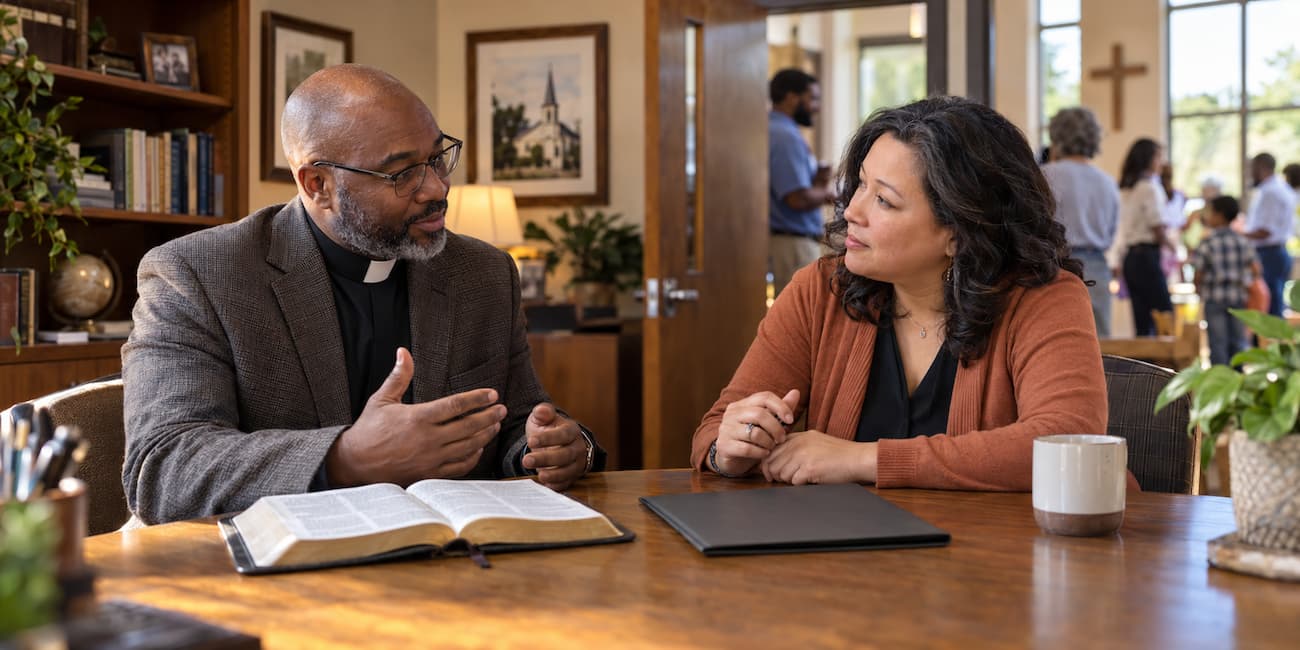
How to Train and Empower a Teaching Team in Your Church
Carrying the teaching load week after week is a big responsibility, and you don’t have to do it alone. In this post, we’ll walk through how to identify and equip gifted communicators in your church, create a healthy structure for shared teaching, and build a team that strengthens discipleship and reflects the collaborative model of the early church.




Every church handles teaching differently. Some have one main communicator, while others rotate through multiple voices. At the end of the day, there is not a single “right” way to do it. However, if you want to increase the diversity of voices in your pulpit, Scripture actually gives us a pretty solid nudge in that direction.
From Moses inviting seventy elders to help him lead and speak to the people (Numbers 11:16–17), to Jesus sending out the seventy-two (Luke 10:1), to the early church appointing elders in every city (Titus 1:5), to Paul working alongside Timothy, Titus, Priscilla, Aquila, and Apollos, God has often multiplied His message through more than one person. The early church in Antioch even had a group of prophets and teachers (Acts 13:1–3) who shared the responsibility of proclaiming the Word.
This pattern is practical and powerful. More voices mean more perspectives, better discipleship, and more leaders being raised up to serve the church for the long haul.
“But What If the Teaching Isn’t as Good?”
Let’s be honest – this is the main hesitation for most pastors. You love your people, and you want them to get solid teaching every week. That is not wrong. In fact, Paul told Timothy to “guard the good deposit” (2 Timothy 1:14), so you are in good company.
Here is the encouraging part: you can keep the teaching strong and still open the mic to others. You simply need to build up a healthy teaching team.
A strong teaching team does more than raise up leaders. It gives the busy pastor space to rest without worrying that the church will miss out on sound teaching. It also cultivates a healthy humility, reminding everyone – including the lead pastor – that the pulpit belongs to Christ alone. Teaching becomes a shared responsibility for the good of the whole body.
So how do you actually build a teaching team that keeps your church grounded in truth while giving more people a voice? Here are some practical steps to get you started.
How to Build Your Teaching Team Step-by-Step
1. Spot the Gift
Your church is full of gifted people! Start by praying for God to identify those who show signs of a teaching gift. This does not have to mean polished public speakers right out of the gate. It could be the small group leader who consistently explains Scripture with clarity, the Bible study facilitator who brings fresh insight, or the volunteer who has a knack for connecting God’s Word to real life.
Remember how in Acts 6 the apostles identified seven leaders who were “full of the Spirit and wisdom” before giving them more responsibility? You are doing the same thing here. Look for spiritual maturity, a teachable heart, and a genuine love for God’s Word. Those three qualities will take someone further than raw talent alone.
Practical ways to spot the gift:
- Visit small groups and observe teaching moments.
- Pay attention to who people in your church already look to for spiritual advice.
- Assign small teaching opportunities (devotionals, announcements with a Scripture thought) and see how they respond.
2. Organize Your Sermon Series Ahead of Time
One of the best gifts you can give your teaching team is a clear roadmap of where you are headed. If you want multiple people to teach well, they need time to prepare. This is where planning your sermon series in advance becomes a game-changer.
When you map out your teaching calendar ahead of time, you create space for:
- Better preparation so teachers can study deeply rather than scrambling at the last-minute
- Shared vision so everyone knows how their message fits into the larger discipleship journey of the church
- Creative collaboration so team members can swap ideas, illustrations, and applications before the week of the sermon
If you are looking for inspiration, check out 10 Great Church Sermon Series Ideas To Engage Your Community. It is packed with creative themes and ideas that can help you craft a teaching plan your whole team can rally behind.
Organizing your series ahead of time communicates value to your team, honors their time, and helps them bring their best to the pulpit.
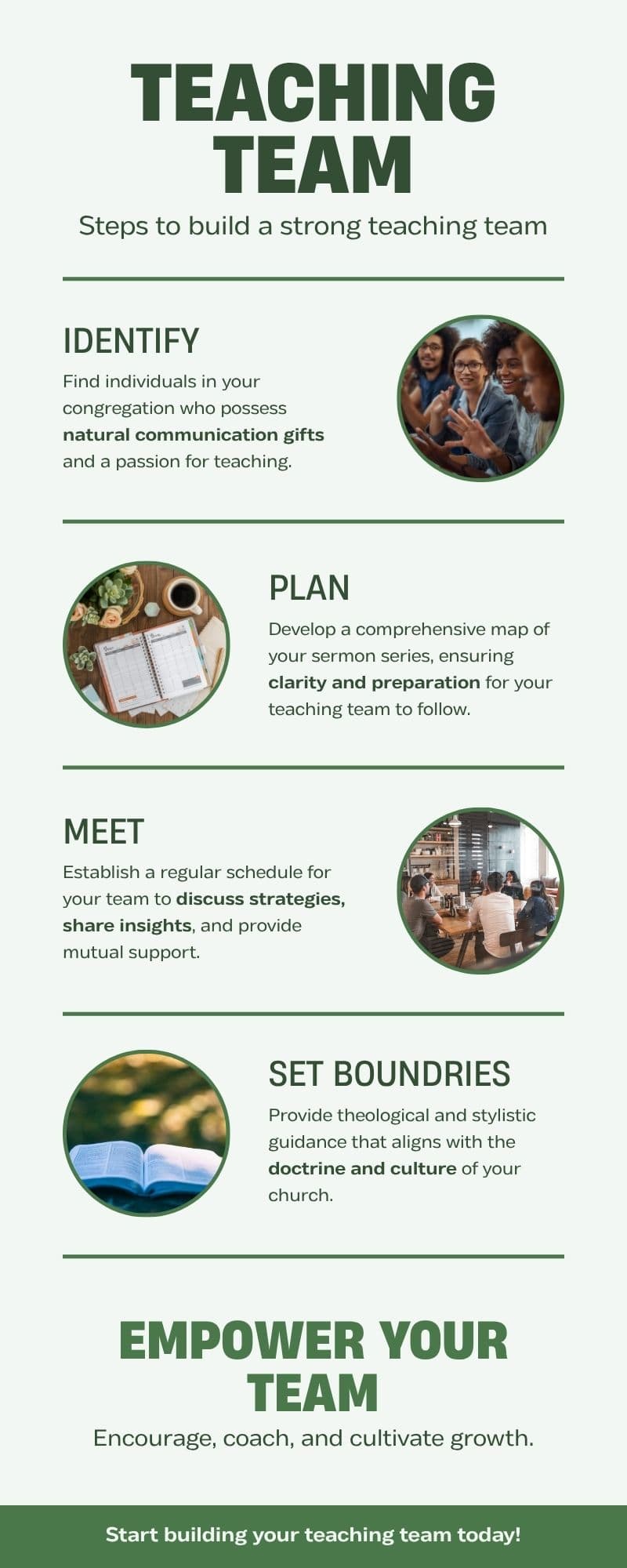
3. Get in a Weekly Rhythm
Once you have identified a few potential teachers, create regular touchpoints so they can grow in skill and confidence. At my multi-site church, our teaching team meets every Monday. We open the Bible to the passage for the week, share our initial insights, ask questions, and pray. We then stay connected throughout the week so that our sermons are aligned come Sunday.
Practical ideas for your rhythm:
- Meet weekly or biweekly to discuss upcoming sermon texts.
- Share resources like commentaries, sermon outlines, or helpful articles.
- Keep a shared document where team members can drop insights throughout the week.
- Create a text group where you can continue to chat throughout the week.
4. Give Guardrails and Leave Room for Personality
Unity matters, but creativity matters, too. Paul gave Timothy clear boundaries about what to teach (1 Timothy 4:13–16), but he ultimately had to trust Timothy to bring his unique voice to the message.
When building a teaching team, make sure to provide:
- Theological boundaries (what is non-negotiable in your preaching).
- A clear main idea or “big thought” for the week.
- A target sermon length.
- Any specific pastoral priorities for the series.
- Practical resources to help new teachers develop sermons.
Then step back and let your teachers add their own stories, illustrations, and style. This is what makes the teaching feel authentic.
We actually see something similar in the Gospels. Matthew, Mark, Luke, and John all proclaim the same gospel truth and stories, but each does so with their own unique perspective, tone, and storytelling approach. Matthew emphasizes Jesus as the promised Messiah, Mark moves quickly and emphasizes Jesus as a suffering servant, Luke offers rich historical detail and emphasizes Jesus for the Gentiles, and John focuses deeply on the identity of Christ. The message never changes, but the voice and vantage point make each account fresh and compelling.
That is what a healthy teaching team can do for your church. The same truth is proclaimed, but the variety of voices helps more people connect with it and see Jesus more clearly. It also keeps your church from becoming dependent on one style or personality to understand God’s Word.
5. Debrief and Celebrate
Teaching is a skill that grows over time, so feedback is essential. After someone teaches, set aside time to debrief. This could be a quick meeting the next day or a casual coffee during the week, but make sure to be intentional!
When you give feedback:
- Start with encouragement. Point out where God’s Word came alive through their teaching.
- Offer constructive suggestions in a way that helps, not discourages.
- Invite them to share what they learned from the experience.
- Don’t expect overnight success! Building up a teaching team takes time and intentionality.
Multiply Your Church’s Impact
Your voice matters. It is also true that your people need to hear from more than one voice. A teaching team is not just a backup plan for when the lead pastor is away. It is a way to multiply your church’s discipleship reach and develop new leaders. The early church in Acts grew rapidly because many were equipped to preach, teach, and lead.
And if you need support getting your church organized so your teaching team can thrive, Tithely is here to help. From scheduling volunteers to managing communication and resources, we provide tools that help you focus on people, not paperwork. Learn more about how Tithely can serve your church.
Sign Up for Product Updates

Susanna is a theological content writer with a Master of Arts in Intercultural Studies from Fuller Theological Seminary. She is passionate about ministry, running, and exploring new cultures through international travel. In her free time, you’ll find her surfing, obsessing over the Olympics, or enjoying the San Diego sunshine!
Every church handles teaching differently. Some have one main communicator, while others rotate through multiple voices. At the end of the day, there is not a single “right” way to do it. However, if you want to increase the diversity of voices in your pulpit, Scripture actually gives us a pretty solid nudge in that direction.
From Moses inviting seventy elders to help him lead and speak to the people (Numbers 11:16–17), to Jesus sending out the seventy-two (Luke 10:1), to the early church appointing elders in every city (Titus 1:5), to Paul working alongside Timothy, Titus, Priscilla, Aquila, and Apollos, God has often multiplied His message through more than one person. The early church in Antioch even had a group of prophets and teachers (Acts 13:1–3) who shared the responsibility of proclaiming the Word.
This pattern is practical and powerful. More voices mean more perspectives, better discipleship, and more leaders being raised up to serve the church for the long haul.
“But What If the Teaching Isn’t as Good?”
Let’s be honest – this is the main hesitation for most pastors. You love your people, and you want them to get solid teaching every week. That is not wrong. In fact, Paul told Timothy to “guard the good deposit” (2 Timothy 1:14), so you are in good company.
Here is the encouraging part: you can keep the teaching strong and still open the mic to others. You simply need to build up a healthy teaching team.
A strong teaching team does more than raise up leaders. It gives the busy pastor space to rest without worrying that the church will miss out on sound teaching. It also cultivates a healthy humility, reminding everyone – including the lead pastor – that the pulpit belongs to Christ alone. Teaching becomes a shared responsibility for the good of the whole body.
So how do you actually build a teaching team that keeps your church grounded in truth while giving more people a voice? Here are some practical steps to get you started.
How to Build Your Teaching Team Step-by-Step
1. Spot the Gift
Your church is full of gifted people! Start by praying for God to identify those who show signs of a teaching gift. This does not have to mean polished public speakers right out of the gate. It could be the small group leader who consistently explains Scripture with clarity, the Bible study facilitator who brings fresh insight, or the volunteer who has a knack for connecting God’s Word to real life.
Remember how in Acts 6 the apostles identified seven leaders who were “full of the Spirit and wisdom” before giving them more responsibility? You are doing the same thing here. Look for spiritual maturity, a teachable heart, and a genuine love for God’s Word. Those three qualities will take someone further than raw talent alone.
Practical ways to spot the gift:
- Visit small groups and observe teaching moments.
- Pay attention to who people in your church already look to for spiritual advice.
- Assign small teaching opportunities (devotionals, announcements with a Scripture thought) and see how they respond.
2. Organize Your Sermon Series Ahead of Time
One of the best gifts you can give your teaching team is a clear roadmap of where you are headed. If you want multiple people to teach well, they need time to prepare. This is where planning your sermon series in advance becomes a game-changer.
When you map out your teaching calendar ahead of time, you create space for:
- Better preparation so teachers can study deeply rather than scrambling at the last-minute
- Shared vision so everyone knows how their message fits into the larger discipleship journey of the church
- Creative collaboration so team members can swap ideas, illustrations, and applications before the week of the sermon
If you are looking for inspiration, check out 10 Great Church Sermon Series Ideas To Engage Your Community. It is packed with creative themes and ideas that can help you craft a teaching plan your whole team can rally behind.
Organizing your series ahead of time communicates value to your team, honors their time, and helps them bring their best to the pulpit.
3. Get in a Weekly Rhythm
Once you have identified a few potential teachers, create regular touchpoints so they can grow in skill and confidence. At my multi-site church, our teaching team meets every Monday. We open the Bible to the passage for the week, share our initial insights, ask questions, and pray. We then stay connected throughout the week so that our sermons are aligned come Sunday.
Practical ideas for your rhythm:
- Meet weekly or biweekly to discuss upcoming sermon texts.
- Share resources like commentaries, sermon outlines, or helpful articles.
- Keep a shared document where team members can drop insights throughout the week.
- Create a text group where you can continue to chat throughout the week.
4. Give Guardrails and Leave Room for Personality
Unity matters, but creativity matters, too. Paul gave Timothy clear boundaries about what to teach (1 Timothy 4:13–16), but he ultimately had to trust Timothy to bring his unique voice to the message.
When building a teaching team, make sure to provide:
- Theological boundaries (what is non-negotiable in your preaching).
- A clear main idea or “big thought” for the week.
- A target sermon length.
- Any specific pastoral priorities for the series.
- Practical resources to help new teachers develop sermons.
Then step back and let your teachers add their own stories, illustrations, and style. This is what makes the teaching feel authentic.
We actually see something similar in the Gospels. Matthew, Mark, Luke, and John all proclaim the same gospel truth and stories, but each does so with their own unique perspective, tone, and storytelling approach. Matthew emphasizes Jesus as the promised Messiah, Mark moves quickly and emphasizes Jesus as a suffering servant, Luke offers rich historical detail and emphasizes Jesus for the Gentiles, and John focuses deeply on the identity of Christ. The message never changes, but the voice and vantage point make each account fresh and compelling.
That is what a healthy teaching team can do for your church. The same truth is proclaimed, but the variety of voices helps more people connect with it and see Jesus more clearly. It also keeps your church from becoming dependent on one style or personality to understand God’s Word.
5. Debrief and Celebrate
Teaching is a skill that grows over time, so feedback is essential. After someone teaches, set aside time to debrief. This could be a quick meeting the next day or a casual coffee during the week, but make sure to be intentional!
When you give feedback:
- Start with encouragement. Point out where God’s Word came alive through their teaching.
- Offer constructive suggestions in a way that helps, not discourages.
- Invite them to share what they learned from the experience.
- Don’t expect overnight success! Building up a teaching team takes time and intentionality.
Multiply Your Church’s Impact
Your voice matters. It is also true that your people need to hear from more than one voice. A teaching team is not just a backup plan for when the lead pastor is away. It is a way to multiply your church’s discipleship reach and develop new leaders. The early church in Acts grew rapidly because many were equipped to preach, teach, and lead.
And if you need support getting your church organized so your teaching team can thrive, Tithely is here to help. From scheduling volunteers to managing communication and resources, we provide tools that help you focus on people, not paperwork. Learn more about how Tithely can serve your church.
podcast transcript
Susanna is a theological content writer with a Master of Arts in Intercultural Studies from Fuller Theological Seminary. She is passionate about ministry, running, and exploring new cultures through international travel. In her free time, you’ll find her surfing, obsessing over the Olympics, or enjoying the San Diego sunshine!
Every church handles teaching differently. Some have one main communicator, while others rotate through multiple voices. At the end of the day, there is not a single “right” way to do it. However, if you want to increase the diversity of voices in your pulpit, Scripture actually gives us a pretty solid nudge in that direction.
From Moses inviting seventy elders to help him lead and speak to the people (Numbers 11:16–17), to Jesus sending out the seventy-two (Luke 10:1), to the early church appointing elders in every city (Titus 1:5), to Paul working alongside Timothy, Titus, Priscilla, Aquila, and Apollos, God has often multiplied His message through more than one person. The early church in Antioch even had a group of prophets and teachers (Acts 13:1–3) who shared the responsibility of proclaiming the Word.
This pattern is practical and powerful. More voices mean more perspectives, better discipleship, and more leaders being raised up to serve the church for the long haul.
“But What If the Teaching Isn’t as Good?”
Let’s be honest – this is the main hesitation for most pastors. You love your people, and you want them to get solid teaching every week. That is not wrong. In fact, Paul told Timothy to “guard the good deposit” (2 Timothy 1:14), so you are in good company.
Here is the encouraging part: you can keep the teaching strong and still open the mic to others. You simply need to build up a healthy teaching team.
A strong teaching team does more than raise up leaders. It gives the busy pastor space to rest without worrying that the church will miss out on sound teaching. It also cultivates a healthy humility, reminding everyone – including the lead pastor – that the pulpit belongs to Christ alone. Teaching becomes a shared responsibility for the good of the whole body.
So how do you actually build a teaching team that keeps your church grounded in truth while giving more people a voice? Here are some practical steps to get you started.
How to Build Your Teaching Team Step-by-Step
1. Spot the Gift
Your church is full of gifted people! Start by praying for God to identify those who show signs of a teaching gift. This does not have to mean polished public speakers right out of the gate. It could be the small group leader who consistently explains Scripture with clarity, the Bible study facilitator who brings fresh insight, or the volunteer who has a knack for connecting God’s Word to real life.
Remember how in Acts 6 the apostles identified seven leaders who were “full of the Spirit and wisdom” before giving them more responsibility? You are doing the same thing here. Look for spiritual maturity, a teachable heart, and a genuine love for God’s Word. Those three qualities will take someone further than raw talent alone.
Practical ways to spot the gift:
- Visit small groups and observe teaching moments.
- Pay attention to who people in your church already look to for spiritual advice.
- Assign small teaching opportunities (devotionals, announcements with a Scripture thought) and see how they respond.
2. Organize Your Sermon Series Ahead of Time
One of the best gifts you can give your teaching team is a clear roadmap of where you are headed. If you want multiple people to teach well, they need time to prepare. This is where planning your sermon series in advance becomes a game-changer.
When you map out your teaching calendar ahead of time, you create space for:
- Better preparation so teachers can study deeply rather than scrambling at the last-minute
- Shared vision so everyone knows how their message fits into the larger discipleship journey of the church
- Creative collaboration so team members can swap ideas, illustrations, and applications before the week of the sermon
If you are looking for inspiration, check out 10 Great Church Sermon Series Ideas To Engage Your Community. It is packed with creative themes and ideas that can help you craft a teaching plan your whole team can rally behind.
Organizing your series ahead of time communicates value to your team, honors their time, and helps them bring their best to the pulpit.
3. Get in a Weekly Rhythm
Once you have identified a few potential teachers, create regular touchpoints so they can grow in skill and confidence. At my multi-site church, our teaching team meets every Monday. We open the Bible to the passage for the week, share our initial insights, ask questions, and pray. We then stay connected throughout the week so that our sermons are aligned come Sunday.
Practical ideas for your rhythm:
- Meet weekly or biweekly to discuss upcoming sermon texts.
- Share resources like commentaries, sermon outlines, or helpful articles.
- Keep a shared document where team members can drop insights throughout the week.
- Create a text group where you can continue to chat throughout the week.
4. Give Guardrails and Leave Room for Personality
Unity matters, but creativity matters, too. Paul gave Timothy clear boundaries about what to teach (1 Timothy 4:13–16), but he ultimately had to trust Timothy to bring his unique voice to the message.
When building a teaching team, make sure to provide:
- Theological boundaries (what is non-negotiable in your preaching).
- A clear main idea or “big thought” for the week.
- A target sermon length.
- Any specific pastoral priorities for the series.
- Practical resources to help new teachers develop sermons.
Then step back and let your teachers add their own stories, illustrations, and style. This is what makes the teaching feel authentic.
We actually see something similar in the Gospels. Matthew, Mark, Luke, and John all proclaim the same gospel truth and stories, but each does so with their own unique perspective, tone, and storytelling approach. Matthew emphasizes Jesus as the promised Messiah, Mark moves quickly and emphasizes Jesus as a suffering servant, Luke offers rich historical detail and emphasizes Jesus for the Gentiles, and John focuses deeply on the identity of Christ. The message never changes, but the voice and vantage point make each account fresh and compelling.
That is what a healthy teaching team can do for your church. The same truth is proclaimed, but the variety of voices helps more people connect with it and see Jesus more clearly. It also keeps your church from becoming dependent on one style or personality to understand God’s Word.
5. Debrief and Celebrate
Teaching is a skill that grows over time, so feedback is essential. After someone teaches, set aside time to debrief. This could be a quick meeting the next day or a casual coffee during the week, but make sure to be intentional!
When you give feedback:
- Start with encouragement. Point out where God’s Word came alive through their teaching.
- Offer constructive suggestions in a way that helps, not discourages.
- Invite them to share what they learned from the experience.
- Don’t expect overnight success! Building up a teaching team takes time and intentionality.
Multiply Your Church’s Impact
Your voice matters. It is also true that your people need to hear from more than one voice. A teaching team is not just a backup plan for when the lead pastor is away. It is a way to multiply your church’s discipleship reach and develop new leaders. The early church in Acts grew rapidly because many were equipped to preach, teach, and lead.
And if you need support getting your church organized so your teaching team can thrive, Tithely is here to help. From scheduling volunteers to managing communication and resources, we provide tools that help you focus on people, not paperwork. Learn more about how Tithely can serve your church.
VIDEO transcript
Every church handles teaching differently. Some have one main communicator, while others rotate through multiple voices. At the end of the day, there is not a single “right” way to do it. However, if you want to increase the diversity of voices in your pulpit, Scripture actually gives us a pretty solid nudge in that direction.
From Moses inviting seventy elders to help him lead and speak to the people (Numbers 11:16–17), to Jesus sending out the seventy-two (Luke 10:1), to the early church appointing elders in every city (Titus 1:5), to Paul working alongside Timothy, Titus, Priscilla, Aquila, and Apollos, God has often multiplied His message through more than one person. The early church in Antioch even had a group of prophets and teachers (Acts 13:1–3) who shared the responsibility of proclaiming the Word.
This pattern is practical and powerful. More voices mean more perspectives, better discipleship, and more leaders being raised up to serve the church for the long haul.
“But What If the Teaching Isn’t as Good?”
Let’s be honest – this is the main hesitation for most pastors. You love your people, and you want them to get solid teaching every week. That is not wrong. In fact, Paul told Timothy to “guard the good deposit” (2 Timothy 1:14), so you are in good company.
Here is the encouraging part: you can keep the teaching strong and still open the mic to others. You simply need to build up a healthy teaching team.
A strong teaching team does more than raise up leaders. It gives the busy pastor space to rest without worrying that the church will miss out on sound teaching. It also cultivates a healthy humility, reminding everyone – including the lead pastor – that the pulpit belongs to Christ alone. Teaching becomes a shared responsibility for the good of the whole body.
So how do you actually build a teaching team that keeps your church grounded in truth while giving more people a voice? Here are some practical steps to get you started.
How to Build Your Teaching Team Step-by-Step
1. Spot the Gift
Your church is full of gifted people! Start by praying for God to identify those who show signs of a teaching gift. This does not have to mean polished public speakers right out of the gate. It could be the small group leader who consistently explains Scripture with clarity, the Bible study facilitator who brings fresh insight, or the volunteer who has a knack for connecting God’s Word to real life.
Remember how in Acts 6 the apostles identified seven leaders who were “full of the Spirit and wisdom” before giving them more responsibility? You are doing the same thing here. Look for spiritual maturity, a teachable heart, and a genuine love for God’s Word. Those three qualities will take someone further than raw talent alone.
Practical ways to spot the gift:
- Visit small groups and observe teaching moments.
- Pay attention to who people in your church already look to for spiritual advice.
- Assign small teaching opportunities (devotionals, announcements with a Scripture thought) and see how they respond.
2. Organize Your Sermon Series Ahead of Time
One of the best gifts you can give your teaching team is a clear roadmap of where you are headed. If you want multiple people to teach well, they need time to prepare. This is where planning your sermon series in advance becomes a game-changer.
When you map out your teaching calendar ahead of time, you create space for:
- Better preparation so teachers can study deeply rather than scrambling at the last-minute
- Shared vision so everyone knows how their message fits into the larger discipleship journey of the church
- Creative collaboration so team members can swap ideas, illustrations, and applications before the week of the sermon
If you are looking for inspiration, check out 10 Great Church Sermon Series Ideas To Engage Your Community. It is packed with creative themes and ideas that can help you craft a teaching plan your whole team can rally behind.
Organizing your series ahead of time communicates value to your team, honors their time, and helps them bring their best to the pulpit.
3. Get in a Weekly Rhythm
Once you have identified a few potential teachers, create regular touchpoints so they can grow in skill and confidence. At my multi-site church, our teaching team meets every Monday. We open the Bible to the passage for the week, share our initial insights, ask questions, and pray. We then stay connected throughout the week so that our sermons are aligned come Sunday.
Practical ideas for your rhythm:
- Meet weekly or biweekly to discuss upcoming sermon texts.
- Share resources like commentaries, sermon outlines, or helpful articles.
- Keep a shared document where team members can drop insights throughout the week.
- Create a text group where you can continue to chat throughout the week.
4. Give Guardrails and Leave Room for Personality
Unity matters, but creativity matters, too. Paul gave Timothy clear boundaries about what to teach (1 Timothy 4:13–16), but he ultimately had to trust Timothy to bring his unique voice to the message.
When building a teaching team, make sure to provide:
- Theological boundaries (what is non-negotiable in your preaching).
- A clear main idea or “big thought” for the week.
- A target sermon length.
- Any specific pastoral priorities for the series.
- Practical resources to help new teachers develop sermons.
Then step back and let your teachers add their own stories, illustrations, and style. This is what makes the teaching feel authentic.
We actually see something similar in the Gospels. Matthew, Mark, Luke, and John all proclaim the same gospel truth and stories, but each does so with their own unique perspective, tone, and storytelling approach. Matthew emphasizes Jesus as the promised Messiah, Mark moves quickly and emphasizes Jesus as a suffering servant, Luke offers rich historical detail and emphasizes Jesus for the Gentiles, and John focuses deeply on the identity of Christ. The message never changes, but the voice and vantage point make each account fresh and compelling.
That is what a healthy teaching team can do for your church. The same truth is proclaimed, but the variety of voices helps more people connect with it and see Jesus more clearly. It also keeps your church from becoming dependent on one style or personality to understand God’s Word.
5. Debrief and Celebrate
Teaching is a skill that grows over time, so feedback is essential. After someone teaches, set aside time to debrief. This could be a quick meeting the next day or a casual coffee during the week, but make sure to be intentional!
When you give feedback:
- Start with encouragement. Point out where God’s Word came alive through their teaching.
- Offer constructive suggestions in a way that helps, not discourages.
- Invite them to share what they learned from the experience.
- Don’t expect overnight success! Building up a teaching team takes time and intentionality.
Multiply Your Church’s Impact
Your voice matters. It is also true that your people need to hear from more than one voice. A teaching team is not just a backup plan for when the lead pastor is away. It is a way to multiply your church’s discipleship reach and develop new leaders. The early church in Acts grew rapidly because many were equipped to preach, teach, and lead.
And if you need support getting your church organized so your teaching team can thrive, Tithely is here to help. From scheduling volunteers to managing communication and resources, we provide tools that help you focus on people, not paperwork. Learn more about how Tithely can serve your church.
Sign Up for Product Updates
Susanna is a theological content writer with a Master of Arts in Intercultural Studies from Fuller Theological Seminary. She is passionate about ministry, running, and exploring new cultures through international travel. In her free time, you’ll find her surfing, obsessing over the Olympics, or enjoying the San Diego sunshine!

You Might Also Like
More Resources

From increasing giving, managing your congregation, and engaging your church, our collection of resources will keep you up-to-date on the latest church and ministry trends.
Free Resources



.jpg)
.jpg)