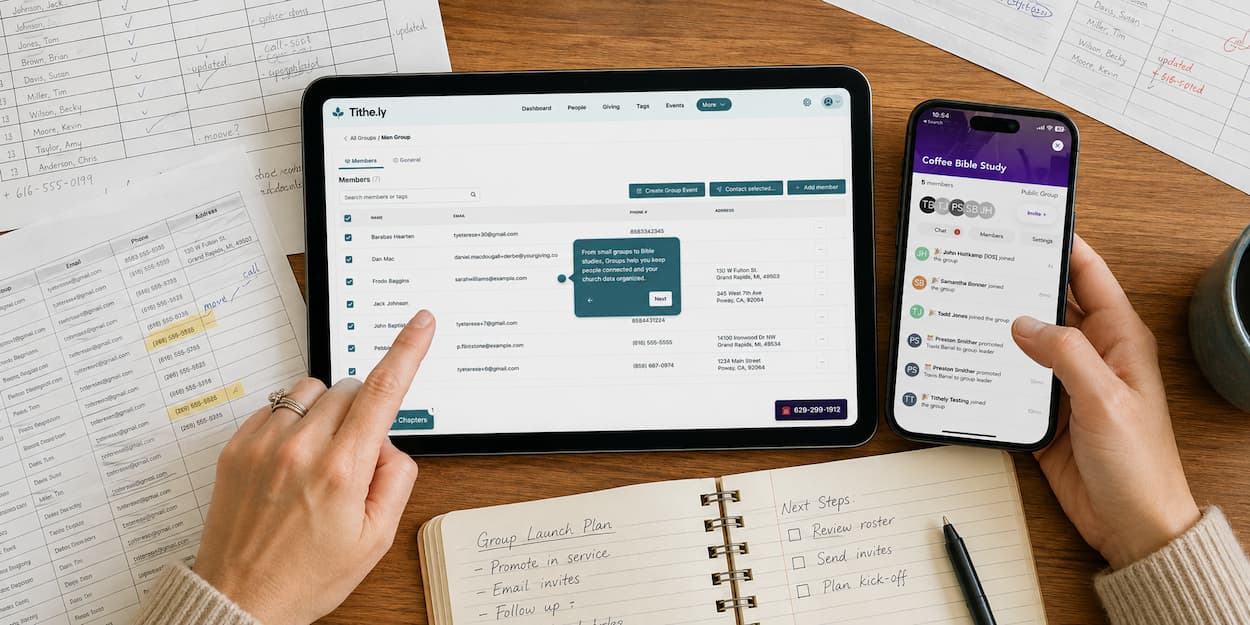
7 Signs Your Church Has Outgrown Spreadsheets
Discover the warning signs that your church has outgrown spreadsheets. Learn how church management software can improve communication, reporting, giving, attendance tracking, and administrative efficiency.
.jpg)



Spreadsheets are often where church systems begin.
They’re easy to create, flexible, and familiar. For a time, they work. You can track members, log attendance, record giving, and manage events without needing anything complex.
Many churches rely on spreadsheets because they feel simple and accessible.
But there comes a point where spreadsheet processes start breaking down.
As your church grows, the volume of information increases. More people and more events. More communication and more giving. More moving parts behind the scenes. What once felt manageable starts to feel fragile.
If your systems are starting to feel stretched, you’re not alone. Many churches reach this point. The key is recognizing the signs early so you can move toward a better setup before things become overwhelming.
In this article, we’ll look at seven clear signs your church has outgrown spreadsheets and needs software designed for growing churches.
Why Spreadsheets Work…Until They Don’t
First, let’s talk about spreadsheets.
Spreadsheets are often the right starting point, depending on your church. They’re flexible, easy to set up, familiar to almost everyone on your team, etc. Most people have used Excel, Google Sheets, or something like that.
For a small church with limited complexity, that simplicity can be helpful. The problem is that spreadsheets don’t evolve well.
Spreadsheets weren’t designed to handle:
- Growing relationships
- Ongoing communication
- Constantly changing data
- Information spread across multiple areas of your church
And they don’t scale in a way that reduces work over time. Instead, they tend to do the opposite.
As your church grows, spreadsheets require more maintenance. You end up with more tabs, more formulas, more manual updates, and more complicated workarounds to keep everything working.
It’s a big house of cards that will start to collapse if something goes wrong.
At that point, your team begins adapting to the limitations of the tool instead of the tool supporting your team. Spreadsheets stop being a helpful tool and start becoming something you have to manage.
And once that happens, growth becomes harder than it should be.
7 Signs Spreadsheets No Longer Work For Your Church
The signs below aren’t just minor frustrations. They’re indicators that your current system is no longer built for the stage your church is in. Recognizing them early gives you a chance to move toward something more sustainable before things start breaking down completely.
1. You Are Entering the Same Information In Multiple Places
One of the earliest warning signs is duplication.
A new guest fills out a form. Their information is added to a spreadsheet. Then it gets copied into another sheet for follow-up. Later, it may be entered again for event registration or communication lists.
At first, this may not seem like a big deal. But over time, duplicate work adds up. Two versions of the same record may not match. One list may be updated while another is not. Someone may rely on outdated information without realizing it.
When your systems require repeated manual entry, it is a sign that your tools are no longer connected in a way that supports your workflow.
2. You Are Not Confident Your Data Is Accurate
Spreadsheets can get dicey. The bigger they get, the more fragile they become, like a big house of cards.
A small formula error, an accidental overwrite, or a missed update can affect your entire dataset. As the number of records grows, it becomes harder to spot these issues quickly.
You may start to notice small inconsistencies. Attendance totals do not match, and giving reports seem slightly off. Lists contain duplicate or incomplete entries.
Over time, this leads to a bigger problem: uncertainty.
If your team is not confident in the data, every decision takes longer. People double-check numbers and reports require extra validation. Simple questions turn into investigations.
Accuracy matters in church administration. It affects communication, follow-up, financial reporting, and trust. When your system makes it difficult to maintain reliable data, it is no longer serving your church well.
3. Reporting Takes Too Long
Reporting is an odd thing. It’s supposed to provide clarity, but it often takes way too much time, and decisions have to be delayed.
With spreadsheets, reporting often involves gathering data from multiple files, cleaning it up, and assembling it into something usable. This can take significant time, especially when reports are needed regularly.
You may find that:
- Weekly or monthly reports take hours to prepare
- Leaders have to wait for updates
- Data needs to be rechecked before sharing
- Last-minute requests create stress
The more your church grows, the more important quick and accurate reporting becomes. Leaders need to understand things giving trends, attendance patterns, and overall engagement without delays.
If reporting feels like a burden that just keeps coming and coming, it is a strong signal that your current system is too manual.
4. Few People Understand How Everything Works
Spreadsheet systems often evolve over time. Like a city that wasn’t planned very far in advance.
One person builds the structure. They add formulas, create tabs, and develop workarounds to handle new needs. Eventually, the system becomes complex enough that only they fully understand it.
This creates a risk.
If that person is unavailable, it becomes difficult for others to step in. Tasks slow down. Questions go unanswered. Changes feel risky because no one wants to break something.
A healthy system should be accessible to your team, and it should not rely on one person’s knowledge to function. As your church grows, shared understanding becomes more important.
5. Communication Feels Disconnected From Your Data
Church communication relies on accurate information.
When your contact lists live in spreadsheets, sending targeted communication to various groups becomes more complicated. You may need to export data, clean up lists, and manually select recipients.
Mistakes are made. Messages may go to the wrong group, and some people may be missed. Lists may become outdated quickly.
It also makes follow-up harder.
If a guest attends for the first time, their information should flow naturally into your communication process. If someone registers for an event, they should receive relevant updates without extra manual steps.
But when your data and communication are disconnected, your team has to bridge the gap manually. That adds time and increases the risk of errors.
6. Your Administrative Workload Keeps Increasing
When systems rely heavily on spreadsheets, growth often brings more manual work. More records to update. More lists to manage. More reports to build. More details to track.
Over time, this creates pressure on your administrative team.
Tasks take longer, small changes require extra effort, and the pace of work becomes harder to maintain. What used to feel manageable starts to feel exhausting. Burnout is just around the corner, if it’s not already there.
Church administrators often carry a significant operational load. When systems are inefficient, that load becomes heavier. Better tools can reduce that burden and make growth more sustainable.
7. Important Details Slip Through the Cracks
This is often the most serious sign. Or a number of signs that point to a much bigger sign:
- Guests don’t receive follow-up
- Volunteer sign-ups are missed
- Donation records are incomplete
- Event registrations are overlooked
- Family updates don’t get reflected in your records
These administrative errors ultimately affect people’s experience.
When details slip through the cracks, it can impact relationships, trust, and engagement. It may not happen often, but even occasional gaps can create frustration.
In many cases, the issue is not a lack of effort. It is a system that makes it difficult to stay organized.
When information is spread across multiple spreadsheets, it becomes harder to keep everything aligned. Important details can get lost in the process.
A growing church needs consistent systems, not ones that rely on constant vigilance.
What Growing Churches Switch To
When churches move beyond spreadsheets, they are both replacing a tool and improving how their systems work together.
Most growing churches transition to a centralized church management platform like Tithely.
Instead of storing data in multiple files, they manage people, attendance, giving, communication, and events in one connected system. This creates a single source of information and reduces the need for manual updates.
With the right system in place, many of the issues described above begin to resolve:
- Information is entered once and stays consistent
- Data is easier to trust
- Reports are generated quickly
- Multiple team members can access the system confidently
- Communication connects directly to current data
- Administrative work becomes more manageable
- Important details are less likely to be missed
No, everything is not effortless. But it does mean your systems are working with you instead of against you.
How to Make the Transition Thoughtfully
Moving away from spreadsheets doesn’t have to be complicated.
Start by identifying your biggest pain points. Where is your team spending the most time? Where do errors happen most often? Which processes feel the most fragile?
Then look for a solution that addresses those needs directly.
Usability is incredibly important. Your team should be able to adopt the system without a steep learning curve. If they can’t or won’t use it, then it defeats the point.
Look for tools designed specifically for churches, as they are more likely to align with your workflows.
It is also helpful to think about integration. A connected system will save more time than a collection of separate tools.
Finally, involve your team in the process. The people who use the system daily can provide valuable insight into what will work best.
Growth Should Feel Sustainable
Growth is a good thing. And it should feel like a good thing, right?
More people, more engagement, more opportunities for ministry. But growth also requires systems that can support it.
If your current setup is creating more work, more confusion, or more stress, it may be time to make a change.
When your systems are aligned, your team can focus less on managing data and more on serving people. That is where church administration makes its greatest impact.
If your church is showing these signs, it may be time to move beyond spreadsheets and use church management software that can grow with you, like Tithely.
Sign Up for Product Updates

Stephen Altrogge lives in Tallahassee, Florida. He is a dad to three wonderful girls and has written for publications like The Gospel Coalition, Church Leaders, Crosswalk, and many more. When he’s not writing, you’ll find him reading or watching The Lord Of the Rings for the 10th time.
Spreadsheets are often where church systems begin.
They’re easy to create, flexible, and familiar. For a time, they work. You can track members, log attendance, record giving, and manage events without needing anything complex.
Many churches rely on spreadsheets because they feel simple and accessible.
But there comes a point where spreadsheet processes start breaking down.
As your church grows, the volume of information increases. More people and more events. More communication and more giving. More moving parts behind the scenes. What once felt manageable starts to feel fragile.
If your systems are starting to feel stretched, you’re not alone. Many churches reach this point. The key is recognizing the signs early so you can move toward a better setup before things become overwhelming.
In this article, we’ll look at seven clear signs your church has outgrown spreadsheets and needs software designed for growing churches.
Why Spreadsheets Work…Until They Don’t
First, let’s talk about spreadsheets.
Spreadsheets are often the right starting point, depending on your church. They’re flexible, easy to set up, familiar to almost everyone on your team, etc. Most people have used Excel, Google Sheets, or something like that.
For a small church with limited complexity, that simplicity can be helpful. The problem is that spreadsheets don’t evolve well.
Spreadsheets weren’t designed to handle:
- Growing relationships
- Ongoing communication
- Constantly changing data
- Information spread across multiple areas of your church
And they don’t scale in a way that reduces work over time. Instead, they tend to do the opposite.
As your church grows, spreadsheets require more maintenance. You end up with more tabs, more formulas, more manual updates, and more complicated workarounds to keep everything working.
It’s a big house of cards that will start to collapse if something goes wrong.
At that point, your team begins adapting to the limitations of the tool instead of the tool supporting your team. Spreadsheets stop being a helpful tool and start becoming something you have to manage.
And once that happens, growth becomes harder than it should be.
7 Signs Spreadsheets No Longer Work For Your Church
The signs below aren’t just minor frustrations. They’re indicators that your current system is no longer built for the stage your church is in. Recognizing them early gives you a chance to move toward something more sustainable before things start breaking down completely.
1. You Are Entering the Same Information In Multiple Places
One of the earliest warning signs is duplication.
A new guest fills out a form. Their information is added to a spreadsheet. Then it gets copied into another sheet for follow-up. Later, it may be entered again for event registration or communication lists.
At first, this may not seem like a big deal. But over time, duplicate work adds up. Two versions of the same record may not match. One list may be updated while another is not. Someone may rely on outdated information without realizing it.
When your systems require repeated manual entry, it is a sign that your tools are no longer connected in a way that supports your workflow.
2. You Are Not Confident Your Data Is Accurate
Spreadsheets can get dicey. The bigger they get, the more fragile they become, like a big house of cards.
A small formula error, an accidental overwrite, or a missed update can affect your entire dataset. As the number of records grows, it becomes harder to spot these issues quickly.
You may start to notice small inconsistencies. Attendance totals do not match, and giving reports seem slightly off. Lists contain duplicate or incomplete entries.
Over time, this leads to a bigger problem: uncertainty.
If your team is not confident in the data, every decision takes longer. People double-check numbers and reports require extra validation. Simple questions turn into investigations.
Accuracy matters in church administration. It affects communication, follow-up, financial reporting, and trust. When your system makes it difficult to maintain reliable data, it is no longer serving your church well.
3. Reporting Takes Too Long
Reporting is an odd thing. It’s supposed to provide clarity, but it often takes way too much time, and decisions have to be delayed.
With spreadsheets, reporting often involves gathering data from multiple files, cleaning it up, and assembling it into something usable. This can take significant time, especially when reports are needed regularly.
You may find that:
- Weekly or monthly reports take hours to prepare
- Leaders have to wait for updates
- Data needs to be rechecked before sharing
- Last-minute requests create stress
The more your church grows, the more important quick and accurate reporting becomes. Leaders need to understand things giving trends, attendance patterns, and overall engagement without delays.
If reporting feels like a burden that just keeps coming and coming, it is a strong signal that your current system is too manual.
4. Few People Understand How Everything Works
Spreadsheet systems often evolve over time. Like a city that wasn’t planned very far in advance.
One person builds the structure. They add formulas, create tabs, and develop workarounds to handle new needs. Eventually, the system becomes complex enough that only they fully understand it.
This creates a risk.
If that person is unavailable, it becomes difficult for others to step in. Tasks slow down. Questions go unanswered. Changes feel risky because no one wants to break something.
A healthy system should be accessible to your team, and it should not rely on one person’s knowledge to function. As your church grows, shared understanding becomes more important.
5. Communication Feels Disconnected From Your Data
Church communication relies on accurate information.
When your contact lists live in spreadsheets, sending targeted communication to various groups becomes more complicated. You may need to export data, clean up lists, and manually select recipients.
Mistakes are made. Messages may go to the wrong group, and some people may be missed. Lists may become outdated quickly.
It also makes follow-up harder.
If a guest attends for the first time, their information should flow naturally into your communication process. If someone registers for an event, they should receive relevant updates without extra manual steps.
But when your data and communication are disconnected, your team has to bridge the gap manually. That adds time and increases the risk of errors.
6. Your Administrative Workload Keeps Increasing
When systems rely heavily on spreadsheets, growth often brings more manual work. More records to update. More lists to manage. More reports to build. More details to track.
Over time, this creates pressure on your administrative team.
Tasks take longer, small changes require extra effort, and the pace of work becomes harder to maintain. What used to feel manageable starts to feel exhausting. Burnout is just around the corner, if it’s not already there.
Church administrators often carry a significant operational load. When systems are inefficient, that load becomes heavier. Better tools can reduce that burden and make growth more sustainable.
7. Important Details Slip Through the Cracks
This is often the most serious sign. Or a number of signs that point to a much bigger sign:
- Guests don’t receive follow-up
- Volunteer sign-ups are missed
- Donation records are incomplete
- Event registrations are overlooked
- Family updates don’t get reflected in your records
These administrative errors ultimately affect people’s experience.
When details slip through the cracks, it can impact relationships, trust, and engagement. It may not happen often, but even occasional gaps can create frustration.
In many cases, the issue is not a lack of effort. It is a system that makes it difficult to stay organized.
When information is spread across multiple spreadsheets, it becomes harder to keep everything aligned. Important details can get lost in the process.
A growing church needs consistent systems, not ones that rely on constant vigilance.
What Growing Churches Switch To
When churches move beyond spreadsheets, they are both replacing a tool and improving how their systems work together.
Most growing churches transition to a centralized church management platform like Tithely.
Instead of storing data in multiple files, they manage people, attendance, giving, communication, and events in one connected system. This creates a single source of information and reduces the need for manual updates.
With the right system in place, many of the issues described above begin to resolve:
- Information is entered once and stays consistent
- Data is easier to trust
- Reports are generated quickly
- Multiple team members can access the system confidently
- Communication connects directly to current data
- Administrative work becomes more manageable
- Important details are less likely to be missed
No, everything is not effortless. But it does mean your systems are working with you instead of against you.
How to Make the Transition Thoughtfully
Moving away from spreadsheets doesn’t have to be complicated.
Start by identifying your biggest pain points. Where is your team spending the most time? Where do errors happen most often? Which processes feel the most fragile?
Then look for a solution that addresses those needs directly.
Usability is incredibly important. Your team should be able to adopt the system without a steep learning curve. If they can’t or won’t use it, then it defeats the point.
Look for tools designed specifically for churches, as they are more likely to align with your workflows.
It is also helpful to think about integration. A connected system will save more time than a collection of separate tools.
Finally, involve your team in the process. The people who use the system daily can provide valuable insight into what will work best.
Growth Should Feel Sustainable
Growth is a good thing. And it should feel like a good thing, right?
More people, more engagement, more opportunities for ministry. But growth also requires systems that can support it.
If your current setup is creating more work, more confusion, or more stress, it may be time to make a change.
When your systems are aligned, your team can focus less on managing data and more on serving people. That is where church administration makes its greatest impact.
If your church is showing these signs, it may be time to move beyond spreadsheets and use church management software that can grow with you, like Tithely.
podcast transcript
Stephen Altrogge lives in Tallahassee, Florida. He is a dad to three wonderful girls and has written for publications like The Gospel Coalition, Church Leaders, Crosswalk, and many more. When he’s not writing, you’ll find him reading or watching The Lord Of the Rings for the 10th time.
Spreadsheets are often where church systems begin.
They’re easy to create, flexible, and familiar. For a time, they work. You can track members, log attendance, record giving, and manage events without needing anything complex.
Many churches rely on spreadsheets because they feel simple and accessible.
But there comes a point where spreadsheet processes start breaking down.
As your church grows, the volume of information increases. More people and more events. More communication and more giving. More moving parts behind the scenes. What once felt manageable starts to feel fragile.
If your systems are starting to feel stretched, you’re not alone. Many churches reach this point. The key is recognizing the signs early so you can move toward a better setup before things become overwhelming.
In this article, we’ll look at seven clear signs your church has outgrown spreadsheets and needs software designed for growing churches.
Why Spreadsheets Work…Until They Don’t
First, let’s talk about spreadsheets.
Spreadsheets are often the right starting point, depending on your church. They’re flexible, easy to set up, familiar to almost everyone on your team, etc. Most people have used Excel, Google Sheets, or something like that.
For a small church with limited complexity, that simplicity can be helpful. The problem is that spreadsheets don’t evolve well.
Spreadsheets weren’t designed to handle:
- Growing relationships
- Ongoing communication
- Constantly changing data
- Information spread across multiple areas of your church
And they don’t scale in a way that reduces work over time. Instead, they tend to do the opposite.
As your church grows, spreadsheets require more maintenance. You end up with more tabs, more formulas, more manual updates, and more complicated workarounds to keep everything working.
It’s a big house of cards that will start to collapse if something goes wrong.
At that point, your team begins adapting to the limitations of the tool instead of the tool supporting your team. Spreadsheets stop being a helpful tool and start becoming something you have to manage.
And once that happens, growth becomes harder than it should be.
7 Signs Spreadsheets No Longer Work For Your Church
The signs below aren’t just minor frustrations. They’re indicators that your current system is no longer built for the stage your church is in. Recognizing them early gives you a chance to move toward something more sustainable before things start breaking down completely.
1. You Are Entering the Same Information In Multiple Places
One of the earliest warning signs is duplication.
A new guest fills out a form. Their information is added to a spreadsheet. Then it gets copied into another sheet for follow-up. Later, it may be entered again for event registration or communication lists.
At first, this may not seem like a big deal. But over time, duplicate work adds up. Two versions of the same record may not match. One list may be updated while another is not. Someone may rely on outdated information without realizing it.
When your systems require repeated manual entry, it is a sign that your tools are no longer connected in a way that supports your workflow.
2. You Are Not Confident Your Data Is Accurate
Spreadsheets can get dicey. The bigger they get, the more fragile they become, like a big house of cards.
A small formula error, an accidental overwrite, or a missed update can affect your entire dataset. As the number of records grows, it becomes harder to spot these issues quickly.
You may start to notice small inconsistencies. Attendance totals do not match, and giving reports seem slightly off. Lists contain duplicate or incomplete entries.
Over time, this leads to a bigger problem: uncertainty.
If your team is not confident in the data, every decision takes longer. People double-check numbers and reports require extra validation. Simple questions turn into investigations.
Accuracy matters in church administration. It affects communication, follow-up, financial reporting, and trust. When your system makes it difficult to maintain reliable data, it is no longer serving your church well.
3. Reporting Takes Too Long
Reporting is an odd thing. It’s supposed to provide clarity, but it often takes way too much time, and decisions have to be delayed.
With spreadsheets, reporting often involves gathering data from multiple files, cleaning it up, and assembling it into something usable. This can take significant time, especially when reports are needed regularly.
You may find that:
- Weekly or monthly reports take hours to prepare
- Leaders have to wait for updates
- Data needs to be rechecked before sharing
- Last-minute requests create stress
The more your church grows, the more important quick and accurate reporting becomes. Leaders need to understand things giving trends, attendance patterns, and overall engagement without delays.
If reporting feels like a burden that just keeps coming and coming, it is a strong signal that your current system is too manual.
4. Few People Understand How Everything Works
Spreadsheet systems often evolve over time. Like a city that wasn’t planned very far in advance.
One person builds the structure. They add formulas, create tabs, and develop workarounds to handle new needs. Eventually, the system becomes complex enough that only they fully understand it.
This creates a risk.
If that person is unavailable, it becomes difficult for others to step in. Tasks slow down. Questions go unanswered. Changes feel risky because no one wants to break something.
A healthy system should be accessible to your team, and it should not rely on one person’s knowledge to function. As your church grows, shared understanding becomes more important.
5. Communication Feels Disconnected From Your Data
Church communication relies on accurate information.
When your contact lists live in spreadsheets, sending targeted communication to various groups becomes more complicated. You may need to export data, clean up lists, and manually select recipients.
Mistakes are made. Messages may go to the wrong group, and some people may be missed. Lists may become outdated quickly.
It also makes follow-up harder.
If a guest attends for the first time, their information should flow naturally into your communication process. If someone registers for an event, they should receive relevant updates without extra manual steps.
But when your data and communication are disconnected, your team has to bridge the gap manually. That adds time and increases the risk of errors.
6. Your Administrative Workload Keeps Increasing
When systems rely heavily on spreadsheets, growth often brings more manual work. More records to update. More lists to manage. More reports to build. More details to track.
Over time, this creates pressure on your administrative team.
Tasks take longer, small changes require extra effort, and the pace of work becomes harder to maintain. What used to feel manageable starts to feel exhausting. Burnout is just around the corner, if it’s not already there.
Church administrators often carry a significant operational load. When systems are inefficient, that load becomes heavier. Better tools can reduce that burden and make growth more sustainable.
7. Important Details Slip Through the Cracks
This is often the most serious sign. Or a number of signs that point to a much bigger sign:
- Guests don’t receive follow-up
- Volunteer sign-ups are missed
- Donation records are incomplete
- Event registrations are overlooked
- Family updates don’t get reflected in your records
These administrative errors ultimately affect people’s experience.
When details slip through the cracks, it can impact relationships, trust, and engagement. It may not happen often, but even occasional gaps can create frustration.
In many cases, the issue is not a lack of effort. It is a system that makes it difficult to stay organized.
When information is spread across multiple spreadsheets, it becomes harder to keep everything aligned. Important details can get lost in the process.
A growing church needs consistent systems, not ones that rely on constant vigilance.
What Growing Churches Switch To
When churches move beyond spreadsheets, they are both replacing a tool and improving how their systems work together.
Most growing churches transition to a centralized church management platform like Tithely.
Instead of storing data in multiple files, they manage people, attendance, giving, communication, and events in one connected system. This creates a single source of information and reduces the need for manual updates.
With the right system in place, many of the issues described above begin to resolve:
- Information is entered once and stays consistent
- Data is easier to trust
- Reports are generated quickly
- Multiple team members can access the system confidently
- Communication connects directly to current data
- Administrative work becomes more manageable
- Important details are less likely to be missed
No, everything is not effortless. But it does mean your systems are working with you instead of against you.
How to Make the Transition Thoughtfully
Moving away from spreadsheets doesn’t have to be complicated.
Start by identifying your biggest pain points. Where is your team spending the most time? Where do errors happen most often? Which processes feel the most fragile?
Then look for a solution that addresses those needs directly.
Usability is incredibly important. Your team should be able to adopt the system without a steep learning curve. If they can’t or won’t use it, then it defeats the point.
Look for tools designed specifically for churches, as they are more likely to align with your workflows.
It is also helpful to think about integration. A connected system will save more time than a collection of separate tools.
Finally, involve your team in the process. The people who use the system daily can provide valuable insight into what will work best.
Growth Should Feel Sustainable
Growth is a good thing. And it should feel like a good thing, right?
More people, more engagement, more opportunities for ministry. But growth also requires systems that can support it.
If your current setup is creating more work, more confusion, or more stress, it may be time to make a change.
When your systems are aligned, your team can focus less on managing data and more on serving people. That is where church administration makes its greatest impact.
If your church is showing these signs, it may be time to move beyond spreadsheets and use church management software that can grow with you, like Tithely.
VIDEO transcript
Spreadsheets are often where church systems begin.
They’re easy to create, flexible, and familiar. For a time, they work. You can track members, log attendance, record giving, and manage events without needing anything complex.
Many churches rely on spreadsheets because they feel simple and accessible.
But there comes a point where spreadsheet processes start breaking down.
As your church grows, the volume of information increases. More people and more events. More communication and more giving. More moving parts behind the scenes. What once felt manageable starts to feel fragile.
If your systems are starting to feel stretched, you’re not alone. Many churches reach this point. The key is recognizing the signs early so you can move toward a better setup before things become overwhelming.
In this article, we’ll look at seven clear signs your church has outgrown spreadsheets and needs software designed for growing churches.
Why Spreadsheets Work…Until They Don’t
First, let’s talk about spreadsheets.
Spreadsheets are often the right starting point, depending on your church. They’re flexible, easy to set up, familiar to almost everyone on your team, etc. Most people have used Excel, Google Sheets, or something like that.
For a small church with limited complexity, that simplicity can be helpful. The problem is that spreadsheets don’t evolve well.
Spreadsheets weren’t designed to handle:
- Growing relationships
- Ongoing communication
- Constantly changing data
- Information spread across multiple areas of your church
And they don’t scale in a way that reduces work over time. Instead, they tend to do the opposite.
As your church grows, spreadsheets require more maintenance. You end up with more tabs, more formulas, more manual updates, and more complicated workarounds to keep everything working.
It’s a big house of cards that will start to collapse if something goes wrong.
At that point, your team begins adapting to the limitations of the tool instead of the tool supporting your team. Spreadsheets stop being a helpful tool and start becoming something you have to manage.
And once that happens, growth becomes harder than it should be.
7 Signs Spreadsheets No Longer Work For Your Church
The signs below aren’t just minor frustrations. They’re indicators that your current system is no longer built for the stage your church is in. Recognizing them early gives you a chance to move toward something more sustainable before things start breaking down completely.
1. You Are Entering the Same Information In Multiple Places
One of the earliest warning signs is duplication.
A new guest fills out a form. Their information is added to a spreadsheet. Then it gets copied into another sheet for follow-up. Later, it may be entered again for event registration or communication lists.
At first, this may not seem like a big deal. But over time, duplicate work adds up. Two versions of the same record may not match. One list may be updated while another is not. Someone may rely on outdated information without realizing it.
When your systems require repeated manual entry, it is a sign that your tools are no longer connected in a way that supports your workflow.
2. You Are Not Confident Your Data Is Accurate
Spreadsheets can get dicey. The bigger they get, the more fragile they become, like a big house of cards.
A small formula error, an accidental overwrite, or a missed update can affect your entire dataset. As the number of records grows, it becomes harder to spot these issues quickly.
You may start to notice small inconsistencies. Attendance totals do not match, and giving reports seem slightly off. Lists contain duplicate or incomplete entries.
Over time, this leads to a bigger problem: uncertainty.
If your team is not confident in the data, every decision takes longer. People double-check numbers and reports require extra validation. Simple questions turn into investigations.
Accuracy matters in church administration. It affects communication, follow-up, financial reporting, and trust. When your system makes it difficult to maintain reliable data, it is no longer serving your church well.
3. Reporting Takes Too Long
Reporting is an odd thing. It’s supposed to provide clarity, but it often takes way too much time, and decisions have to be delayed.
With spreadsheets, reporting often involves gathering data from multiple files, cleaning it up, and assembling it into something usable. This can take significant time, especially when reports are needed regularly.
You may find that:
- Weekly or monthly reports take hours to prepare
- Leaders have to wait for updates
- Data needs to be rechecked before sharing
- Last-minute requests create stress
The more your church grows, the more important quick and accurate reporting becomes. Leaders need to understand things giving trends, attendance patterns, and overall engagement without delays.
If reporting feels like a burden that just keeps coming and coming, it is a strong signal that your current system is too manual.
4. Few People Understand How Everything Works
Spreadsheet systems often evolve over time. Like a city that wasn’t planned very far in advance.
One person builds the structure. They add formulas, create tabs, and develop workarounds to handle new needs. Eventually, the system becomes complex enough that only they fully understand it.
This creates a risk.
If that person is unavailable, it becomes difficult for others to step in. Tasks slow down. Questions go unanswered. Changes feel risky because no one wants to break something.
A healthy system should be accessible to your team, and it should not rely on one person’s knowledge to function. As your church grows, shared understanding becomes more important.
5. Communication Feels Disconnected From Your Data
Church communication relies on accurate information.
When your contact lists live in spreadsheets, sending targeted communication to various groups becomes more complicated. You may need to export data, clean up lists, and manually select recipients.
Mistakes are made. Messages may go to the wrong group, and some people may be missed. Lists may become outdated quickly.
It also makes follow-up harder.
If a guest attends for the first time, their information should flow naturally into your communication process. If someone registers for an event, they should receive relevant updates without extra manual steps.
But when your data and communication are disconnected, your team has to bridge the gap manually. That adds time and increases the risk of errors.
6. Your Administrative Workload Keeps Increasing
When systems rely heavily on spreadsheets, growth often brings more manual work. More records to update. More lists to manage. More reports to build. More details to track.
Over time, this creates pressure on your administrative team.
Tasks take longer, small changes require extra effort, and the pace of work becomes harder to maintain. What used to feel manageable starts to feel exhausting. Burnout is just around the corner, if it’s not already there.
Church administrators often carry a significant operational load. When systems are inefficient, that load becomes heavier. Better tools can reduce that burden and make growth more sustainable.
7. Important Details Slip Through the Cracks
This is often the most serious sign. Or a number of signs that point to a much bigger sign:
- Guests don’t receive follow-up
- Volunteer sign-ups are missed
- Donation records are incomplete
- Event registrations are overlooked
- Family updates don’t get reflected in your records
These administrative errors ultimately affect people’s experience.
When details slip through the cracks, it can impact relationships, trust, and engagement. It may not happen often, but even occasional gaps can create frustration.
In many cases, the issue is not a lack of effort. It is a system that makes it difficult to stay organized.
When information is spread across multiple spreadsheets, it becomes harder to keep everything aligned. Important details can get lost in the process.
A growing church needs consistent systems, not ones that rely on constant vigilance.
What Growing Churches Switch To
When churches move beyond spreadsheets, they are both replacing a tool and improving how their systems work together.
Most growing churches transition to a centralized church management platform like Tithely.
Instead of storing data in multiple files, they manage people, attendance, giving, communication, and events in one connected system. This creates a single source of information and reduces the need for manual updates.
With the right system in place, many of the issues described above begin to resolve:
- Information is entered once and stays consistent
- Data is easier to trust
- Reports are generated quickly
- Multiple team members can access the system confidently
- Communication connects directly to current data
- Administrative work becomes more manageable
- Important details are less likely to be missed
No, everything is not effortless. But it does mean your systems are working with you instead of against you.
How to Make the Transition Thoughtfully
Moving away from spreadsheets doesn’t have to be complicated.
Start by identifying your biggest pain points. Where is your team spending the most time? Where do errors happen most often? Which processes feel the most fragile?
Then look for a solution that addresses those needs directly.
Usability is incredibly important. Your team should be able to adopt the system without a steep learning curve. If they can’t or won’t use it, then it defeats the point.
Look for tools designed specifically for churches, as they are more likely to align with your workflows.
It is also helpful to think about integration. A connected system will save more time than a collection of separate tools.
Finally, involve your team in the process. The people who use the system daily can provide valuable insight into what will work best.
Growth Should Feel Sustainable
Growth is a good thing. And it should feel like a good thing, right?
More people, more engagement, more opportunities for ministry. But growth also requires systems that can support it.
If your current setup is creating more work, more confusion, or more stress, it may be time to make a change.
When your systems are aligned, your team can focus less on managing data and more on serving people. That is where church administration makes its greatest impact.
If your church is showing these signs, it may be time to move beyond spreadsheets and use church management software that can grow with you, like Tithely.
Sign Up for Product Updates
Stephen Altrogge lives in Tallahassee, Florida. He is a dad to three wonderful girls and has written for publications like The Gospel Coalition, Church Leaders, Crosswalk, and many more. When he’s not writing, you’ll find him reading or watching The Lord Of the Rings for the 10th time.

You Might Also Like
More Resources

From increasing giving, managing your congregation, and engaging your church, our collection of resources will keep you up-to-date on the latest church and ministry trends.
Free Resources.jpg)







.jpg)