How to Talk About Year-End Giving Without Feeling Awkward: A Pastoral Guide to Inspiring Generosity
Year-end giving season is coming, and with it, that familiar tension every pastor feels. Here’s how to talk about generosity with clarity, confidence, and zero cringe while leading your church into deeper discipleship.




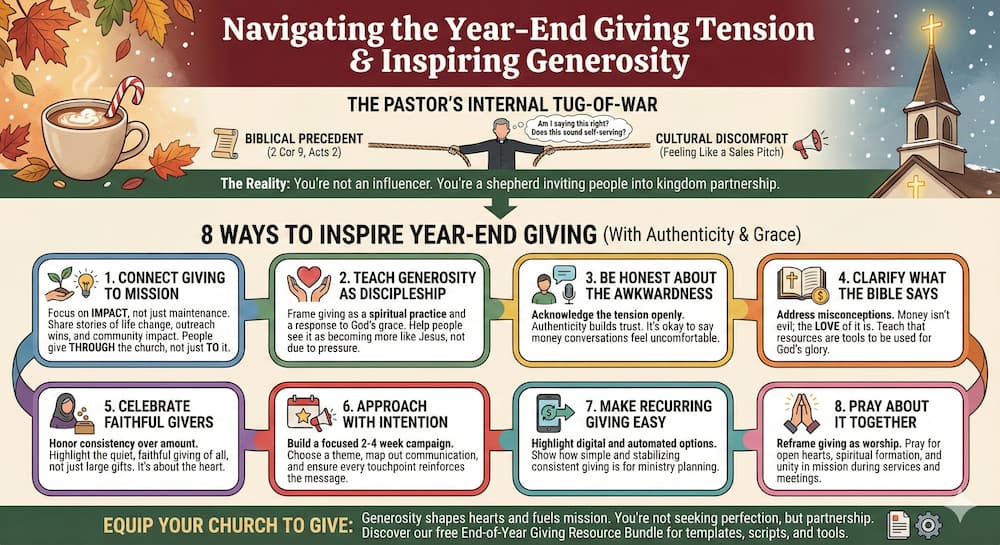
Leaves are falling, peppermint mochas are back on the menu, and somewhere in the back of your mind… You can already feel it. Year-end giving season is coming, and with it, many church leaders experience that familiar internal tug-of-war.
You know that God can provide however He chooses, but you also know there’s biblical precedent for giving through the Body of Christ (2 Corinthians 9; Acts 2; 1 Timothy 6). Ultimately, you understand that giving is a good and healthy part of discipleship, and yet reminding people of it week after week can still feel a little uncomfortable.
And then comes the big year-end campaign. Suddenly, the stakes feel higher and the ask feels heavier. Even seasoned pastors can start to feel a flicker of vulnerability.
The thoughts start creeping in. Am I saying this right? Does this sound self-serving?
The Year-End Giving Tension Every Pastor Knows
Part of this tension comes from the cultural moment we’re all living in. We’re constantly surrounded by sales pitches, sponsored content, and social media influencers who always feel like they’re selling something. We’re constantly being marketed to, and the last place we want to experience that is inside the walls of the church.
But let me remind you, wonderful pastor or church leader on the other side of this article, that you are not another influencer trying to make a living off of marketing (no shame to the hustle for them!). You are a follower of Jesus. You are a shepherd. And you are someone trying to lead the people of God into greater levels of trust and spiritual maturity.
When you invite people to give to your church, you aren’t asking them to pad a budget or keep the lights on. You’re inviting them to sow into the kingdom and to partner with what God is already doing through your church.
The bottom line is that if your heart is in the right place, you don’t need to be ashamed to invite people into generosity.
Let’s Talk About Giving (Without Making Everyone Uncomfortable)
While church leaders should not be afraid to talk about giving, it is worth paying attention to how we invite people to give. I’ve sat through far too many cringy offering messages that felt more like a sales pitch than a meaningful moment of teaching.
And I’ve also heard incredibly beautiful, motivating sermons that reminded me why I choose to give – sermons that inspired me to lean into generosity on a deeper level, both in the church and in the world.
I believe every church leader should learn how to better communicate year-end giving campaigns and offering messages with clarity and intentionality. Not to learn to manipulate (which we should avoid at all costs), but to offer a sincere invitation into generosity.
So, how should we extend this beautiful invitation? Here are seven ways to inspire generosity at your church that honor both your people and the heart of the gospel.
Download the FREE End-of-Year Giving Resource Bundle
8 Ways to Inspire Year-End Giving at Your Church
1. Connect Giving to Mission, Not Just Maintenance
People want to give to something that matters. They’re not typically moved by “keeping the lights on,” but they are moved by seeing God’s work come alive through their church. When you talk about giving, make sure to tell stories of impact. Highlight life change, outreach, discipleship wins, community impact, and the ministry moments that the pastoral team knows about but the congregation may not have heard yet.
Help your congregation understand that they are giving through the church, not just to the church. When an offering message tells the story of what God is doing, people begin to understand that their giving is part of something bigger than themselves – or even their individual church community.
2. Teach on Generosity as Discipleship
Many people have never truly been taught why giving matters spiritually. They know it supports the church, but they may not understand how deeply Scripture connects generosity to trust and spiritual formation. Take time to unpack that. Help your church see that giving is a discipleship practice.
The Bible frames generosity as part of becoming more like Jesus. When people understand the biblical “why,” their giving becomes a response to God rather than a reaction to pressure. We definitely don’t want anyone in our congregations feeling pressure to give. We want them to give out of a heart of joy and generosity! Make that clear to your congregation, and give them space to give when they’re ready.
3. Be Honest About the Awkwardness
Talking about money in church can feel weird, and everyone knows it. Sometimes the best way to build trust is simply naming that reality. I’ve always appreciated when pastors acknowledge it openly – not in a dramatic way, but in a human way. Something like, “Hey, I know money conversations can feel uncomfortable, but Jesus talked about money a lot because He cared about our hearts and our attachment to money.”
When pastors are honest about the tension, people relax. They stop waiting for the “sales pitch” moment and start listening with an open heart. You can still be confident about inviting people to give, but you don’t have to be perfectly polished and put together. Authenticity in this moment tells your church you’re human and you’re navigating this conversation together.
4. Clarify What the Bible Actually Says About Money
Many people grew up hearing, “Money is the root of all evil,” but that’s not what Scripture teaches.
The Bible says the love of money is the root of all kinds of evil (1 Timothy 6:10). It is not dollars that pull us away from God… it is our attachment to them. Money itself is neutral. It’s a tool. But like any tool, it can shape us for better or for worse depending on how we use it.
When you take a moment to clarify this with your congregation, it moves the conversation away from guilt and toward growth. Giving becomes a matter of Christian maturity and learning how to handle resources in a way that reflects God’s character.
5. Celebrate Faithful Givers, Not Just Big Gifts
Many churches love to spotlight dramatic stories of large gifts or “miracle moments,” but faithful giving often looks much quieter than that. Jesus made this clear when He watched the widow drop her two small coins into the temple treasury (Luke 21:1-4). Others gave more on paper, but He honored her gift above all because it revealed her heart of trust.
When the offering moment comes around, tell stories about consistency as well as big gifts. There’s no need to call out names, but honor the people who give faithfully over time: the single moms who set up $25/month recurring giving, the teenagers who tithe from their part-time jobs, and the couple who sets aside a portion of their income each month for generosity. When you highlight consistency over amount, you reinforce the truth that generosity is about the heart, not the number.
6. Approach Your Year-End Giving Campaign with Intention
As you are focusing on generosity during this season, you may want to take time to build an intentional year-end campaign. Start by deciding how many weeks you want to highlight year-end giving. For most churches, a simple two- to four-week window works well and keeps your messaging clear.
Choose a theme that ties everything together, whether it is a Scripture, a phrase, or a specific ministry story you want to elevate. Then map out your communication plan. Decide what you will share each week, where you will share it, and how each touchpoint reinforces your theme.
7. Make Recurring Giving Easy and Visible
Year-end giving is not just about a one-time gift. It is important to invite your congregation into recurring giving, too.
Recurring giving is incredibly helpful for ministry planning, but many churches barely talk about it. If your church offers digital giving or automated options, highlight them clearly and consistently. Show people how simple it is, explain the impact of predictable giving, and make the process as intuitive as possible.
The easier you make it, the more likely people are to take a step into consistent generosity. Recurring giving often becomes one of the most stabilizing forces for your church’s financial health, both during the holiday season and throughout the year.
If you want practical steps for communicating recurring giving well, our free recurring giving guide offers actionable steps, real-life examples, and teaching moments you can use to build a culture of consistent, year-round giving rooted in discipleship.
8. Pray About It Together
Generosity is ultimately a matter of trust, and trust grows in prayer. Take intentional moments in services, staff meetings, small groups, or leadership gatherings to pray specifically about giving. Not just for finances to come through, but for hearts to be open, for lives to be formed, and for your church to grow in unity and mission.
Praying about generosity reframes giving as worship. It reminds your congregation that everything belongs to God and that giving is an act of aligning our hearts with His.
Equip Your Church to Give
As you step into your year-end giving efforts, give yourself grace! Talking about money in church will probably always feel a little awkward, and that’s okay. You are not doing it for the perfect delivery or the flawless transition. You are doing it because generosity shapes people, forms hearts, and fuels the mission God has entrusted to your church.
If you need practical support this season, explore our free End-of-Year Giving Resource Bundle filled with templates, graphics, scripts, and simple tools to help you communicate with clarity and confidence.
Sign Up for Product Updates

Susanna is a theological content writer with a Master of Arts in Intercultural Studies from Fuller Theological Seminary. She is passionate about ministry, running, and exploring new cultures through international travel. In her free time, you’ll find her surfing, obsessing over the Olympics, or enjoying the San Diego sunshine!
Leaves are falling, peppermint mochas are back on the menu, and somewhere in the back of your mind… You can already feel it. Year-end giving season is coming, and with it, many church leaders experience that familiar internal tug-of-war.
You know that God can provide however He chooses, but you also know there’s biblical precedent for giving through the Body of Christ (2 Corinthians 9; Acts 2; 1 Timothy 6). Ultimately, you understand that giving is a good and healthy part of discipleship, and yet reminding people of it week after week can still feel a little uncomfortable.
And then comes the big year-end campaign. Suddenly, the stakes feel higher and the ask feels heavier. Even seasoned pastors can start to feel a flicker of vulnerability.
The thoughts start creeping in. Am I saying this right? Does this sound self-serving?
The Year-End Giving Tension Every Pastor Knows
Part of this tension comes from the cultural moment we’re all living in. We’re constantly surrounded by sales pitches, sponsored content, and social media influencers who always feel like they’re selling something. We’re constantly being marketed to, and the last place we want to experience that is inside the walls of the church.
But let me remind you, wonderful pastor or church leader on the other side of this article, that you are not another influencer trying to make a living off of marketing (no shame to the hustle for them!). You are a follower of Jesus. You are a shepherd. And you are someone trying to lead the people of God into greater levels of trust and spiritual maturity.
When you invite people to give to your church, you aren’t asking them to pad a budget or keep the lights on. You’re inviting them to sow into the kingdom and to partner with what God is already doing through your church.
The bottom line is that if your heart is in the right place, you don’t need to be ashamed to invite people into generosity.
Let’s Talk About Giving (Without Making Everyone Uncomfortable)
While church leaders should not be afraid to talk about giving, it is worth paying attention to how we invite people to give. I’ve sat through far too many cringy offering messages that felt more like a sales pitch than a meaningful moment of teaching.
And I’ve also heard incredibly beautiful, motivating sermons that reminded me why I choose to give – sermons that inspired me to lean into generosity on a deeper level, both in the church and in the world.
I believe every church leader should learn how to better communicate year-end giving campaigns and offering messages with clarity and intentionality. Not to learn to manipulate (which we should avoid at all costs), but to offer a sincere invitation into generosity.
So, how should we extend this beautiful invitation? Here are seven ways to inspire generosity at your church that honor both your people and the heart of the gospel.
Download the FREE End-of-Year Giving Resource Bundle
8 Ways to Inspire Year-End Giving at Your Church
1. Connect Giving to Mission, Not Just Maintenance
People want to give to something that matters. They’re not typically moved by “keeping the lights on,” but they are moved by seeing God’s work come alive through their church. When you talk about giving, make sure to tell stories of impact. Highlight life change, outreach, discipleship wins, community impact, and the ministry moments that the pastoral team knows about but the congregation may not have heard yet.
Help your congregation understand that they are giving through the church, not just to the church. When an offering message tells the story of what God is doing, people begin to understand that their giving is part of something bigger than themselves – or even their individual church community.
2. Teach on Generosity as Discipleship
Many people have never truly been taught why giving matters spiritually. They know it supports the church, but they may not understand how deeply Scripture connects generosity to trust and spiritual formation. Take time to unpack that. Help your church see that giving is a discipleship practice.
The Bible frames generosity as part of becoming more like Jesus. When people understand the biblical “why,” their giving becomes a response to God rather than a reaction to pressure. We definitely don’t want anyone in our congregations feeling pressure to give. We want them to give out of a heart of joy and generosity! Make that clear to your congregation, and give them space to give when they’re ready.
3. Be Honest About the Awkwardness
Talking about money in church can feel weird, and everyone knows it. Sometimes the best way to build trust is simply naming that reality. I’ve always appreciated when pastors acknowledge it openly – not in a dramatic way, but in a human way. Something like, “Hey, I know money conversations can feel uncomfortable, but Jesus talked about money a lot because He cared about our hearts and our attachment to money.”
When pastors are honest about the tension, people relax. They stop waiting for the “sales pitch” moment and start listening with an open heart. You can still be confident about inviting people to give, but you don’t have to be perfectly polished and put together. Authenticity in this moment tells your church you’re human and you’re navigating this conversation together.
4. Clarify What the Bible Actually Says About Money
Many people grew up hearing, “Money is the root of all evil,” but that’s not what Scripture teaches.
The Bible says the love of money is the root of all kinds of evil (1 Timothy 6:10). It is not dollars that pull us away from God… it is our attachment to them. Money itself is neutral. It’s a tool. But like any tool, it can shape us for better or for worse depending on how we use it.
When you take a moment to clarify this with your congregation, it moves the conversation away from guilt and toward growth. Giving becomes a matter of Christian maturity and learning how to handle resources in a way that reflects God’s character.
5. Celebrate Faithful Givers, Not Just Big Gifts
Many churches love to spotlight dramatic stories of large gifts or “miracle moments,” but faithful giving often looks much quieter than that. Jesus made this clear when He watched the widow drop her two small coins into the temple treasury (Luke 21:1-4). Others gave more on paper, but He honored her gift above all because it revealed her heart of trust.
When the offering moment comes around, tell stories about consistency as well as big gifts. There’s no need to call out names, but honor the people who give faithfully over time: the single moms who set up $25/month recurring giving, the teenagers who tithe from their part-time jobs, and the couple who sets aside a portion of their income each month for generosity. When you highlight consistency over amount, you reinforce the truth that generosity is about the heart, not the number.
6. Approach Your Year-End Giving Campaign with Intention
As you are focusing on generosity during this season, you may want to take time to build an intentional year-end campaign. Start by deciding how many weeks you want to highlight year-end giving. For most churches, a simple two- to four-week window works well and keeps your messaging clear.
Choose a theme that ties everything together, whether it is a Scripture, a phrase, or a specific ministry story you want to elevate. Then map out your communication plan. Decide what you will share each week, where you will share it, and how each touchpoint reinforces your theme.
7. Make Recurring Giving Easy and Visible
Year-end giving is not just about a one-time gift. It is important to invite your congregation into recurring giving, too.
Recurring giving is incredibly helpful for ministry planning, but many churches barely talk about it. If your church offers digital giving or automated options, highlight them clearly and consistently. Show people how simple it is, explain the impact of predictable giving, and make the process as intuitive as possible.
The easier you make it, the more likely people are to take a step into consistent generosity. Recurring giving often becomes one of the most stabilizing forces for your church’s financial health, both during the holiday season and throughout the year.
If you want practical steps for communicating recurring giving well, our free recurring giving guide offers actionable steps, real-life examples, and teaching moments you can use to build a culture of consistent, year-round giving rooted in discipleship.
8. Pray About It Together
Generosity is ultimately a matter of trust, and trust grows in prayer. Take intentional moments in services, staff meetings, small groups, or leadership gatherings to pray specifically about giving. Not just for finances to come through, but for hearts to be open, for lives to be formed, and for your church to grow in unity and mission.
Praying about generosity reframes giving as worship. It reminds your congregation that everything belongs to God and that giving is an act of aligning our hearts with His.
Equip Your Church to Give
As you step into your year-end giving efforts, give yourself grace! Talking about money in church will probably always feel a little awkward, and that’s okay. You are not doing it for the perfect delivery or the flawless transition. You are doing it because generosity shapes people, forms hearts, and fuels the mission God has entrusted to your church.
If you need practical support this season, explore our free End-of-Year Giving Resource Bundle filled with templates, graphics, scripts, and simple tools to help you communicate with clarity and confidence.
podcast transcript
Susanna is a theological content writer with a Master of Arts in Intercultural Studies from Fuller Theological Seminary. She is passionate about ministry, running, and exploring new cultures through international travel. In her free time, you’ll find her surfing, obsessing over the Olympics, or enjoying the San Diego sunshine!
Leaves are falling, peppermint mochas are back on the menu, and somewhere in the back of your mind… You can already feel it. Year-end giving season is coming, and with it, many church leaders experience that familiar internal tug-of-war.
You know that God can provide however He chooses, but you also know there’s biblical precedent for giving through the Body of Christ (2 Corinthians 9; Acts 2; 1 Timothy 6). Ultimately, you understand that giving is a good and healthy part of discipleship, and yet reminding people of it week after week can still feel a little uncomfortable.
And then comes the big year-end campaign. Suddenly, the stakes feel higher and the ask feels heavier. Even seasoned pastors can start to feel a flicker of vulnerability.
The thoughts start creeping in. Am I saying this right? Does this sound self-serving?
The Year-End Giving Tension Every Pastor Knows
Part of this tension comes from the cultural moment we’re all living in. We’re constantly surrounded by sales pitches, sponsored content, and social media influencers who always feel like they’re selling something. We’re constantly being marketed to, and the last place we want to experience that is inside the walls of the church.
But let me remind you, wonderful pastor or church leader on the other side of this article, that you are not another influencer trying to make a living off of marketing (no shame to the hustle for them!). You are a follower of Jesus. You are a shepherd. And you are someone trying to lead the people of God into greater levels of trust and spiritual maturity.
When you invite people to give to your church, you aren’t asking them to pad a budget or keep the lights on. You’re inviting them to sow into the kingdom and to partner with what God is already doing through your church.
The bottom line is that if your heart is in the right place, you don’t need to be ashamed to invite people into generosity.
Let’s Talk About Giving (Without Making Everyone Uncomfortable)
While church leaders should not be afraid to talk about giving, it is worth paying attention to how we invite people to give. I’ve sat through far too many cringy offering messages that felt more like a sales pitch than a meaningful moment of teaching.
And I’ve also heard incredibly beautiful, motivating sermons that reminded me why I choose to give – sermons that inspired me to lean into generosity on a deeper level, both in the church and in the world.
I believe every church leader should learn how to better communicate year-end giving campaigns and offering messages with clarity and intentionality. Not to learn to manipulate (which we should avoid at all costs), but to offer a sincere invitation into generosity.
So, how should we extend this beautiful invitation? Here are seven ways to inspire generosity at your church that honor both your people and the heart of the gospel.
Download the FREE End-of-Year Giving Resource Bundle
8 Ways to Inspire Year-End Giving at Your Church
1. Connect Giving to Mission, Not Just Maintenance
People want to give to something that matters. They’re not typically moved by “keeping the lights on,” but they are moved by seeing God’s work come alive through their church. When you talk about giving, make sure to tell stories of impact. Highlight life change, outreach, discipleship wins, community impact, and the ministry moments that the pastoral team knows about but the congregation may not have heard yet.
Help your congregation understand that they are giving through the church, not just to the church. When an offering message tells the story of what God is doing, people begin to understand that their giving is part of something bigger than themselves – or even their individual church community.
2. Teach on Generosity as Discipleship
Many people have never truly been taught why giving matters spiritually. They know it supports the church, but they may not understand how deeply Scripture connects generosity to trust and spiritual formation. Take time to unpack that. Help your church see that giving is a discipleship practice.
The Bible frames generosity as part of becoming more like Jesus. When people understand the biblical “why,” their giving becomes a response to God rather than a reaction to pressure. We definitely don’t want anyone in our congregations feeling pressure to give. We want them to give out of a heart of joy and generosity! Make that clear to your congregation, and give them space to give when they’re ready.
3. Be Honest About the Awkwardness
Talking about money in church can feel weird, and everyone knows it. Sometimes the best way to build trust is simply naming that reality. I’ve always appreciated when pastors acknowledge it openly – not in a dramatic way, but in a human way. Something like, “Hey, I know money conversations can feel uncomfortable, but Jesus talked about money a lot because He cared about our hearts and our attachment to money.”
When pastors are honest about the tension, people relax. They stop waiting for the “sales pitch” moment and start listening with an open heart. You can still be confident about inviting people to give, but you don’t have to be perfectly polished and put together. Authenticity in this moment tells your church you’re human and you’re navigating this conversation together.
4. Clarify What the Bible Actually Says About Money
Many people grew up hearing, “Money is the root of all evil,” but that’s not what Scripture teaches.
The Bible says the love of money is the root of all kinds of evil (1 Timothy 6:10). It is not dollars that pull us away from God… it is our attachment to them. Money itself is neutral. It’s a tool. But like any tool, it can shape us for better or for worse depending on how we use it.
When you take a moment to clarify this with your congregation, it moves the conversation away from guilt and toward growth. Giving becomes a matter of Christian maturity and learning how to handle resources in a way that reflects God’s character.
5. Celebrate Faithful Givers, Not Just Big Gifts
Many churches love to spotlight dramatic stories of large gifts or “miracle moments,” but faithful giving often looks much quieter than that. Jesus made this clear when He watched the widow drop her two small coins into the temple treasury (Luke 21:1-4). Others gave more on paper, but He honored her gift above all because it revealed her heart of trust.
When the offering moment comes around, tell stories about consistency as well as big gifts. There’s no need to call out names, but honor the people who give faithfully over time: the single moms who set up $25/month recurring giving, the teenagers who tithe from their part-time jobs, and the couple who sets aside a portion of their income each month for generosity. When you highlight consistency over amount, you reinforce the truth that generosity is about the heart, not the number.
6. Approach Your Year-End Giving Campaign with Intention
As you are focusing on generosity during this season, you may want to take time to build an intentional year-end campaign. Start by deciding how many weeks you want to highlight year-end giving. For most churches, a simple two- to four-week window works well and keeps your messaging clear.
Choose a theme that ties everything together, whether it is a Scripture, a phrase, or a specific ministry story you want to elevate. Then map out your communication plan. Decide what you will share each week, where you will share it, and how each touchpoint reinforces your theme.
7. Make Recurring Giving Easy and Visible
Year-end giving is not just about a one-time gift. It is important to invite your congregation into recurring giving, too.
Recurring giving is incredibly helpful for ministry planning, but many churches barely talk about it. If your church offers digital giving or automated options, highlight them clearly and consistently. Show people how simple it is, explain the impact of predictable giving, and make the process as intuitive as possible.
The easier you make it, the more likely people are to take a step into consistent generosity. Recurring giving often becomes one of the most stabilizing forces for your church’s financial health, both during the holiday season and throughout the year.
If you want practical steps for communicating recurring giving well, our free recurring giving guide offers actionable steps, real-life examples, and teaching moments you can use to build a culture of consistent, year-round giving rooted in discipleship.
8. Pray About It Together
Generosity is ultimately a matter of trust, and trust grows in prayer. Take intentional moments in services, staff meetings, small groups, or leadership gatherings to pray specifically about giving. Not just for finances to come through, but for hearts to be open, for lives to be formed, and for your church to grow in unity and mission.
Praying about generosity reframes giving as worship. It reminds your congregation that everything belongs to God and that giving is an act of aligning our hearts with His.
Equip Your Church to Give
As you step into your year-end giving efforts, give yourself grace! Talking about money in church will probably always feel a little awkward, and that’s okay. You are not doing it for the perfect delivery or the flawless transition. You are doing it because generosity shapes people, forms hearts, and fuels the mission God has entrusted to your church.
If you need practical support this season, explore our free End-of-Year Giving Resource Bundle filled with templates, graphics, scripts, and simple tools to help you communicate with clarity and confidence.
VIDEO transcript
Leaves are falling, peppermint mochas are back on the menu, and somewhere in the back of your mind… You can already feel it. Year-end giving season is coming, and with it, many church leaders experience that familiar internal tug-of-war.
You know that God can provide however He chooses, but you also know there’s biblical precedent for giving through the Body of Christ (2 Corinthians 9; Acts 2; 1 Timothy 6). Ultimately, you understand that giving is a good and healthy part of discipleship, and yet reminding people of it week after week can still feel a little uncomfortable.
And then comes the big year-end campaign. Suddenly, the stakes feel higher and the ask feels heavier. Even seasoned pastors can start to feel a flicker of vulnerability.
The thoughts start creeping in. Am I saying this right? Does this sound self-serving?
The Year-End Giving Tension Every Pastor Knows
Part of this tension comes from the cultural moment we’re all living in. We’re constantly surrounded by sales pitches, sponsored content, and social media influencers who always feel like they’re selling something. We’re constantly being marketed to, and the last place we want to experience that is inside the walls of the church.
But let me remind you, wonderful pastor or church leader on the other side of this article, that you are not another influencer trying to make a living off of marketing (no shame to the hustle for them!). You are a follower of Jesus. You are a shepherd. And you are someone trying to lead the people of God into greater levels of trust and spiritual maturity.
When you invite people to give to your church, you aren’t asking them to pad a budget or keep the lights on. You’re inviting them to sow into the kingdom and to partner with what God is already doing through your church.
The bottom line is that if your heart is in the right place, you don’t need to be ashamed to invite people into generosity.
Let’s Talk About Giving (Without Making Everyone Uncomfortable)
While church leaders should not be afraid to talk about giving, it is worth paying attention to how we invite people to give. I’ve sat through far too many cringy offering messages that felt more like a sales pitch than a meaningful moment of teaching.
And I’ve also heard incredibly beautiful, motivating sermons that reminded me why I choose to give – sermons that inspired me to lean into generosity on a deeper level, both in the church and in the world.
I believe every church leader should learn how to better communicate year-end giving campaigns and offering messages with clarity and intentionality. Not to learn to manipulate (which we should avoid at all costs), but to offer a sincere invitation into generosity.
So, how should we extend this beautiful invitation? Here are seven ways to inspire generosity at your church that honor both your people and the heart of the gospel.
Download the FREE End-of-Year Giving Resource Bundle
8 Ways to Inspire Year-End Giving at Your Church
1. Connect Giving to Mission, Not Just Maintenance
People want to give to something that matters. They’re not typically moved by “keeping the lights on,” but they are moved by seeing God’s work come alive through their church. When you talk about giving, make sure to tell stories of impact. Highlight life change, outreach, discipleship wins, community impact, and the ministry moments that the pastoral team knows about but the congregation may not have heard yet.
Help your congregation understand that they are giving through the church, not just to the church. When an offering message tells the story of what God is doing, people begin to understand that their giving is part of something bigger than themselves – or even their individual church community.
2. Teach on Generosity as Discipleship
Many people have never truly been taught why giving matters spiritually. They know it supports the church, but they may not understand how deeply Scripture connects generosity to trust and spiritual formation. Take time to unpack that. Help your church see that giving is a discipleship practice.
The Bible frames generosity as part of becoming more like Jesus. When people understand the biblical “why,” their giving becomes a response to God rather than a reaction to pressure. We definitely don’t want anyone in our congregations feeling pressure to give. We want them to give out of a heart of joy and generosity! Make that clear to your congregation, and give them space to give when they’re ready.
3. Be Honest About the Awkwardness
Talking about money in church can feel weird, and everyone knows it. Sometimes the best way to build trust is simply naming that reality. I’ve always appreciated when pastors acknowledge it openly – not in a dramatic way, but in a human way. Something like, “Hey, I know money conversations can feel uncomfortable, but Jesus talked about money a lot because He cared about our hearts and our attachment to money.”
When pastors are honest about the tension, people relax. They stop waiting for the “sales pitch” moment and start listening with an open heart. You can still be confident about inviting people to give, but you don’t have to be perfectly polished and put together. Authenticity in this moment tells your church you’re human and you’re navigating this conversation together.
4. Clarify What the Bible Actually Says About Money
Many people grew up hearing, “Money is the root of all evil,” but that’s not what Scripture teaches.
The Bible says the love of money is the root of all kinds of evil (1 Timothy 6:10). It is not dollars that pull us away from God… it is our attachment to them. Money itself is neutral. It’s a tool. But like any tool, it can shape us for better or for worse depending on how we use it.
When you take a moment to clarify this with your congregation, it moves the conversation away from guilt and toward growth. Giving becomes a matter of Christian maturity and learning how to handle resources in a way that reflects God’s character.
5. Celebrate Faithful Givers, Not Just Big Gifts
Many churches love to spotlight dramatic stories of large gifts or “miracle moments,” but faithful giving often looks much quieter than that. Jesus made this clear when He watched the widow drop her two small coins into the temple treasury (Luke 21:1-4). Others gave more on paper, but He honored her gift above all because it revealed her heart of trust.
When the offering moment comes around, tell stories about consistency as well as big gifts. There’s no need to call out names, but honor the people who give faithfully over time: the single moms who set up $25/month recurring giving, the teenagers who tithe from their part-time jobs, and the couple who sets aside a portion of their income each month for generosity. When you highlight consistency over amount, you reinforce the truth that generosity is about the heart, not the number.
6. Approach Your Year-End Giving Campaign with Intention
As you are focusing on generosity during this season, you may want to take time to build an intentional year-end campaign. Start by deciding how many weeks you want to highlight year-end giving. For most churches, a simple two- to four-week window works well and keeps your messaging clear.
Choose a theme that ties everything together, whether it is a Scripture, a phrase, or a specific ministry story you want to elevate. Then map out your communication plan. Decide what you will share each week, where you will share it, and how each touchpoint reinforces your theme.
7. Make Recurring Giving Easy and Visible
Year-end giving is not just about a one-time gift. It is important to invite your congregation into recurring giving, too.
Recurring giving is incredibly helpful for ministry planning, but many churches barely talk about it. If your church offers digital giving or automated options, highlight them clearly and consistently. Show people how simple it is, explain the impact of predictable giving, and make the process as intuitive as possible.
The easier you make it, the more likely people are to take a step into consistent generosity. Recurring giving often becomes one of the most stabilizing forces for your church’s financial health, both during the holiday season and throughout the year.
If you want practical steps for communicating recurring giving well, our free recurring giving guide offers actionable steps, real-life examples, and teaching moments you can use to build a culture of consistent, year-round giving rooted in discipleship.
8. Pray About It Together
Generosity is ultimately a matter of trust, and trust grows in prayer. Take intentional moments in services, staff meetings, small groups, or leadership gatherings to pray specifically about giving. Not just for finances to come through, but for hearts to be open, for lives to be formed, and for your church to grow in unity and mission.
Praying about generosity reframes giving as worship. It reminds your congregation that everything belongs to God and that giving is an act of aligning our hearts with His.
Equip Your Church to Give
As you step into your year-end giving efforts, give yourself grace! Talking about money in church will probably always feel a little awkward, and that’s okay. You are not doing it for the perfect delivery or the flawless transition. You are doing it because generosity shapes people, forms hearts, and fuels the mission God has entrusted to your church.
If you need practical support this season, explore our free End-of-Year Giving Resource Bundle filled with templates, graphics, scripts, and simple tools to help you communicate with clarity and confidence.
Sign Up for Product Updates
Susanna is a theological content writer with a Master of Arts in Intercultural Studies from Fuller Theological Seminary. She is passionate about ministry, running, and exploring new cultures through international travel. In her free time, you’ll find her surfing, obsessing over the Olympics, or enjoying the San Diego sunshine!

You Might Also Like
More Resources

From increasing giving, managing your congregation, and engaging your church, our collection of resources will keep you up-to-date on the latest church and ministry trends.
Free Resources