How To Create Amazing Ministry Content
A behind-the-scenes look at a repeatable creative process that explains how focused research, disciplined routines, and intentional white space make it possible to create clear, compelling content, and even preach without notes.




One of the most common comments I hear after preaching is,
“How do you preach a 40 minute sermon without notes?”
People tend to be dumbfounded that I, and others who preach at our church, can do this.
The honest truth is that I think anyone could because it has to do with the creative process that I choose.
My creative process is both simple and complicated.
It’s simple because I do the exact same thing every time that I preach and yet it is complicated because it’s a long, multi-step process.
I decided to share the process in this post.
Now, you may or may not preach or teach in your role. Also, if you do, preaching without notes might be a good or terrible idea.
I’m less interested in a conversation about that and more interested in a conversation about creative process.
I would love to help you create amazing content - whatever that content is for you.
Anyway, here’s how I preach without notes.
1. Focused Research
The first step in my process is to start my research as far out as possible.
I want to start research at least a month before I preach and I would prefer to start much earlier.
A couple keys to my research process:
- 1. I always go to the same library 2. I always study at the same coffee shops 3. I always study at the same time 4. I always take notes the exact same way 5. I always study without distraction
Why am I so boring? Because repetition is the pathway to efficiency and mastery.
If you’re curious, my research always starts with an online search of the best commentaries.
I don’t have a huge personal library of resources so I use a local university library.
My most recent sermon was on John 11 so, here is the site I used...
My process is to screen shot this list, go to the library and pick only three to four commentaries.
My go-to series are Tyndale and the NIV Application Commentary Series.
I only choose 3-4 because I have to draw a line between exhaustive research and actually being ready to preach a sermon.
Occasionally, I’ll pull in another resource if the text is complex or confusing.
In this sermon, I pulled in Encounters with Jesus, mostly because I’d like to be Tim Keller when I grow up.

Back to my mundane process.
I always study at the same place, at the same time and structure my notes in exactly the same way because I’m trying to maximize as much creative capacity as possible.
It might sound strange but taking the decision of when and where to study off the table saves mental capacity.
Also, matching creative thinking time with my most productive time of the day is huge.
For me, this is the morning. I completely block out my schedule in the mornings.
Monday, Wednesday and Thursday mornings are sacred and no one can schedule a meeting with me during these times because they are my most productive thinking times and they are reserved for the creative work that I am called to do.
Also, I study at the same place and structure my notes in exactly the same way because, again, I believe that repetition leads to greater efficiency and mastery.
If you’re wondering, my initial notes always look like this:
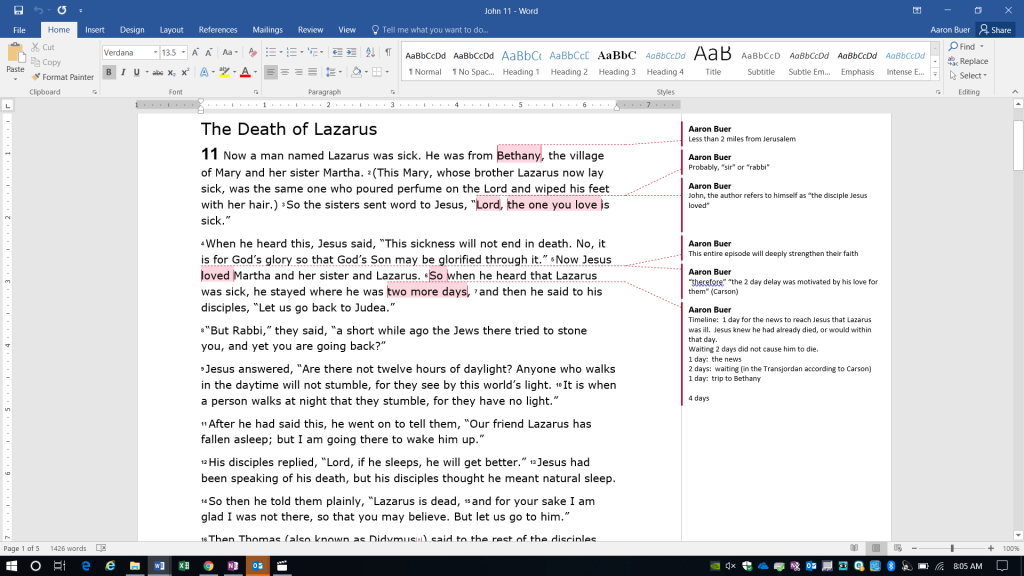
I copy the passage I am studying from Bible Gateway and use comments in Microsoft Word to track all I am learning from commentaries and other resources.
Now, the greatest enemy to the research phase is distraction.
There is this notion out there called “multi-tasking.”
Personally, I don’t believe in it.
Whatever it is that you are responsible to create in your role - curriculum, a meaningful worship experience, a sermon, training...whatever it is, it will be so much better if you put away your phone and turn off your email and focus.
If you want to give this a try, schedule a 1 ½ hour block during your most productive time and focus.
Then, take a 15 minute break and focus for another 1 ½ hour block...and then move on to other tasks for the day.
In my experience, 3 hours of concentrated focus structured in this way, without distraction is more productive than 6 hours of distracted time where I’m checking my phone and watching emails come into my inbox.
So, whatever it is that you create...I would suggest that you make your process mundane because repetition helps with efficiency and mastery.
And, if you want to go next-level, remove distractions.
2. White Space
Alright, the next phase of my creative process is white space.
And truthfully, white space is important from beginning to end.
And what, you might be thinking, is white space?
White space is intentional time in which I am quiet and unfocused. There is no itinerary or agenda.
It is just scheduled time for my brain to go wherever it wants to go.

Some examples of white space:
- • Going for a walk • Driving • The shower
You see, there is a reason that all your good ideas come to you in the shower.
It’s because it is white space.
Your brain has amazing creative potential but it needs to be freed to unleash that creative potential.
It might sound crazy, but even when the pressure is on and deadlines are looming, I try to build time into my schedule for white space and without fail, it is during these times that the most important and creative ideas pop into my head.
Quite literally, white space provides the content that moves a sermon from a B- to an A-.
The point I’m trying to make is that white space is essential to any creative process.
If you want to improve your creative output, I would schedule white space into your day, every day.
It doesn’t have to be long, it can be as short as a 15 minute walk after lunch or choosing to drive to and from work without music or podcasts.
I’m telling you, it is worth the investment of time.
3. Collaboration
We may be different in this regard, but I am not a mad scientist type that hides away in my secret lab and comes up with amazing content all on my own.
I am actually more of an assimilator and less of a creator.
What I mean is that I steal good ideas from everywhere and assimilate them into a content that has my own design, spin and flair.
Most of the time, this assimilation process happens through collaboration with other people.
Here’s how collaboration works in my world.
When I am preaching a sermon, I always connect with a good friend of mine who serves as an unofficial preaching coach for me.

We meet up after work at a local restaurant and I share what I’ve pulled together through research and creative thinking.
As I talk through ideas, crafted language and details that interest me, he often gets excited and says,
“What if...”
...and then launches into an idea for the sermon.
Sometimes these ideas are crazy and unworkable but other times they are brilliant.
I have yet to preach a sermon that has not included a few of his brilliant ideas.
Here’s something else that happens in these conversations.
Sometimes as I talk through an idea I have for a specific point or illustration, I see a total lack of connection in my friend’s face and then he says, “Yeah...that isn’t grabbing me.”
Then, I know that my idea is either terrible or needs some serious refinement.
Over the course of the development of a sermon, I usually meet with my friend several times and each meeting yields a few gems.
Of course, multiple collaborative conversations require that I begin my research a month or more out from the date a sermon is due to be preached.
What I am getting at here is one of my core beliefs as a creative person.
What we create together will always be better than what I create alone.
It’s called collaboration.
The beauty of collaboration is that if you do it well, it always leads to a better product - whatever that product is for you.
The downside of collaboration is that it seriously slows down the process and it can be painful.
Why painful?
Sometimes, as the writer Stephen King says, you have to “Kill your darlings.”
By this he means ideas that you love that will not help the final product.
Collaboration often helps reveal what is not essential, confusing or unhelpful - what darlings you need to kill.
Collaboration. I love you and I hate you.
At the end of the day if you are interested in creating amazing content, I highly recommend finding a few people who you trust, who can collaborate with you because what we create together will always be better than what I create alone.
4. Refinement
The next step in the process for me is refinement. It’s time to take this creative product - in my case a sermon, and boil it down to what is absolutely essential.
My process for doing this is twofold.
I write and rewrite my notes and I practice out loud.
Let’s start with my notes.
Here, I take my research notes and use them to create a sermon outline and then over the course of several weeks I write and rewrite these notes.
By the end of the process, I often have five or six iterations.
Each is an improvement on the last...at least I hope that it is.
Side note - if you’re wondering, sometimes this requires that I have several sets of notes going at the same time for several different sermons that are in process.
Here is an image that shows what I’m talking about.
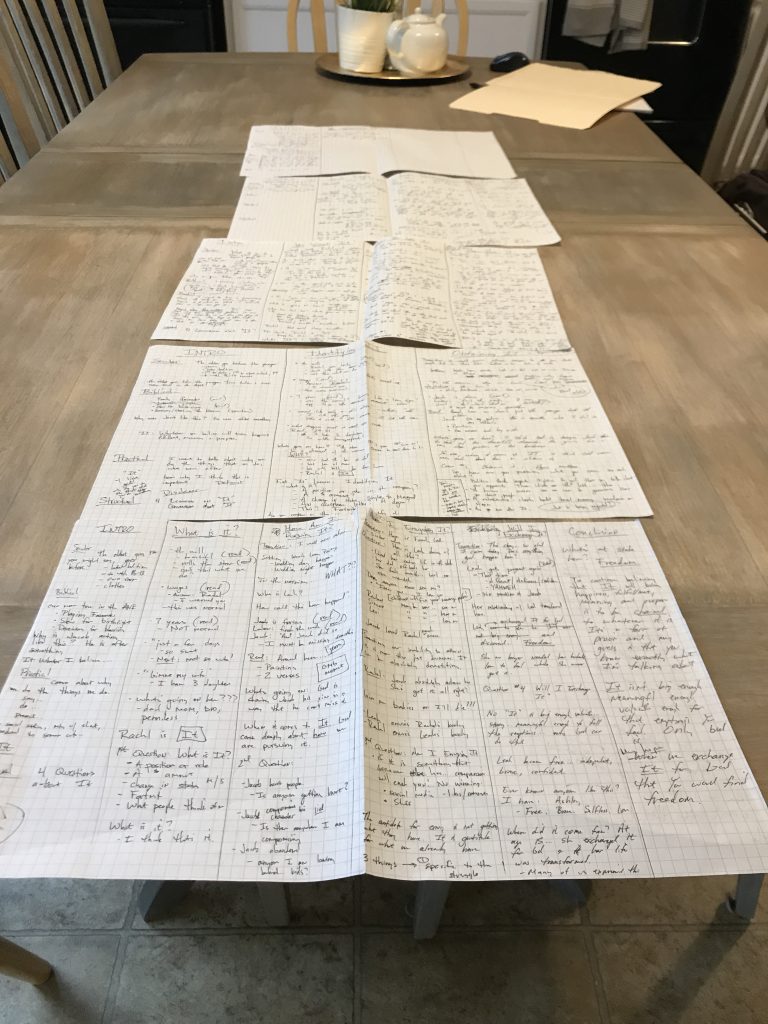
First off, yes I’m weird.
I use huge graph paper and I look very odd at the coffee shops I use for study.
But something else that is important here...I always use the exact same paper, same outline format, same sermon structure, same pen...same, same, same!
Personally, I believe there is wisdom in using the same structure repeatedly because it leads to efficiency, speed and expertise. It’s called refinement.
My model might not be the best out there but I know exactly what it is that I’m doing and why I do it.
I’m becoming a master craftsman in the way that I approach creating content.
My suggestion would be for you to choose your exact form and structure and stick with your process so that you can fully capitalize on the process of refinement.
The second aspect of refinement in my process is verbal practice.
Here’s my schedule the week of preaching.
Monday:
- 1. Rewrite my notes in the morning. 2. Write up an outline for our devotional writing team in the afternoon.
Tuesday:
- 1. Talk through my sermon with our devotional writing team. 2. Talk through slides and visual with our creative department.
Wednesday:
- 1. In the morning: Go for a walk and practice the sermon out loud...looking like a crazy person to anyone else on that trail. 2. In the afternoon: Practice the sermon in the auditorium with slides, mic'd up and everything with only my preaching coach and the devotional writing team in the audience.
Thursday:
- 1. In the morning, go for a walk and talk through the sermon. 2. In the afternoon, refine the slides and visuals.
Friday:
- 1. On the way to and from my men’s group, talk through the sermon as I drive.
Saturday:
- 1. Go for a walk and practice the sermon out loud. 2. Go to one of our campuses and practice the sermon as if I am delivering it in an empty room. 3. Practice the sermon as I drive to the campus where I will preach live. 4. Talk through the slides transitions with the person operating ProPresenter. 5. Preach the sermon live.
Sunday:
- 1. Preach the sermon. 2. Preach the sermon again. 3. Take a nap.
Ok, that was a lot.
The point I’m trying to make is that I practice and I practice a lot and I use this process to refine the content.
By the time I actually preach the sermon to the congregation, I know the content inside and out and have (hopefully) refined the final product to what is absolutely essential and crystal clear.
Now, you don’t have to practice 900 times like me. But I would suggest developing a rhythm of refinement for whatever it is that you are creating.
One thing that is for sure: Your 10th attempt will always be far better than your 1st attempt.
5. Reflective Reps
Alright, one last idea to share here.
It’s what Scott Cormode from Fuller Seminary (check out his stuff online!) calls reflective reps.
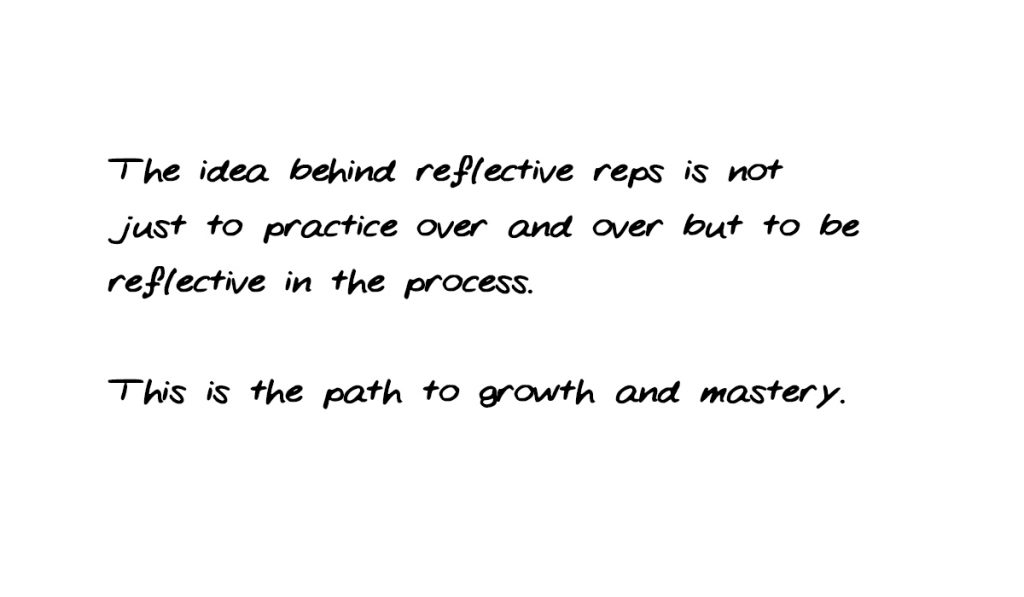
The idea behind reflective reps is not just to do something over and over and over again so that you can get better at it, but rather to do something once, listen to feedback, make adjustments and do that same thing again, listen to feedback, make adjustments, and do that same thing again.
You see the difference.
You see, practice doesn’t make perfect. Practice makes habit.
Practice with feedback and adjustments makes perfect.
Here’s how this works for me.
After practicing my sermon on Wednesday afternoon, I listen to feedback from a few trustworthy sources and make adjustments.
Then after our Saturday night service, I listen to feedback from a few trusted sources and make adjustments.
After preaching Sunday morning I listen to feedback and watch myself on video and make adjustments for the next time I preach.
So, if you are interested in creating amazing content, take the long view and find a way to practice reflective reps.
Find a few people who are ahead of you in whatever skill you are developing and invite them to critique your work.
Yes, it is vulnerable and at times painful but it is the path the growth and mastery.
Sign Up for Product Updates

Tithely provides the tools you need to engage with your church online, stay connected, increase generosity, and simplify the lives of your staff.
With tools like text and email messaging, custom church apps and websites, church management software, digital giving, and so much more… it’s no wonder why over 53,000 churches in 50 countries trust Tithely to help run their church.
One of the most common comments I hear after preaching is,
“How do you preach a 40 minute sermon without notes?”
People tend to be dumbfounded that I, and others who preach at our church, can do this.
The honest truth is that I think anyone could because it has to do with the creative process that I choose.
My creative process is both simple and complicated.
It’s simple because I do the exact same thing every time that I preach and yet it is complicated because it’s a long, multi-step process.
I decided to share the process in this post.
Now, you may or may not preach or teach in your role. Also, if you do, preaching without notes might be a good or terrible idea.
I’m less interested in a conversation about that and more interested in a conversation about creative process.
I would love to help you create amazing content - whatever that content is for you.
Anyway, here’s how I preach without notes.
1. Focused Research
The first step in my process is to start my research as far out as possible.
I want to start research at least a month before I preach and I would prefer to start much earlier.
A couple keys to my research process:
- 1. I always go to the same library 2. I always study at the same coffee shops 3. I always study at the same time 4. I always take notes the exact same way 5. I always study without distraction
Why am I so boring? Because repetition is the pathway to efficiency and mastery.
If you’re curious, my research always starts with an online search of the best commentaries.
I don’t have a huge personal library of resources so I use a local university library.
My most recent sermon was on John 11 so, here is the site I used...
My process is to screen shot this list, go to the library and pick only three to four commentaries.
My go-to series are Tyndale and the NIV Application Commentary Series.
I only choose 3-4 because I have to draw a line between exhaustive research and actually being ready to preach a sermon.
Occasionally, I’ll pull in another resource if the text is complex or confusing.
In this sermon, I pulled in Encounters with Jesus, mostly because I’d like to be Tim Keller when I grow up.
Back to my mundane process.
I always study at the same place, at the same time and structure my notes in exactly the same way because I’m trying to maximize as much creative capacity as possible.
It might sound strange but taking the decision of when and where to study off the table saves mental capacity.
Also, matching creative thinking time with my most productive time of the day is huge.
For me, this is the morning. I completely block out my schedule in the mornings.
Monday, Wednesday and Thursday mornings are sacred and no one can schedule a meeting with me during these times because they are my most productive thinking times and they are reserved for the creative work that I am called to do.
Also, I study at the same place and structure my notes in exactly the same way because, again, I believe that repetition leads to greater efficiency and mastery.
If you’re wondering, my initial notes always look like this:
I copy the passage I am studying from Bible Gateway and use comments in Microsoft Word to track all I am learning from commentaries and other resources.
Now, the greatest enemy to the research phase is distraction.
There is this notion out there called “multi-tasking.”
Personally, I don’t believe in it.
Whatever it is that you are responsible to create in your role - curriculum, a meaningful worship experience, a sermon, training...whatever it is, it will be so much better if you put away your phone and turn off your email and focus.
If you want to give this a try, schedule a 1 ½ hour block during your most productive time and focus.
Then, take a 15 minute break and focus for another 1 ½ hour block...and then move on to other tasks for the day.
In my experience, 3 hours of concentrated focus structured in this way, without distraction is more productive than 6 hours of distracted time where I’m checking my phone and watching emails come into my inbox.
So, whatever it is that you create...I would suggest that you make your process mundane because repetition helps with efficiency and mastery.
And, if you want to go next-level, remove distractions.
2. White Space
Alright, the next phase of my creative process is white space.
And truthfully, white space is important from beginning to end.
And what, you might be thinking, is white space?
White space is intentional time in which I am quiet and unfocused. There is no itinerary or agenda.
It is just scheduled time for my brain to go wherever it wants to go.
Some examples of white space:
- • Going for a walk • Driving • The shower
You see, there is a reason that all your good ideas come to you in the shower.
It’s because it is white space.
Your brain has amazing creative potential but it needs to be freed to unleash that creative potential.
It might sound crazy, but even when the pressure is on and deadlines are looming, I try to build time into my schedule for white space and without fail, it is during these times that the most important and creative ideas pop into my head.
Quite literally, white space provides the content that moves a sermon from a B- to an A-.
The point I’m trying to make is that white space is essential to any creative process.
If you want to improve your creative output, I would schedule white space into your day, every day.
It doesn’t have to be long, it can be as short as a 15 minute walk after lunch or choosing to drive to and from work without music or podcasts.
I’m telling you, it is worth the investment of time.
3. Collaboration
We may be different in this regard, but I am not a mad scientist type that hides away in my secret lab and comes up with amazing content all on my own.
I am actually more of an assimilator and less of a creator.
What I mean is that I steal good ideas from everywhere and assimilate them into a content that has my own design, spin and flair.
Most of the time, this assimilation process happens through collaboration with other people.
Here’s how collaboration works in my world.
When I am preaching a sermon, I always connect with a good friend of mine who serves as an unofficial preaching coach for me.
We meet up after work at a local restaurant and I share what I’ve pulled together through research and creative thinking.
As I talk through ideas, crafted language and details that interest me, he often gets excited and says,
“What if...”
...and then launches into an idea for the sermon.
Sometimes these ideas are crazy and unworkable but other times they are brilliant.
I have yet to preach a sermon that has not included a few of his brilliant ideas.
Here’s something else that happens in these conversations.
Sometimes as I talk through an idea I have for a specific point or illustration, I see a total lack of connection in my friend’s face and then he says, “Yeah...that isn’t grabbing me.”
Then, I know that my idea is either terrible or needs some serious refinement.
Over the course of the development of a sermon, I usually meet with my friend several times and each meeting yields a few gems.
Of course, multiple collaborative conversations require that I begin my research a month or more out from the date a sermon is due to be preached.
What I am getting at here is one of my core beliefs as a creative person.
What we create together will always be better than what I create alone.
It’s called collaboration.
The beauty of collaboration is that if you do it well, it always leads to a better product - whatever that product is for you.
The downside of collaboration is that it seriously slows down the process and it can be painful.
Why painful?
Sometimes, as the writer Stephen King says, you have to “Kill your darlings.”
By this he means ideas that you love that will not help the final product.
Collaboration often helps reveal what is not essential, confusing or unhelpful - what darlings you need to kill.
Collaboration. I love you and I hate you.
At the end of the day if you are interested in creating amazing content, I highly recommend finding a few people who you trust, who can collaborate with you because what we create together will always be better than what I create alone.
4. Refinement
The next step in the process for me is refinement. It’s time to take this creative product - in my case a sermon, and boil it down to what is absolutely essential.
My process for doing this is twofold.
I write and rewrite my notes and I practice out loud.
Let’s start with my notes.
Here, I take my research notes and use them to create a sermon outline and then over the course of several weeks I write and rewrite these notes.
By the end of the process, I often have five or six iterations.
Each is an improvement on the last...at least I hope that it is.
Side note - if you’re wondering, sometimes this requires that I have several sets of notes going at the same time for several different sermons that are in process.
Here is an image that shows what I’m talking about.
First off, yes I’m weird.
I use huge graph paper and I look very odd at the coffee shops I use for study.
But something else that is important here...I always use the exact same paper, same outline format, same sermon structure, same pen...same, same, same!
Personally, I believe there is wisdom in using the same structure repeatedly because it leads to efficiency, speed and expertise. It’s called refinement.
My model might not be the best out there but I know exactly what it is that I’m doing and why I do it.
I’m becoming a master craftsman in the way that I approach creating content.
My suggestion would be for you to choose your exact form and structure and stick with your process so that you can fully capitalize on the process of refinement.
The second aspect of refinement in my process is verbal practice.
Here’s my schedule the week of preaching.
Monday:
- 1. Rewrite my notes in the morning. 2. Write up an outline for our devotional writing team in the afternoon.
Tuesday:
- 1. Talk through my sermon with our devotional writing team. 2. Talk through slides and visual with our creative department.
Wednesday:
- 1. In the morning: Go for a walk and practice the sermon out loud...looking like a crazy person to anyone else on that trail. 2. In the afternoon: Practice the sermon in the auditorium with slides, mic'd up and everything with only my preaching coach and the devotional writing team in the audience.
Thursday:
- 1. In the morning, go for a walk and talk through the sermon. 2. In the afternoon, refine the slides and visuals.
Friday:
- 1. On the way to and from my men’s group, talk through the sermon as I drive.
Saturday:
- 1. Go for a walk and practice the sermon out loud. 2. Go to one of our campuses and practice the sermon as if I am delivering it in an empty room. 3. Practice the sermon as I drive to the campus where I will preach live. 4. Talk through the slides transitions with the person operating ProPresenter. 5. Preach the sermon live.
Sunday:
- 1. Preach the sermon. 2. Preach the sermon again. 3. Take a nap.
Ok, that was a lot.
The point I’m trying to make is that I practice and I practice a lot and I use this process to refine the content.
By the time I actually preach the sermon to the congregation, I know the content inside and out and have (hopefully) refined the final product to what is absolutely essential and crystal clear.
Now, you don’t have to practice 900 times like me. But I would suggest developing a rhythm of refinement for whatever it is that you are creating.
One thing that is for sure: Your 10th attempt will always be far better than your 1st attempt.
5. Reflective Reps
Alright, one last idea to share here.
It’s what Scott Cormode from Fuller Seminary (check out his stuff online!) calls reflective reps.
The idea behind reflective reps is not just to do something over and over and over again so that you can get better at it, but rather to do something once, listen to feedback, make adjustments and do that same thing again, listen to feedback, make adjustments, and do that same thing again.
You see the difference.
You see, practice doesn’t make perfect. Practice makes habit.
Practice with feedback and adjustments makes perfect.
Here’s how this works for me.
After practicing my sermon on Wednesday afternoon, I listen to feedback from a few trustworthy sources and make adjustments.
Then after our Saturday night service, I listen to feedback from a few trusted sources and make adjustments.
After preaching Sunday morning I listen to feedback and watch myself on video and make adjustments for the next time I preach.
So, if you are interested in creating amazing content, take the long view and find a way to practice reflective reps.
Find a few people who are ahead of you in whatever skill you are developing and invite them to critique your work.
Yes, it is vulnerable and at times painful but it is the path the growth and mastery.
podcast transcript
Tithely provides the tools you need to engage with your church online, stay connected, increase generosity, and simplify the lives of your staff.
With tools like text and email messaging, custom church apps and websites, church management software, digital giving, and so much more… it’s no wonder why over 53,000 churches in 50 countries trust Tithely to help run their church.
One of the most common comments I hear after preaching is,
“How do you preach a 40 minute sermon without notes?”
People tend to be dumbfounded that I, and others who preach at our church, can do this.
The honest truth is that I think anyone could because it has to do with the creative process that I choose.
My creative process is both simple and complicated.
It’s simple because I do the exact same thing every time that I preach and yet it is complicated because it’s a long, multi-step process.
I decided to share the process in this post.
Now, you may or may not preach or teach in your role. Also, if you do, preaching without notes might be a good or terrible idea.
I’m less interested in a conversation about that and more interested in a conversation about creative process.
I would love to help you create amazing content - whatever that content is for you.
Anyway, here’s how I preach without notes.
1. Focused Research
The first step in my process is to start my research as far out as possible.
I want to start research at least a month before I preach and I would prefer to start much earlier.
A couple keys to my research process:
- 1. I always go to the same library 2. I always study at the same coffee shops 3. I always study at the same time 4. I always take notes the exact same way 5. I always study without distraction
Why am I so boring? Because repetition is the pathway to efficiency and mastery.
If you’re curious, my research always starts with an online search of the best commentaries.
I don’t have a huge personal library of resources so I use a local university library.
My most recent sermon was on John 11 so, here is the site I used...
My process is to screen shot this list, go to the library and pick only three to four commentaries.
My go-to series are Tyndale and the NIV Application Commentary Series.
I only choose 3-4 because I have to draw a line between exhaustive research and actually being ready to preach a sermon.
Occasionally, I’ll pull in another resource if the text is complex or confusing.
In this sermon, I pulled in Encounters with Jesus, mostly because I’d like to be Tim Keller when I grow up.
Back to my mundane process.
I always study at the same place, at the same time and structure my notes in exactly the same way because I’m trying to maximize as much creative capacity as possible.
It might sound strange but taking the decision of when and where to study off the table saves mental capacity.
Also, matching creative thinking time with my most productive time of the day is huge.
For me, this is the morning. I completely block out my schedule in the mornings.
Monday, Wednesday and Thursday mornings are sacred and no one can schedule a meeting with me during these times because they are my most productive thinking times and they are reserved for the creative work that I am called to do.
Also, I study at the same place and structure my notes in exactly the same way because, again, I believe that repetition leads to greater efficiency and mastery.
If you’re wondering, my initial notes always look like this:
I copy the passage I am studying from Bible Gateway and use comments in Microsoft Word to track all I am learning from commentaries and other resources.
Now, the greatest enemy to the research phase is distraction.
There is this notion out there called “multi-tasking.”
Personally, I don’t believe in it.
Whatever it is that you are responsible to create in your role - curriculum, a meaningful worship experience, a sermon, training...whatever it is, it will be so much better if you put away your phone and turn off your email and focus.
If you want to give this a try, schedule a 1 ½ hour block during your most productive time and focus.
Then, take a 15 minute break and focus for another 1 ½ hour block...and then move on to other tasks for the day.
In my experience, 3 hours of concentrated focus structured in this way, without distraction is more productive than 6 hours of distracted time where I’m checking my phone and watching emails come into my inbox.
So, whatever it is that you create...I would suggest that you make your process mundane because repetition helps with efficiency and mastery.
And, if you want to go next-level, remove distractions.
2. White Space
Alright, the next phase of my creative process is white space.
And truthfully, white space is important from beginning to end.
And what, you might be thinking, is white space?
White space is intentional time in which I am quiet and unfocused. There is no itinerary or agenda.
It is just scheduled time for my brain to go wherever it wants to go.
Some examples of white space:
- • Going for a walk • Driving • The shower
You see, there is a reason that all your good ideas come to you in the shower.
It’s because it is white space.
Your brain has amazing creative potential but it needs to be freed to unleash that creative potential.
It might sound crazy, but even when the pressure is on and deadlines are looming, I try to build time into my schedule for white space and without fail, it is during these times that the most important and creative ideas pop into my head.
Quite literally, white space provides the content that moves a sermon from a B- to an A-.
The point I’m trying to make is that white space is essential to any creative process.
If you want to improve your creative output, I would schedule white space into your day, every day.
It doesn’t have to be long, it can be as short as a 15 minute walk after lunch or choosing to drive to and from work without music or podcasts.
I’m telling you, it is worth the investment of time.
3. Collaboration
We may be different in this regard, but I am not a mad scientist type that hides away in my secret lab and comes up with amazing content all on my own.
I am actually more of an assimilator and less of a creator.
What I mean is that I steal good ideas from everywhere and assimilate them into a content that has my own design, spin and flair.
Most of the time, this assimilation process happens through collaboration with other people.
Here’s how collaboration works in my world.
When I am preaching a sermon, I always connect with a good friend of mine who serves as an unofficial preaching coach for me.
We meet up after work at a local restaurant and I share what I’ve pulled together through research and creative thinking.
As I talk through ideas, crafted language and details that interest me, he often gets excited and says,
“What if...”
...and then launches into an idea for the sermon.
Sometimes these ideas are crazy and unworkable but other times they are brilliant.
I have yet to preach a sermon that has not included a few of his brilliant ideas.
Here’s something else that happens in these conversations.
Sometimes as I talk through an idea I have for a specific point or illustration, I see a total lack of connection in my friend’s face and then he says, “Yeah...that isn’t grabbing me.”
Then, I know that my idea is either terrible or needs some serious refinement.
Over the course of the development of a sermon, I usually meet with my friend several times and each meeting yields a few gems.
Of course, multiple collaborative conversations require that I begin my research a month or more out from the date a sermon is due to be preached.
What I am getting at here is one of my core beliefs as a creative person.
What we create together will always be better than what I create alone.
It’s called collaboration.
The beauty of collaboration is that if you do it well, it always leads to a better product - whatever that product is for you.
The downside of collaboration is that it seriously slows down the process and it can be painful.
Why painful?
Sometimes, as the writer Stephen King says, you have to “Kill your darlings.”
By this he means ideas that you love that will not help the final product.
Collaboration often helps reveal what is not essential, confusing or unhelpful - what darlings you need to kill.
Collaboration. I love you and I hate you.
At the end of the day if you are interested in creating amazing content, I highly recommend finding a few people who you trust, who can collaborate with you because what we create together will always be better than what I create alone.
4. Refinement
The next step in the process for me is refinement. It’s time to take this creative product - in my case a sermon, and boil it down to what is absolutely essential.
My process for doing this is twofold.
I write and rewrite my notes and I practice out loud.
Let’s start with my notes.
Here, I take my research notes and use them to create a sermon outline and then over the course of several weeks I write and rewrite these notes.
By the end of the process, I often have five or six iterations.
Each is an improvement on the last...at least I hope that it is.
Side note - if you’re wondering, sometimes this requires that I have several sets of notes going at the same time for several different sermons that are in process.
Here is an image that shows what I’m talking about.
First off, yes I’m weird.
I use huge graph paper and I look very odd at the coffee shops I use for study.
But something else that is important here...I always use the exact same paper, same outline format, same sermon structure, same pen...same, same, same!
Personally, I believe there is wisdom in using the same structure repeatedly because it leads to efficiency, speed and expertise. It’s called refinement.
My model might not be the best out there but I know exactly what it is that I’m doing and why I do it.
I’m becoming a master craftsman in the way that I approach creating content.
My suggestion would be for you to choose your exact form and structure and stick with your process so that you can fully capitalize on the process of refinement.
The second aspect of refinement in my process is verbal practice.
Here’s my schedule the week of preaching.
Monday:
- 1. Rewrite my notes in the morning. 2. Write up an outline for our devotional writing team in the afternoon.
Tuesday:
- 1. Talk through my sermon with our devotional writing team. 2. Talk through slides and visual with our creative department.
Wednesday:
- 1. In the morning: Go for a walk and practice the sermon out loud...looking like a crazy person to anyone else on that trail. 2. In the afternoon: Practice the sermon in the auditorium with slides, mic'd up and everything with only my preaching coach and the devotional writing team in the audience.
Thursday:
- 1. In the morning, go for a walk and talk through the sermon. 2. In the afternoon, refine the slides and visuals.
Friday:
- 1. On the way to and from my men’s group, talk through the sermon as I drive.
Saturday:
- 1. Go for a walk and practice the sermon out loud. 2. Go to one of our campuses and practice the sermon as if I am delivering it in an empty room. 3. Practice the sermon as I drive to the campus where I will preach live. 4. Talk through the slides transitions with the person operating ProPresenter. 5. Preach the sermon live.
Sunday:
- 1. Preach the sermon. 2. Preach the sermon again. 3. Take a nap.
Ok, that was a lot.
The point I’m trying to make is that I practice and I practice a lot and I use this process to refine the content.
By the time I actually preach the sermon to the congregation, I know the content inside and out and have (hopefully) refined the final product to what is absolutely essential and crystal clear.
Now, you don’t have to practice 900 times like me. But I would suggest developing a rhythm of refinement for whatever it is that you are creating.
One thing that is for sure: Your 10th attempt will always be far better than your 1st attempt.
5. Reflective Reps
Alright, one last idea to share here.
It’s what Scott Cormode from Fuller Seminary (check out his stuff online!) calls reflective reps.
The idea behind reflective reps is not just to do something over and over and over again so that you can get better at it, but rather to do something once, listen to feedback, make adjustments and do that same thing again, listen to feedback, make adjustments, and do that same thing again.
You see the difference.
You see, practice doesn’t make perfect. Practice makes habit.
Practice with feedback and adjustments makes perfect.
Here’s how this works for me.
After practicing my sermon on Wednesday afternoon, I listen to feedback from a few trustworthy sources and make adjustments.
Then after our Saturday night service, I listen to feedback from a few trusted sources and make adjustments.
After preaching Sunday morning I listen to feedback and watch myself on video and make adjustments for the next time I preach.
So, if you are interested in creating amazing content, take the long view and find a way to practice reflective reps.
Find a few people who are ahead of you in whatever skill you are developing and invite them to critique your work.
Yes, it is vulnerable and at times painful but it is the path the growth and mastery.
VIDEO transcript
One of the most common comments I hear after preaching is,
“How do you preach a 40 minute sermon without notes?”
People tend to be dumbfounded that I, and others who preach at our church, can do this.
The honest truth is that I think anyone could because it has to do with the creative process that I choose.
My creative process is both simple and complicated.
It’s simple because I do the exact same thing every time that I preach and yet it is complicated because it’s a long, multi-step process.
I decided to share the process in this post.
Now, you may or may not preach or teach in your role. Also, if you do, preaching without notes might be a good or terrible idea.
I’m less interested in a conversation about that and more interested in a conversation about creative process.
I would love to help you create amazing content - whatever that content is for you.
Anyway, here’s how I preach without notes.
1. Focused Research
The first step in my process is to start my research as far out as possible.
I want to start research at least a month before I preach and I would prefer to start much earlier.
A couple keys to my research process:
- 1. I always go to the same library 2. I always study at the same coffee shops 3. I always study at the same time 4. I always take notes the exact same way 5. I always study without distraction
Why am I so boring? Because repetition is the pathway to efficiency and mastery.
If you’re curious, my research always starts with an online search of the best commentaries.
I don’t have a huge personal library of resources so I use a local university library.
My most recent sermon was on John 11 so, here is the site I used...
My process is to screen shot this list, go to the library and pick only three to four commentaries.
My go-to series are Tyndale and the NIV Application Commentary Series.
I only choose 3-4 because I have to draw a line between exhaustive research and actually being ready to preach a sermon.
Occasionally, I’ll pull in another resource if the text is complex or confusing.
In this sermon, I pulled in Encounters with Jesus, mostly because I’d like to be Tim Keller when I grow up.
Back to my mundane process.
I always study at the same place, at the same time and structure my notes in exactly the same way because I’m trying to maximize as much creative capacity as possible.
It might sound strange but taking the decision of when and where to study off the table saves mental capacity.
Also, matching creative thinking time with my most productive time of the day is huge.
For me, this is the morning. I completely block out my schedule in the mornings.
Monday, Wednesday and Thursday mornings are sacred and no one can schedule a meeting with me during these times because they are my most productive thinking times and they are reserved for the creative work that I am called to do.
Also, I study at the same place and structure my notes in exactly the same way because, again, I believe that repetition leads to greater efficiency and mastery.
If you’re wondering, my initial notes always look like this:
I copy the passage I am studying from Bible Gateway and use comments in Microsoft Word to track all I am learning from commentaries and other resources.
Now, the greatest enemy to the research phase is distraction.
There is this notion out there called “multi-tasking.”
Personally, I don’t believe in it.
Whatever it is that you are responsible to create in your role - curriculum, a meaningful worship experience, a sermon, training...whatever it is, it will be so much better if you put away your phone and turn off your email and focus.
If you want to give this a try, schedule a 1 ½ hour block during your most productive time and focus.
Then, take a 15 minute break and focus for another 1 ½ hour block...and then move on to other tasks for the day.
In my experience, 3 hours of concentrated focus structured in this way, without distraction is more productive than 6 hours of distracted time where I’m checking my phone and watching emails come into my inbox.
So, whatever it is that you create...I would suggest that you make your process mundane because repetition helps with efficiency and mastery.
And, if you want to go next-level, remove distractions.
2. White Space
Alright, the next phase of my creative process is white space.
And truthfully, white space is important from beginning to end.
And what, you might be thinking, is white space?
White space is intentional time in which I am quiet and unfocused. There is no itinerary or agenda.
It is just scheduled time for my brain to go wherever it wants to go.
Some examples of white space:
- • Going for a walk • Driving • The shower
You see, there is a reason that all your good ideas come to you in the shower.
It’s because it is white space.
Your brain has amazing creative potential but it needs to be freed to unleash that creative potential.
It might sound crazy, but even when the pressure is on and deadlines are looming, I try to build time into my schedule for white space and without fail, it is during these times that the most important and creative ideas pop into my head.
Quite literally, white space provides the content that moves a sermon from a B- to an A-.
The point I’m trying to make is that white space is essential to any creative process.
If you want to improve your creative output, I would schedule white space into your day, every day.
It doesn’t have to be long, it can be as short as a 15 minute walk after lunch or choosing to drive to and from work without music or podcasts.
I’m telling you, it is worth the investment of time.
3. Collaboration
We may be different in this regard, but I am not a mad scientist type that hides away in my secret lab and comes up with amazing content all on my own.
I am actually more of an assimilator and less of a creator.
What I mean is that I steal good ideas from everywhere and assimilate them into a content that has my own design, spin and flair.
Most of the time, this assimilation process happens through collaboration with other people.
Here’s how collaboration works in my world.
When I am preaching a sermon, I always connect with a good friend of mine who serves as an unofficial preaching coach for me.
We meet up after work at a local restaurant and I share what I’ve pulled together through research and creative thinking.
As I talk through ideas, crafted language and details that interest me, he often gets excited and says,
“What if...”
...and then launches into an idea for the sermon.
Sometimes these ideas are crazy and unworkable but other times they are brilliant.
I have yet to preach a sermon that has not included a few of his brilliant ideas.
Here’s something else that happens in these conversations.
Sometimes as I talk through an idea I have for a specific point or illustration, I see a total lack of connection in my friend’s face and then he says, “Yeah...that isn’t grabbing me.”
Then, I know that my idea is either terrible or needs some serious refinement.
Over the course of the development of a sermon, I usually meet with my friend several times and each meeting yields a few gems.
Of course, multiple collaborative conversations require that I begin my research a month or more out from the date a sermon is due to be preached.
What I am getting at here is one of my core beliefs as a creative person.
What we create together will always be better than what I create alone.
It’s called collaboration.
The beauty of collaboration is that if you do it well, it always leads to a better product - whatever that product is for you.
The downside of collaboration is that it seriously slows down the process and it can be painful.
Why painful?
Sometimes, as the writer Stephen King says, you have to “Kill your darlings.”
By this he means ideas that you love that will not help the final product.
Collaboration often helps reveal what is not essential, confusing or unhelpful - what darlings you need to kill.
Collaboration. I love you and I hate you.
At the end of the day if you are interested in creating amazing content, I highly recommend finding a few people who you trust, who can collaborate with you because what we create together will always be better than what I create alone.
4. Refinement
The next step in the process for me is refinement. It’s time to take this creative product - in my case a sermon, and boil it down to what is absolutely essential.
My process for doing this is twofold.
I write and rewrite my notes and I practice out loud.
Let’s start with my notes.
Here, I take my research notes and use them to create a sermon outline and then over the course of several weeks I write and rewrite these notes.
By the end of the process, I often have five or six iterations.
Each is an improvement on the last...at least I hope that it is.
Side note - if you’re wondering, sometimes this requires that I have several sets of notes going at the same time for several different sermons that are in process.
Here is an image that shows what I’m talking about.
First off, yes I’m weird.
I use huge graph paper and I look very odd at the coffee shops I use for study.
But something else that is important here...I always use the exact same paper, same outline format, same sermon structure, same pen...same, same, same!
Personally, I believe there is wisdom in using the same structure repeatedly because it leads to efficiency, speed and expertise. It’s called refinement.
My model might not be the best out there but I know exactly what it is that I’m doing and why I do it.
I’m becoming a master craftsman in the way that I approach creating content.
My suggestion would be for you to choose your exact form and structure and stick with your process so that you can fully capitalize on the process of refinement.
The second aspect of refinement in my process is verbal practice.
Here’s my schedule the week of preaching.
Monday:
- 1. Rewrite my notes in the morning. 2. Write up an outline for our devotional writing team in the afternoon.
Tuesday:
- 1. Talk through my sermon with our devotional writing team. 2. Talk through slides and visual with our creative department.
Wednesday:
- 1. In the morning: Go for a walk and practice the sermon out loud...looking like a crazy person to anyone else on that trail. 2. In the afternoon: Practice the sermon in the auditorium with slides, mic'd up and everything with only my preaching coach and the devotional writing team in the audience.
Thursday:
- 1. In the morning, go for a walk and talk through the sermon. 2. In the afternoon, refine the slides and visuals.
Friday:
- 1. On the way to and from my men’s group, talk through the sermon as I drive.
Saturday:
- 1. Go for a walk and practice the sermon out loud. 2. Go to one of our campuses and practice the sermon as if I am delivering it in an empty room. 3. Practice the sermon as I drive to the campus where I will preach live. 4. Talk through the slides transitions with the person operating ProPresenter. 5. Preach the sermon live.
Sunday:
- 1. Preach the sermon. 2. Preach the sermon again. 3. Take a nap.
Ok, that was a lot.
The point I’m trying to make is that I practice and I practice a lot and I use this process to refine the content.
By the time I actually preach the sermon to the congregation, I know the content inside and out and have (hopefully) refined the final product to what is absolutely essential and crystal clear.
Now, you don’t have to practice 900 times like me. But I would suggest developing a rhythm of refinement for whatever it is that you are creating.
One thing that is for sure: Your 10th attempt will always be far better than your 1st attempt.
5. Reflective Reps
Alright, one last idea to share here.
It’s what Scott Cormode from Fuller Seminary (check out his stuff online!) calls reflective reps.
The idea behind reflective reps is not just to do something over and over and over again so that you can get better at it, but rather to do something once, listen to feedback, make adjustments and do that same thing again, listen to feedback, make adjustments, and do that same thing again.
You see the difference.
You see, practice doesn’t make perfect. Practice makes habit.
Practice with feedback and adjustments makes perfect.
Here’s how this works for me.
After practicing my sermon on Wednesday afternoon, I listen to feedback from a few trustworthy sources and make adjustments.
Then after our Saturday night service, I listen to feedback from a few trusted sources and make adjustments.
After preaching Sunday morning I listen to feedback and watch myself on video and make adjustments for the next time I preach.
So, if you are interested in creating amazing content, take the long view and find a way to practice reflective reps.
Find a few people who are ahead of you in whatever skill you are developing and invite them to critique your work.
Yes, it is vulnerable and at times painful but it is the path the growth and mastery.
Sign Up for Product Updates
Tithely provides the tools you need to engage with your church online, stay connected, increase generosity, and simplify the lives of your staff.
With tools like text and email messaging, custom church apps and websites, church management software, digital giving, and so much more… it’s no wonder why over 53,000 churches in 50 countries trust Tithely to help run their church.

You Might Also Like
More Resources

From increasing giving, managing your congregation, and engaging your church, our collection of resources will keep you up-to-date on the latest church and ministry trends.
Free Resources.jpg)
.jpg)



.jpg)


.jpg)