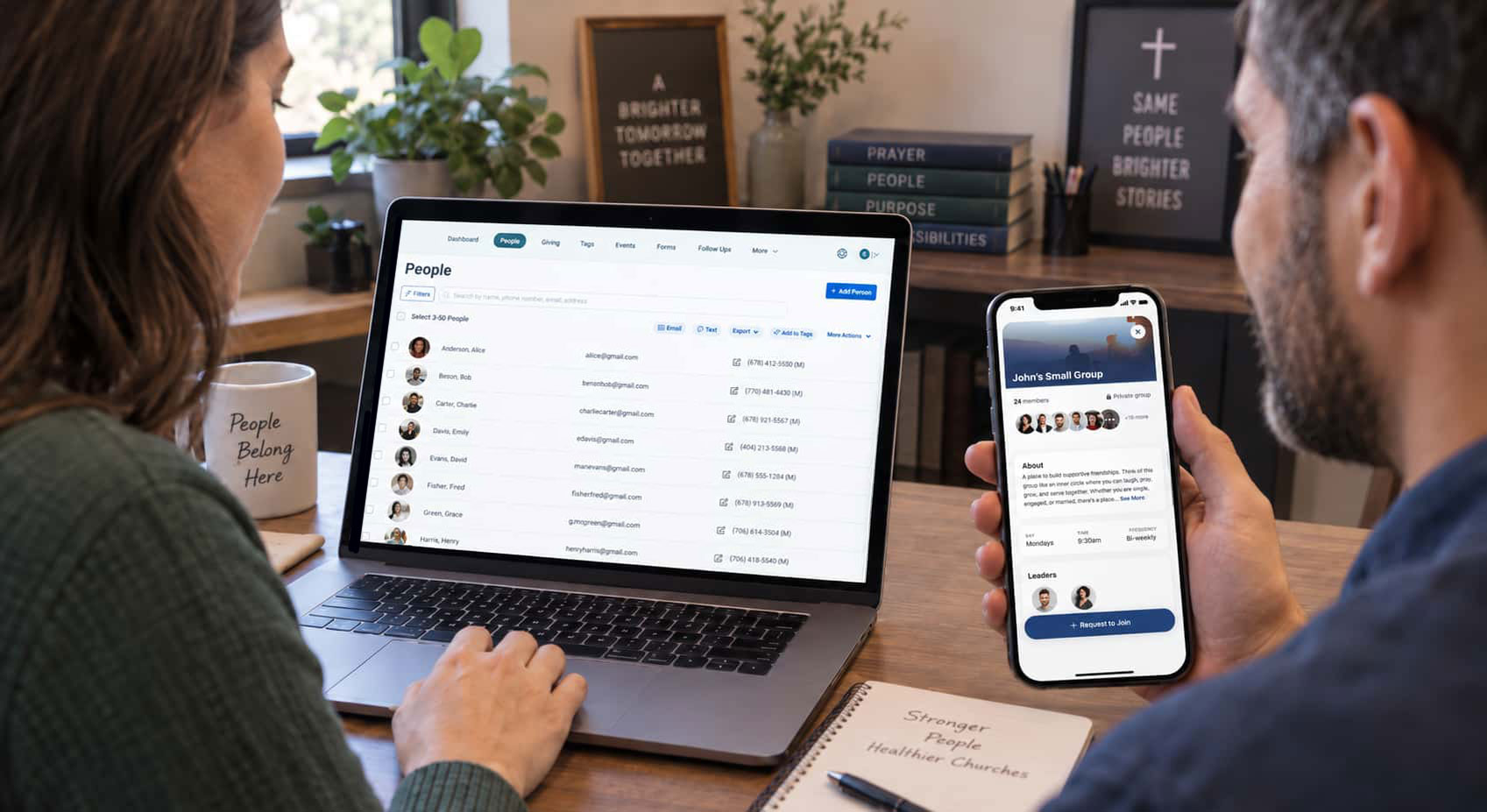
Church Data Management: Unify Giving & People Data
Church data management isn’t about software. It’s about stewardship. When your information is scattered, ministry feels heavier than it should, but when your data works together, you gain the margin to shepherd people—not manage spreadsheets.




Church Data Silos: Why Your Money Is Unified and Your People Aren't
Ask your church what the Dunagan family gave last year and you will have an answer in under a minute. It will be exact. It will be to the dollar, broken out by fund, and defensible in an audit.
Now ask whether the Dunagans still attend.
Somebody will think about it. Somebody else will say they saw them at the Christmas service. A third person will remember that their son aged out of the youth group last spring. Nobody will know, and there is no system in the building that can settle it.
That gap is not a staffing problem or a caring problem. It is a structural one, and it exists in almost every church, including well-run ones.
Your finances are the most organized part of your church
This is worth sitting with, because it is counterintuitive.
Church finance is usually the cleanest data operation in the whole organization. There is one system. It reconciles monthly. A committee reviews it. A CPA touches it once a year. There is a documented chart of accounts, and if you ask which record is authoritative, nobody argues. Every dollar that enters the church gets classified, dated, and stored in a single place that multiple people can read.
Your people data has none of that.
The reason is historical. Money got regulated. It got audited, boarded, and reported on, and that pressure forced churches into unified systems decades ago. People data never faced the same pressure, so it grew the way water flows: into whatever container was nearest at the time.
Where a church actually keeps what it knows
Take an inventory of a typical mid-sized church and you will usually find something like this:
- Giving in the giving platform
- Attendance in a check-in system, or a clipboard, or a headcount someone texts the office
- Small groups in a spreadsheet owned by the groups director
- Serving teams in a scheduling tool the worship pastor picked
- First-time guests in a stack of connection cards, or a form tool, or the connections pastor's inbox
- The directory in whichever system was current three years ago
- Pastoral notes in one person's head, which is the most important database in the church and the least backed up
Each of these is accurate. That is what makes the situation so easy to live with. Nothing is broken. Every individual system is doing its job correctly.
The problem is that none of them know about each other, and everything interesting about a church happens in the space between them.
The questions nobody can answer
Here is a practical test. Try answering these about your own church:
Did the first-time guests from our spring outreach ever give? Guest records are in one place. Giving is in another. Answering this means somebody exports two lists and matches them by hand, which is why nobody has done it.
Which of our regular givers stopped attending before they stopped giving? This one is important and almost nobody can answer it. Giving usually lags disengagement by months, because an auto-recurring gift keeps running long after someone has quietly left. By the time the giving stops, they have been gone since spring.
Are our small group members more generous, or are our generous people more likely to join groups? Genuinely useful for planning, and completely unanswerable when groups live in a spreadsheet.
How many households do we actually have? Giving records say 340. The directory says 512. The check-in system says something else. All three numbers get quoted in different meetings, and no one is wrong, because they are counting different things and nobody has ever reconciled them.
None of these questions need better software. They need two systems that share a spine.
The lapsed giver who is really a lapsed attender
This is the one that matters pastorally, so it is worth slowing down on.
A drop in someone's giving is ambiguous on its own. It could be a job loss. It could be a switch to a different payment method, or a card that expired, or a decision to give to a mission organization directly this year. Reading a giving decline as a spiritual signal is how churches end up making awkward phone calls about money.
A drop in someone's attendance is also ambiguous on its own. People travel. People get sick. People work weekends. A month of absence in the summer means almost nothing.
Put the two together and the ambiguity mostly disappears. Someone who has stopped attending and stopped giving and dropped off their serving rotation, all within about six weeks, is not on vacation. Something happened. It might be a new job or a sick parent or a hurt nobody named out loud, and in all three cases the conversation goes better in week six than in month six.
That signal is not hidden. It is fully present in your church's records right now. It is just split across three systems that cannot see each other, which means the only way anyone notices is if a human being happens to hold all three facts at once, and remembers to put them together.
That is what a unified record does. Not surveillance. Just making sure the pattern reaches somebody while it still matters.
Why your accounting system can't be the source of truth
The natural instinct, once you see the problem, is to reach for the system that is already unified. If the books are the cleanest data in the church, why not run everything through them?
Because accounting software holds money, not people. QuickBooks has no concept of someone who attends twice a month, serves on the parking team, joined a group in February, and gives occasionally. It has a donor name attached to a transaction. That is not a person, that is a line item.
This is not a criticism. It is exactly what accounting software is supposed to do, and it is why QuickBooks remains the right home for most church books. It just means the ledger can never be where your church's understanding of its people lives. If you want the accounting side handled well, the answer is to feed it properly, which is what a good connection between Tithely and QuickBooks Online is for. Our guide to church bookkeeping software covers where accounting tools fit more broadly.
Why a giving platform alone can't either
Worth being equally honest about the other side.
A giving-only tool knows donors. It does not know your congregation. Depending on the church, somewhere between a third and half of the people in the room on a given Sunday are not in the giving records at all: students, kids, spouses whose gift comes from a joint household record, people who give cash, people who are new, people who are struggling.
Build your picture of the church from giving data alone and you will systematically overweight the households who give digitally and lose sight of everyone else. That is a bad map, and it tends to be wrong in the direction that matters most pastorally.
What unified actually means
Not one giant system that does everything. That is a procurement fantasy and it usually ends badly.
What it means is narrower: one record per person, and everything else hangs off it.
The person is the spine. Their attendance, their giving, their group, their serving, their family connections, their first visit, and their most recent contact are all attributes of that one record rather than separate records in separate tools that happen to describe the same human being.
Then the financial output of that record flows onward into accounting, where it becomes a number in the ledger. The chain runs in one direction and it is short:
A person gives → the gift attaches to that person's record → the fund is applied → the transaction posts to the books → leadership sees both the money and the people behind it.
Every step in that chain already happens at your church. The only question is how many of them require somebody to carry information across a gap by hand.
What changes when it's connected
- Follow-up stops depending on who noticed. A three-week absence creates a task instead of a vague feeling.
- The finance committee and the connections pastor work from the same numbers. Household counts stop varying by meeting.
- Generosity gets context. You can see that giving dipped in a quarter when attendance also dipped, which is a very different story from giving dipping on its own.
- Guest follow-up becomes measurable. First visit to second visit to first gift is a path you can actually trace instead of a hope.
- Reporting stops being a merge project. Board and denominational reports pull from one place.
- Turnover stops being a data loss event. The record survives the staff member.
If you are earlier in this and still sorting out the people side, church attendance tracking software is usually where churches start, and our comparison of the best CRM for churches covers how the systems differ.
How to get there without a rip-and-replace
Nobody has to do this all at once, and churches that try usually stall out in month two.
- Inventory where people data currently lives. Every system, every spreadsheet, every inbox. This takes an afternoon and is almost always more sobering than expected.
- Decide which system holds the person. Not which system does the most. Which one owns the identity record that everything else references.
- Consolidate people before you consolidate anything else. Merge duplicates, reconcile the household count, agree on what "active" means. This is the unglamorous part and it is the part that determines whether the rest works.
- Connect giving to the person record. Once people are clean, giving attaches to them rather than sitting alongside them.
- Connect to accounting last. With people and giving unified, the handoff to QuickBooks is a mapping exercise rather than a reconciliation exercise.
- Write down the mapping. Which fund goes to which account, who reviews what, when. The step everyone skips and every new treasurer wishes had happened.
The order matters. Churches that connect accounting first end up with clean books describing a congregation they still can't see.
Frequently asked questions regarding church data silos
What are church data silos?
Church data silos are separate systems that each hold part of the picture of a person without sharing it. Giving lives in one tool, attendance in another, small groups in a spreadsheet, and guest records somewhere else. Each is accurate on its own, but no system can answer a question that spans two of them.
Why does it matter if church giving and attendance are in different systems?
Because the most useful signals require both. Someone who stops attending and stops giving in the same six weeks is a clear signal worth responding to. Either fact alone is ambiguous. When the two live in systems that cannot see each other, the pattern only gets noticed if a person happens to hold both facts at once.
Can QuickBooks be my church's main database?
No. QuickBooks holds financial transactions, not people. It has no concept of attendance, groups, serving, or family relationships, and it is not designed to. It works best as the destination for your financial data rather than the source of truth about your congregation.
Do we need one system that does everything?
Not necessarily. What matters is that one system owns the person record and the others reference it, rather than each system keeping its own separate version of the same human being. Fewer systems usually helps, but the identity spine matters more than the count.
Where should a church start?
Start by inventorying where people data currently lives, then consolidate the people records before connecting anything else. Cleaning up duplicates and agreeing on a household count is unglamorous, and it determines whether every later step works.
The church already knows
Here is the part worth remembering. Almost everything a church needs in order to notice the Delgados is already recorded somewhere in the building. The attendance is captured. The giving is captured. The group they joined and the team they served on are both written down.
The information is not missing. It is just scattered, and scattered information cannot notice anything.
Your books solved this problem a long time ago, because they had to. One system, one record, one version of the truth, reviewed on a schedule. The people side of your church deserves the same thing, and then it deserves to be connected to the money side, so what happens on Sunday and what shows up in the ledger are finally describing the same congregation.
Tithely Church Management keeps giving, attendance, groups, and people on one record, and connects it to the accounting system you already use.
Sign Up for Product Updates

Chris Dunagan is a marketing strategist focused on church tech and digital engagement. He helps churches grow through SEO, email campaigns, and tools like Tithely and Breeze ChMS, with an emphasis on online giving, content strategy, and digital outreach.
Church Data Silos: Why Your Money Is Unified and Your People Aren't
Ask your church what the Dunagan family gave last year and you will have an answer in under a minute. It will be exact. It will be to the dollar, broken out by fund, and defensible in an audit.
Now ask whether the Dunagans still attend.
Somebody will think about it. Somebody else will say they saw them at the Christmas service. A third person will remember that their son aged out of the youth group last spring. Nobody will know, and there is no system in the building that can settle it.
That gap is not a staffing problem or a caring problem. It is a structural one, and it exists in almost every church, including well-run ones.
Your finances are the most organized part of your church
This is worth sitting with, because it is counterintuitive.
Church finance is usually the cleanest data operation in the whole organization. There is one system. It reconciles monthly. A committee reviews it. A CPA touches it once a year. There is a documented chart of accounts, and if you ask which record is authoritative, nobody argues. Every dollar that enters the church gets classified, dated, and stored in a single place that multiple people can read.
Your people data has none of that.
The reason is historical. Money got regulated. It got audited, boarded, and reported on, and that pressure forced churches into unified systems decades ago. People data never faced the same pressure, so it grew the way water flows: into whatever container was nearest at the time.
Where a church actually keeps what it knows
Take an inventory of a typical mid-sized church and you will usually find something like this:
- Giving in the giving platform
- Attendance in a check-in system, or a clipboard, or a headcount someone texts the office
- Small groups in a spreadsheet owned by the groups director
- Serving teams in a scheduling tool the worship pastor picked
- First-time guests in a stack of connection cards, or a form tool, or the connections pastor's inbox
- The directory in whichever system was current three years ago
- Pastoral notes in one person's head, which is the most important database in the church and the least backed up
Each of these is accurate. That is what makes the situation so easy to live with. Nothing is broken. Every individual system is doing its job correctly.
The problem is that none of them know about each other, and everything interesting about a church happens in the space between them.
The questions nobody can answer
Here is a practical test. Try answering these about your own church:
Did the first-time guests from our spring outreach ever give? Guest records are in one place. Giving is in another. Answering this means somebody exports two lists and matches them by hand, which is why nobody has done it.
Which of our regular givers stopped attending before they stopped giving? This one is important and almost nobody can answer it. Giving usually lags disengagement by months, because an auto-recurring gift keeps running long after someone has quietly left. By the time the giving stops, they have been gone since spring.
Are our small group members more generous, or are our generous people more likely to join groups? Genuinely useful for planning, and completely unanswerable when groups live in a spreadsheet.
How many households do we actually have? Giving records say 340. The directory says 512. The check-in system says something else. All three numbers get quoted in different meetings, and no one is wrong, because they are counting different things and nobody has ever reconciled them.
None of these questions need better software. They need two systems that share a spine.
The lapsed giver who is really a lapsed attender
This is the one that matters pastorally, so it is worth slowing down on.
A drop in someone's giving is ambiguous on its own. It could be a job loss. It could be a switch to a different payment method, or a card that expired, or a decision to give to a mission organization directly this year. Reading a giving decline as a spiritual signal is how churches end up making awkward phone calls about money.
A drop in someone's attendance is also ambiguous on its own. People travel. People get sick. People work weekends. A month of absence in the summer means almost nothing.
Put the two together and the ambiguity mostly disappears. Someone who has stopped attending and stopped giving and dropped off their serving rotation, all within about six weeks, is not on vacation. Something happened. It might be a new job or a sick parent or a hurt nobody named out loud, and in all three cases the conversation goes better in week six than in month six.
That signal is not hidden. It is fully present in your church's records right now. It is just split across three systems that cannot see each other, which means the only way anyone notices is if a human being happens to hold all three facts at once, and remembers to put them together.
That is what a unified record does. Not surveillance. Just making sure the pattern reaches somebody while it still matters.
Why your accounting system can't be the source of truth
The natural instinct, once you see the problem, is to reach for the system that is already unified. If the books are the cleanest data in the church, why not run everything through them?
Because accounting software holds money, not people. QuickBooks has no concept of someone who attends twice a month, serves on the parking team, joined a group in February, and gives occasionally. It has a donor name attached to a transaction. That is not a person, that is a line item.
This is not a criticism. It is exactly what accounting software is supposed to do, and it is why QuickBooks remains the right home for most church books. It just means the ledger can never be where your church's understanding of its people lives. If you want the accounting side handled well, the answer is to feed it properly, which is what a good connection between Tithely and QuickBooks Online is for. Our guide to church bookkeeping software covers where accounting tools fit more broadly.
Why a giving platform alone can't either
Worth being equally honest about the other side.
A giving-only tool knows donors. It does not know your congregation. Depending on the church, somewhere between a third and half of the people in the room on a given Sunday are not in the giving records at all: students, kids, spouses whose gift comes from a joint household record, people who give cash, people who are new, people who are struggling.
Build your picture of the church from giving data alone and you will systematically overweight the households who give digitally and lose sight of everyone else. That is a bad map, and it tends to be wrong in the direction that matters most pastorally.
What unified actually means
Not one giant system that does everything. That is a procurement fantasy and it usually ends badly.
What it means is narrower: one record per person, and everything else hangs off it.
The person is the spine. Their attendance, their giving, their group, their serving, their family connections, their first visit, and their most recent contact are all attributes of that one record rather than separate records in separate tools that happen to describe the same human being.
Then the financial output of that record flows onward into accounting, where it becomes a number in the ledger. The chain runs in one direction and it is short:
A person gives → the gift attaches to that person's record → the fund is applied → the transaction posts to the books → leadership sees both the money and the people behind it.
Every step in that chain already happens at your church. The only question is how many of them require somebody to carry information across a gap by hand.
What changes when it's connected
- Follow-up stops depending on who noticed. A three-week absence creates a task instead of a vague feeling.
- The finance committee and the connections pastor work from the same numbers. Household counts stop varying by meeting.
- Generosity gets context. You can see that giving dipped in a quarter when attendance also dipped, which is a very different story from giving dipping on its own.
- Guest follow-up becomes measurable. First visit to second visit to first gift is a path you can actually trace instead of a hope.
- Reporting stops being a merge project. Board and denominational reports pull from one place.
- Turnover stops being a data loss event. The record survives the staff member.
If you are earlier in this and still sorting out the people side, church attendance tracking software is usually where churches start, and our comparison of the best CRM for churches covers how the systems differ.
How to get there without a rip-and-replace
Nobody has to do this all at once, and churches that try usually stall out in month two.
- Inventory where people data currently lives. Every system, every spreadsheet, every inbox. This takes an afternoon and is almost always more sobering than expected.
- Decide which system holds the person. Not which system does the most. Which one owns the identity record that everything else references.
- Consolidate people before you consolidate anything else. Merge duplicates, reconcile the household count, agree on what "active" means. This is the unglamorous part and it is the part that determines whether the rest works.
- Connect giving to the person record. Once people are clean, giving attaches to them rather than sitting alongside them.
- Connect to accounting last. With people and giving unified, the handoff to QuickBooks is a mapping exercise rather than a reconciliation exercise.
- Write down the mapping. Which fund goes to which account, who reviews what, when. The step everyone skips and every new treasurer wishes had happened.
The order matters. Churches that connect accounting first end up with clean books describing a congregation they still can't see.
Frequently asked questions regarding church data silos
What are church data silos?
Church data silos are separate systems that each hold part of the picture of a person without sharing it. Giving lives in one tool, attendance in another, small groups in a spreadsheet, and guest records somewhere else. Each is accurate on its own, but no system can answer a question that spans two of them.
Why does it matter if church giving and attendance are in different systems?
Because the most useful signals require both. Someone who stops attending and stops giving in the same six weeks is a clear signal worth responding to. Either fact alone is ambiguous. When the two live in systems that cannot see each other, the pattern only gets noticed if a person happens to hold both facts at once.
Can QuickBooks be my church's main database?
No. QuickBooks holds financial transactions, not people. It has no concept of attendance, groups, serving, or family relationships, and it is not designed to. It works best as the destination for your financial data rather than the source of truth about your congregation.
Do we need one system that does everything?
Not necessarily. What matters is that one system owns the person record and the others reference it, rather than each system keeping its own separate version of the same human being. Fewer systems usually helps, but the identity spine matters more than the count.
Where should a church start?
Start by inventorying where people data currently lives, then consolidate the people records before connecting anything else. Cleaning up duplicates and agreeing on a household count is unglamorous, and it determines whether every later step works.
The church already knows
Here is the part worth remembering. Almost everything a church needs in order to notice the Delgados is already recorded somewhere in the building. The attendance is captured. The giving is captured. The group they joined and the team they served on are both written down.
The information is not missing. It is just scattered, and scattered information cannot notice anything.
Your books solved this problem a long time ago, because they had to. One system, one record, one version of the truth, reviewed on a schedule. The people side of your church deserves the same thing, and then it deserves to be connected to the money side, so what happens on Sunday and what shows up in the ledger are finally describing the same congregation.
Tithely Church Management keeps giving, attendance, groups, and people on one record, and connects it to the accounting system you already use.
podcast transcript
Chris Dunagan is a marketing strategist focused on church tech and digital engagement. He helps churches grow through SEO, email campaigns, and tools like Tithely and Breeze ChMS, with an emphasis on online giving, content strategy, and digital outreach.
Church Data Silos: Why Your Money Is Unified and Your People Aren't
Ask your church what the Dunagan family gave last year and you will have an answer in under a minute. It will be exact. It will be to the dollar, broken out by fund, and defensible in an audit.
Now ask whether the Dunagans still attend.
Somebody will think about it. Somebody else will say they saw them at the Christmas service. A third person will remember that their son aged out of the youth group last spring. Nobody will know, and there is no system in the building that can settle it.
That gap is not a staffing problem or a caring problem. It is a structural one, and it exists in almost every church, including well-run ones.
Your finances are the most organized part of your church
This is worth sitting with, because it is counterintuitive.
Church finance is usually the cleanest data operation in the whole organization. There is one system. It reconciles monthly. A committee reviews it. A CPA touches it once a year. There is a documented chart of accounts, and if you ask which record is authoritative, nobody argues. Every dollar that enters the church gets classified, dated, and stored in a single place that multiple people can read.
Your people data has none of that.
The reason is historical. Money got regulated. It got audited, boarded, and reported on, and that pressure forced churches into unified systems decades ago. People data never faced the same pressure, so it grew the way water flows: into whatever container was nearest at the time.
Where a church actually keeps what it knows
Take an inventory of a typical mid-sized church and you will usually find something like this:
- Giving in the giving platform
- Attendance in a check-in system, or a clipboard, or a headcount someone texts the office
- Small groups in a spreadsheet owned by the groups director
- Serving teams in a scheduling tool the worship pastor picked
- First-time guests in a stack of connection cards, or a form tool, or the connections pastor's inbox
- The directory in whichever system was current three years ago
- Pastoral notes in one person's head, which is the most important database in the church and the least backed up
Each of these is accurate. That is what makes the situation so easy to live with. Nothing is broken. Every individual system is doing its job correctly.
The problem is that none of them know about each other, and everything interesting about a church happens in the space between them.
The questions nobody can answer
Here is a practical test. Try answering these about your own church:
Did the first-time guests from our spring outreach ever give? Guest records are in one place. Giving is in another. Answering this means somebody exports two lists and matches them by hand, which is why nobody has done it.
Which of our regular givers stopped attending before they stopped giving? This one is important and almost nobody can answer it. Giving usually lags disengagement by months, because an auto-recurring gift keeps running long after someone has quietly left. By the time the giving stops, they have been gone since spring.
Are our small group members more generous, or are our generous people more likely to join groups? Genuinely useful for planning, and completely unanswerable when groups live in a spreadsheet.
How many households do we actually have? Giving records say 340. The directory says 512. The check-in system says something else. All three numbers get quoted in different meetings, and no one is wrong, because they are counting different things and nobody has ever reconciled them.
None of these questions need better software. They need two systems that share a spine.
The lapsed giver who is really a lapsed attender
This is the one that matters pastorally, so it is worth slowing down on.
A drop in someone's giving is ambiguous on its own. It could be a job loss. It could be a switch to a different payment method, or a card that expired, or a decision to give to a mission organization directly this year. Reading a giving decline as a spiritual signal is how churches end up making awkward phone calls about money.
A drop in someone's attendance is also ambiguous on its own. People travel. People get sick. People work weekends. A month of absence in the summer means almost nothing.
Put the two together and the ambiguity mostly disappears. Someone who has stopped attending and stopped giving and dropped off their serving rotation, all within about six weeks, is not on vacation. Something happened. It might be a new job or a sick parent or a hurt nobody named out loud, and in all three cases the conversation goes better in week six than in month six.
That signal is not hidden. It is fully present in your church's records right now. It is just split across three systems that cannot see each other, which means the only way anyone notices is if a human being happens to hold all three facts at once, and remembers to put them together.
That is what a unified record does. Not surveillance. Just making sure the pattern reaches somebody while it still matters.
Why your accounting system can't be the source of truth
The natural instinct, once you see the problem, is to reach for the system that is already unified. If the books are the cleanest data in the church, why not run everything through them?
Because accounting software holds money, not people. QuickBooks has no concept of someone who attends twice a month, serves on the parking team, joined a group in February, and gives occasionally. It has a donor name attached to a transaction. That is not a person, that is a line item.
This is not a criticism. It is exactly what accounting software is supposed to do, and it is why QuickBooks remains the right home for most church books. It just means the ledger can never be where your church's understanding of its people lives. If you want the accounting side handled well, the answer is to feed it properly, which is what a good connection between Tithely and QuickBooks Online is for. Our guide to church bookkeeping software covers where accounting tools fit more broadly.
Why a giving platform alone can't either
Worth being equally honest about the other side.
A giving-only tool knows donors. It does not know your congregation. Depending on the church, somewhere between a third and half of the people in the room on a given Sunday are not in the giving records at all: students, kids, spouses whose gift comes from a joint household record, people who give cash, people who are new, people who are struggling.
Build your picture of the church from giving data alone and you will systematically overweight the households who give digitally and lose sight of everyone else. That is a bad map, and it tends to be wrong in the direction that matters most pastorally.
What unified actually means
Not one giant system that does everything. That is a procurement fantasy and it usually ends badly.
What it means is narrower: one record per person, and everything else hangs off it.
The person is the spine. Their attendance, their giving, their group, their serving, their family connections, their first visit, and their most recent contact are all attributes of that one record rather than separate records in separate tools that happen to describe the same human being.
Then the financial output of that record flows onward into accounting, where it becomes a number in the ledger. The chain runs in one direction and it is short:
A person gives → the gift attaches to that person's record → the fund is applied → the transaction posts to the books → leadership sees both the money and the people behind it.
Every step in that chain already happens at your church. The only question is how many of them require somebody to carry information across a gap by hand.
What changes when it's connected
- Follow-up stops depending on who noticed. A three-week absence creates a task instead of a vague feeling.
- The finance committee and the connections pastor work from the same numbers. Household counts stop varying by meeting.
- Generosity gets context. You can see that giving dipped in a quarter when attendance also dipped, which is a very different story from giving dipping on its own.
- Guest follow-up becomes measurable. First visit to second visit to first gift is a path you can actually trace instead of a hope.
- Reporting stops being a merge project. Board and denominational reports pull from one place.
- Turnover stops being a data loss event. The record survives the staff member.
If you are earlier in this and still sorting out the people side, church attendance tracking software is usually where churches start, and our comparison of the best CRM for churches covers how the systems differ.
How to get there without a rip-and-replace
Nobody has to do this all at once, and churches that try usually stall out in month two.
- Inventory where people data currently lives. Every system, every spreadsheet, every inbox. This takes an afternoon and is almost always more sobering than expected.
- Decide which system holds the person. Not which system does the most. Which one owns the identity record that everything else references.
- Consolidate people before you consolidate anything else. Merge duplicates, reconcile the household count, agree on what "active" means. This is the unglamorous part and it is the part that determines whether the rest works.
- Connect giving to the person record. Once people are clean, giving attaches to them rather than sitting alongside them.
- Connect to accounting last. With people and giving unified, the handoff to QuickBooks is a mapping exercise rather than a reconciliation exercise.
- Write down the mapping. Which fund goes to which account, who reviews what, when. The step everyone skips and every new treasurer wishes had happened.
The order matters. Churches that connect accounting first end up with clean books describing a congregation they still can't see.
Frequently asked questions regarding church data silos
What are church data silos?
Church data silos are separate systems that each hold part of the picture of a person without sharing it. Giving lives in one tool, attendance in another, small groups in a spreadsheet, and guest records somewhere else. Each is accurate on its own, but no system can answer a question that spans two of them.
Why does it matter if church giving and attendance are in different systems?
Because the most useful signals require both. Someone who stops attending and stops giving in the same six weeks is a clear signal worth responding to. Either fact alone is ambiguous. When the two live in systems that cannot see each other, the pattern only gets noticed if a person happens to hold both facts at once.
Can QuickBooks be my church's main database?
No. QuickBooks holds financial transactions, not people. It has no concept of attendance, groups, serving, or family relationships, and it is not designed to. It works best as the destination for your financial data rather than the source of truth about your congregation.
Do we need one system that does everything?
Not necessarily. What matters is that one system owns the person record and the others reference it, rather than each system keeping its own separate version of the same human being. Fewer systems usually helps, but the identity spine matters more than the count.
Where should a church start?
Start by inventorying where people data currently lives, then consolidate the people records before connecting anything else. Cleaning up duplicates and agreeing on a household count is unglamorous, and it determines whether every later step works.
The church already knows
Here is the part worth remembering. Almost everything a church needs in order to notice the Delgados is already recorded somewhere in the building. The attendance is captured. The giving is captured. The group they joined and the team they served on are both written down.
The information is not missing. It is just scattered, and scattered information cannot notice anything.
Your books solved this problem a long time ago, because they had to. One system, one record, one version of the truth, reviewed on a schedule. The people side of your church deserves the same thing, and then it deserves to be connected to the money side, so what happens on Sunday and what shows up in the ledger are finally describing the same congregation.
Tithely Church Management keeps giving, attendance, groups, and people on one record, and connects it to the accounting system you already use.
VIDEO transcript
Church Data Silos: Why Your Money Is Unified and Your People Aren't
Ask your church what the Dunagan family gave last year and you will have an answer in under a minute. It will be exact. It will be to the dollar, broken out by fund, and defensible in an audit.
Now ask whether the Dunagans still attend.
Somebody will think about it. Somebody else will say they saw them at the Christmas service. A third person will remember that their son aged out of the youth group last spring. Nobody will know, and there is no system in the building that can settle it.
That gap is not a staffing problem or a caring problem. It is a structural one, and it exists in almost every church, including well-run ones.
Your finances are the most organized part of your church
This is worth sitting with, because it is counterintuitive.
Church finance is usually the cleanest data operation in the whole organization. There is one system. It reconciles monthly. A committee reviews it. A CPA touches it once a year. There is a documented chart of accounts, and if you ask which record is authoritative, nobody argues. Every dollar that enters the church gets classified, dated, and stored in a single place that multiple people can read.
Your people data has none of that.
The reason is historical. Money got regulated. It got audited, boarded, and reported on, and that pressure forced churches into unified systems decades ago. People data never faced the same pressure, so it grew the way water flows: into whatever container was nearest at the time.
Where a church actually keeps what it knows
Take an inventory of a typical mid-sized church and you will usually find something like this:
- Giving in the giving platform
- Attendance in a check-in system, or a clipboard, or a headcount someone texts the office
- Small groups in a spreadsheet owned by the groups director
- Serving teams in a scheduling tool the worship pastor picked
- First-time guests in a stack of connection cards, or a form tool, or the connections pastor's inbox
- The directory in whichever system was current three years ago
- Pastoral notes in one person's head, which is the most important database in the church and the least backed up
Each of these is accurate. That is what makes the situation so easy to live with. Nothing is broken. Every individual system is doing its job correctly.
The problem is that none of them know about each other, and everything interesting about a church happens in the space between them.
The questions nobody can answer
Here is a practical test. Try answering these about your own church:
Did the first-time guests from our spring outreach ever give? Guest records are in one place. Giving is in another. Answering this means somebody exports two lists and matches them by hand, which is why nobody has done it.
Which of our regular givers stopped attending before they stopped giving? This one is important and almost nobody can answer it. Giving usually lags disengagement by months, because an auto-recurring gift keeps running long after someone has quietly left. By the time the giving stops, they have been gone since spring.
Are our small group members more generous, or are our generous people more likely to join groups? Genuinely useful for planning, and completely unanswerable when groups live in a spreadsheet.
How many households do we actually have? Giving records say 340. The directory says 512. The check-in system says something else. All three numbers get quoted in different meetings, and no one is wrong, because they are counting different things and nobody has ever reconciled them.
None of these questions need better software. They need two systems that share a spine.
The lapsed giver who is really a lapsed attender
This is the one that matters pastorally, so it is worth slowing down on.
A drop in someone's giving is ambiguous on its own. It could be a job loss. It could be a switch to a different payment method, or a card that expired, or a decision to give to a mission organization directly this year. Reading a giving decline as a spiritual signal is how churches end up making awkward phone calls about money.
A drop in someone's attendance is also ambiguous on its own. People travel. People get sick. People work weekends. A month of absence in the summer means almost nothing.
Put the two together and the ambiguity mostly disappears. Someone who has stopped attending and stopped giving and dropped off their serving rotation, all within about six weeks, is not on vacation. Something happened. It might be a new job or a sick parent or a hurt nobody named out loud, and in all three cases the conversation goes better in week six than in month six.
That signal is not hidden. It is fully present in your church's records right now. It is just split across three systems that cannot see each other, which means the only way anyone notices is if a human being happens to hold all three facts at once, and remembers to put them together.
That is what a unified record does. Not surveillance. Just making sure the pattern reaches somebody while it still matters.
Why your accounting system can't be the source of truth
The natural instinct, once you see the problem, is to reach for the system that is already unified. If the books are the cleanest data in the church, why not run everything through them?
Because accounting software holds money, not people. QuickBooks has no concept of someone who attends twice a month, serves on the parking team, joined a group in February, and gives occasionally. It has a donor name attached to a transaction. That is not a person, that is a line item.
This is not a criticism. It is exactly what accounting software is supposed to do, and it is why QuickBooks remains the right home for most church books. It just means the ledger can never be where your church's understanding of its people lives. If you want the accounting side handled well, the answer is to feed it properly, which is what a good connection between Tithely and QuickBooks Online is for. Our guide to church bookkeeping software covers where accounting tools fit more broadly.
Why a giving platform alone can't either
Worth being equally honest about the other side.
A giving-only tool knows donors. It does not know your congregation. Depending on the church, somewhere between a third and half of the people in the room on a given Sunday are not in the giving records at all: students, kids, spouses whose gift comes from a joint household record, people who give cash, people who are new, people who are struggling.
Build your picture of the church from giving data alone and you will systematically overweight the households who give digitally and lose sight of everyone else. That is a bad map, and it tends to be wrong in the direction that matters most pastorally.
What unified actually means
Not one giant system that does everything. That is a procurement fantasy and it usually ends badly.
What it means is narrower: one record per person, and everything else hangs off it.
The person is the spine. Their attendance, their giving, their group, their serving, their family connections, their first visit, and their most recent contact are all attributes of that one record rather than separate records in separate tools that happen to describe the same human being.
Then the financial output of that record flows onward into accounting, where it becomes a number in the ledger. The chain runs in one direction and it is short:
A person gives → the gift attaches to that person's record → the fund is applied → the transaction posts to the books → leadership sees both the money and the people behind it.
Every step in that chain already happens at your church. The only question is how many of them require somebody to carry information across a gap by hand.
What changes when it's connected
- Follow-up stops depending on who noticed. A three-week absence creates a task instead of a vague feeling.
- The finance committee and the connections pastor work from the same numbers. Household counts stop varying by meeting.
- Generosity gets context. You can see that giving dipped in a quarter when attendance also dipped, which is a very different story from giving dipping on its own.
- Guest follow-up becomes measurable. First visit to second visit to first gift is a path you can actually trace instead of a hope.
- Reporting stops being a merge project. Board and denominational reports pull from one place.
- Turnover stops being a data loss event. The record survives the staff member.
If you are earlier in this and still sorting out the people side, church attendance tracking software is usually where churches start, and our comparison of the best CRM for churches covers how the systems differ.
How to get there without a rip-and-replace
Nobody has to do this all at once, and churches that try usually stall out in month two.
- Inventory where people data currently lives. Every system, every spreadsheet, every inbox. This takes an afternoon and is almost always more sobering than expected.
- Decide which system holds the person. Not which system does the most. Which one owns the identity record that everything else references.
- Consolidate people before you consolidate anything else. Merge duplicates, reconcile the household count, agree on what "active" means. This is the unglamorous part and it is the part that determines whether the rest works.
- Connect giving to the person record. Once people are clean, giving attaches to them rather than sitting alongside them.
- Connect to accounting last. With people and giving unified, the handoff to QuickBooks is a mapping exercise rather than a reconciliation exercise.
- Write down the mapping. Which fund goes to which account, who reviews what, when. The step everyone skips and every new treasurer wishes had happened.
The order matters. Churches that connect accounting first end up with clean books describing a congregation they still can't see.
Frequently asked questions regarding church data silos
What are church data silos?
Church data silos are separate systems that each hold part of the picture of a person without sharing it. Giving lives in one tool, attendance in another, small groups in a spreadsheet, and guest records somewhere else. Each is accurate on its own, but no system can answer a question that spans two of them.
Why does it matter if church giving and attendance are in different systems?
Because the most useful signals require both. Someone who stops attending and stops giving in the same six weeks is a clear signal worth responding to. Either fact alone is ambiguous. When the two live in systems that cannot see each other, the pattern only gets noticed if a person happens to hold both facts at once.
Can QuickBooks be my church's main database?
No. QuickBooks holds financial transactions, not people. It has no concept of attendance, groups, serving, or family relationships, and it is not designed to. It works best as the destination for your financial data rather than the source of truth about your congregation.
Do we need one system that does everything?
Not necessarily. What matters is that one system owns the person record and the others reference it, rather than each system keeping its own separate version of the same human being. Fewer systems usually helps, but the identity spine matters more than the count.
Where should a church start?
Start by inventorying where people data currently lives, then consolidate the people records before connecting anything else. Cleaning up duplicates and agreeing on a household count is unglamorous, and it determines whether every later step works.
The church already knows
Here is the part worth remembering. Almost everything a church needs in order to notice the Delgados is already recorded somewhere in the building. The attendance is captured. The giving is captured. The group they joined and the team they served on are both written down.
The information is not missing. It is just scattered, and scattered information cannot notice anything.
Your books solved this problem a long time ago, because they had to. One system, one record, one version of the truth, reviewed on a schedule. The people side of your church deserves the same thing, and then it deserves to be connected to the money side, so what happens on Sunday and what shows up in the ledger are finally describing the same congregation.
Tithely Church Management keeps giving, attendance, groups, and people on one record, and connects it to the accounting system you already use.
Sign Up for Product Updates
Chris Dunagan is a marketing strategist focused on church tech and digital engagement. He helps churches grow through SEO, email campaigns, and tools like Tithely and Breeze ChMS, with an emphasis on online giving, content strategy, and digital outreach.

You Might Also Like
More Resources

From increasing giving, managing your congregation, and engaging your church, our collection of resources will keep you up-to-date on the latest church and ministry trends.
Free Resources