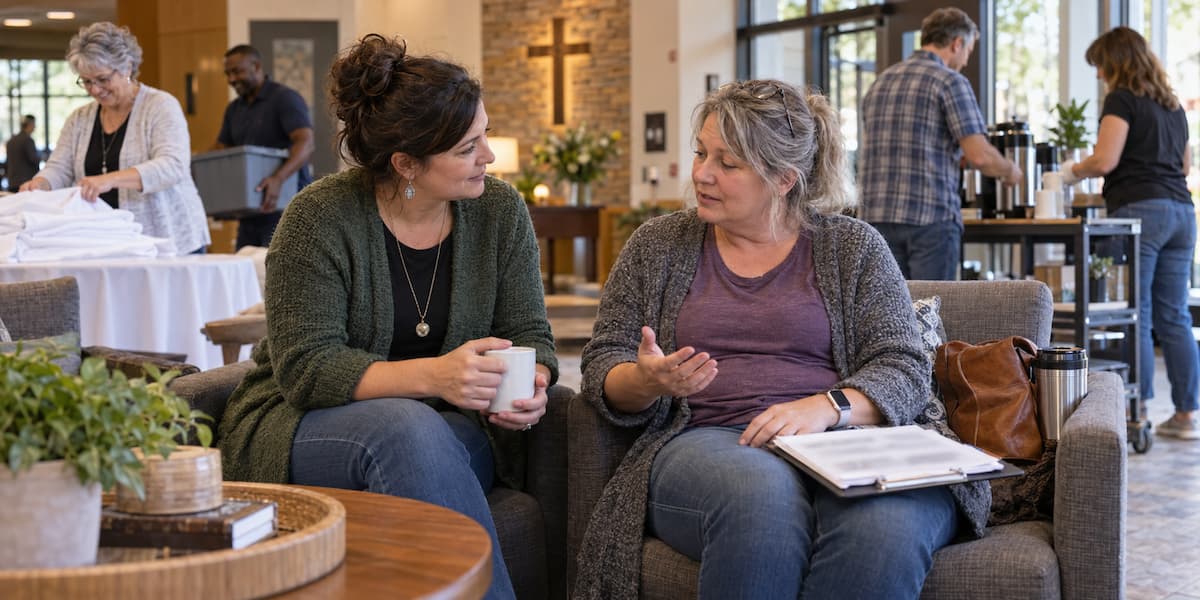
All-Day Church: Why This Viral Trend Is Resonating (And What Churches Can Learn)
The all-day church model is a flexible approach to Sunday gatherings where people can come and go throughout the day instead of attending a single service. It typically includes multiple spaces for worship, teaching, and community, allowing attendees to engage at their own pace.




There is a concept making its way around Christian social media right now that really has people talking.
What if church wasn’t a one-hour service… but an all-day church model?
What Is the All-Day Church Model?
In a recent viral Instagram post, @continuous.church described this innovative church model and their plans to make it a reality.
Think of an all-day Sunday gathering, roughly 9am-6pm, without a strict start or end time. No rushing in or out. Just an open space from morning to evening where people can move freely between three rooms focused on worship, teaching, and community at their own pace.
According to the post’s caption, the idea is that “you don’t just ‘attend’ – you dwell. Arrive when you want, leave when you want. Be completely led by the Spirit.”
Why the All-Day Church Trend Is Going Viral
A pinned comment from @continuous.church explains the heart behind this model: “Church stops being a place where people come to ‘get fed’ and becomes a place where every member comes to give, contribute, and function as an equal part of the body.”
Based on the thousands of likes and shares, it is clear that people are paying attention. Some people are into it. Really into it.
The viral post also has hundreds of comments, many of them overwhelmingly supportive. There is something about this idea that feels refreshing, especially for people who have experienced church as rushed, structured, or disconnected. The idea of lingering, of being led by the Spirit instead of a clock, of having space to sit in worship or actually talk to people… it is appealing.
Critiques of the All-Day Church Model
At the same time, a few honest questions and criticisms are surfacing in the conversation.
One comment said, “You didn’t mention the kids… what do we do with them?”
Another comment noted that this model sounds more like a “buffet-style consumer-focused church” than the anti-consumer approach it aims to embody.
So, what are we to make of this? The reality is, there is no one-size-fits-all model for the Church. What feels life-giving in one context may not translate the same way in another.
Regardless of whether this model would work for your church, there are certainly aspects here worth paying attention to, as well as important questions to consider.
Let’s walk through both.
Benefits of the All-Day Church Model
There are real reasons this kind of model is resonating right now. In our hyper-rushed culture, people are positively responding to the idea of slowing down with their families and having space to sit, process, and linger in worship instead of moving quickly from one moment to the next.
There is also a clear desire for a deeper connection with others. Many people don’t just want to be greeted in the church lobby. They want to have time to actually sit, talk, and build real relationships.
The all-day church model meets these desires in several practical ways:
It creates space for presence.
Instead of a tightly scheduled service, this model creates an environment where people can move between spaces dedicated to worship and prayer, teaching, and community. One room might be filled with quiet worship and people praying for one another. Another might offer rich, ongoing teaching. Another might simply be a place to sit, sip tea, and talk.
That kind of environment allows people to slow down, stay in a moment, and engage at their own pace. It creates room for people to actually experience God, not just hear about Him.
It allows for flexibility.
Life does not always fit neatly into a single service time. Families run late. Schedules shift. Energy levels vary.
An open, come-and-go model removes some of that pressure. People can arrive when they are able, stay as long as they need, and engage in the spaces that are most meaningful to them at that moment. That flexibility can make church feel more accessible and less performative.
It brings families together instead of separating them.
One of the more distinct aspects of this model is that it keeps families together. Instead of dividing everyone into age-based environments, parents and children experience church side by side.
For some families, this could be incredibly meaningful. Children are able to see their parents worship, pray, and engage with others in real time. Faith is not something that happens in a separate room. Instead, the entire family gets to participate in faith together.
It invites people to step into leadership.
A model that runs from morning to evening cannot rely on a small group of leaders to carry it. It requires people to step up. To lead prayer. To facilitate conversations. To create spaces of welcome and care. To be attentive to what others need.
And in that sense, it has the potential to activate the body in a powerful way. Instead of just attending, more people are invited to contribute. They begin to function as part of the body in real, tangible ways.
Challenges Churches Should Consider
At the same time, ideas like this often feel simpler in concept than they are in practice.
What sounds freeing on the surface can quickly become complex when you begin to think through what it actually takes to sustain it week after week.
It requires significant people and planning.
An all-day church model does not run on its own. It requires teams rotating in and out, consistent leadership throughout the day, and a level of coordination that most churches are not currently set up for. Without that infrastructure or the help of a sophisticated church management software, it can quickly become overwhelming for church staff and volunteers.
Kids ministry becomes a central challenge.
The question is not just where kids go, but how they experience something like this. If adults are moving freely between spaces, what does that look like for families? How do you create an environment that serves both children and the people leading them well?
Volunteer capacity matters more than we think.
What feels freeing for attendees can feel very different for the people serving. Longer hours and less defined structure can lead to burnout if roles and expectations are not clearly communicated. Healthy ministry always considers the people behind the scenes.
Not everyone thrives in open-ended environments.
While flexibility is appealing to some, others need structure. A clear start time. A defined flow. A sense of what to expect. Removing that entirely can create confusion instead of freedom. The goal should not be to eliminate structure, but to use it wisely.
How to Apply the Best Ideas Without Going All-In
You do not have to fully adopt an all-day church model to learn from it. There are simple ways to incorporate what is working here into your existing rhythms.
Start by creating more space to linger. Build in intentional time before or after service where people can stay, talk, and connect without feeling rushed.
You can also consider adding environments beyond the main service. A simple prayer room, a space for deeper conversation, or a place where people can sit and just exist together can help your church feel less like a service and more like a gathering of believers.
Finally, look for opportunities to involve more people in leading. Invite people in your congregation to pray, facilitate, or host. Small moments of ownership can go a long way in activating your church body.
Tools That Help Churches Stay Organized
No matter what your church model looks like, having the right systems in place makes it easier to lead well.
With tools for volunteer scheduling, kids check-in, communication, and more, Tithely helps churches stay organized so you can focus on what matters most, building a healthy, connected community.
Sign Up for Product Updates

Susanna is a theological content writer with a Master of Arts in Intercultural Studies from Fuller Theological Seminary. She is passionate about ministry, running, and exploring new cultures through international travel. In her free time, you’ll find her surfing, obsessing over the Olympics, or enjoying the San Diego sunshine!
There is a concept making its way around Christian social media right now that really has people talking.
What if church wasn’t a one-hour service… but an all-day church model?
What Is the All-Day Church Model?
In a recent viral Instagram post, @continuous.church described this innovative church model and their plans to make it a reality.
Think of an all-day Sunday gathering, roughly 9am-6pm, without a strict start or end time. No rushing in or out. Just an open space from morning to evening where people can move freely between three rooms focused on worship, teaching, and community at their own pace.
According to the post’s caption, the idea is that “you don’t just ‘attend’ – you dwell. Arrive when you want, leave when you want. Be completely led by the Spirit.”
Why the All-Day Church Trend Is Going Viral
A pinned comment from @continuous.church explains the heart behind this model: “Church stops being a place where people come to ‘get fed’ and becomes a place where every member comes to give, contribute, and function as an equal part of the body.”
Based on the thousands of likes and shares, it is clear that people are paying attention. Some people are into it. Really into it.
The viral post also has hundreds of comments, many of them overwhelmingly supportive. There is something about this idea that feels refreshing, especially for people who have experienced church as rushed, structured, or disconnected. The idea of lingering, of being led by the Spirit instead of a clock, of having space to sit in worship or actually talk to people… it is appealing.
Critiques of the All-Day Church Model
At the same time, a few honest questions and criticisms are surfacing in the conversation.
One comment said, “You didn’t mention the kids… what do we do with them?”
Another comment noted that this model sounds more like a “buffet-style consumer-focused church” than the anti-consumer approach it aims to embody.
So, what are we to make of this? The reality is, there is no one-size-fits-all model for the Church. What feels life-giving in one context may not translate the same way in another.
Regardless of whether this model would work for your church, there are certainly aspects here worth paying attention to, as well as important questions to consider.
Let’s walk through both.
Benefits of the All-Day Church Model
There are real reasons this kind of model is resonating right now. In our hyper-rushed culture, people are positively responding to the idea of slowing down with their families and having space to sit, process, and linger in worship instead of moving quickly from one moment to the next.
There is also a clear desire for a deeper connection with others. Many people don’t just want to be greeted in the church lobby. They want to have time to actually sit, talk, and build real relationships.
The all-day church model meets these desires in several practical ways:
It creates space for presence.
Instead of a tightly scheduled service, this model creates an environment where people can move between spaces dedicated to worship and prayer, teaching, and community. One room might be filled with quiet worship and people praying for one another. Another might offer rich, ongoing teaching. Another might simply be a place to sit, sip tea, and talk.
That kind of environment allows people to slow down, stay in a moment, and engage at their own pace. It creates room for people to actually experience God, not just hear about Him.
It allows for flexibility.
Life does not always fit neatly into a single service time. Families run late. Schedules shift. Energy levels vary.
An open, come-and-go model removes some of that pressure. People can arrive when they are able, stay as long as they need, and engage in the spaces that are most meaningful to them at that moment. That flexibility can make church feel more accessible and less performative.
It brings families together instead of separating them.
One of the more distinct aspects of this model is that it keeps families together. Instead of dividing everyone into age-based environments, parents and children experience church side by side.
For some families, this could be incredibly meaningful. Children are able to see their parents worship, pray, and engage with others in real time. Faith is not something that happens in a separate room. Instead, the entire family gets to participate in faith together.
It invites people to step into leadership.
A model that runs from morning to evening cannot rely on a small group of leaders to carry it. It requires people to step up. To lead prayer. To facilitate conversations. To create spaces of welcome and care. To be attentive to what others need.
And in that sense, it has the potential to activate the body in a powerful way. Instead of just attending, more people are invited to contribute. They begin to function as part of the body in real, tangible ways.
Challenges Churches Should Consider
At the same time, ideas like this often feel simpler in concept than they are in practice.
What sounds freeing on the surface can quickly become complex when you begin to think through what it actually takes to sustain it week after week.
It requires significant people and planning.
An all-day church model does not run on its own. It requires teams rotating in and out, consistent leadership throughout the day, and a level of coordination that most churches are not currently set up for. Without that infrastructure or the help of a sophisticated church management software, it can quickly become overwhelming for church staff and volunteers.
Kids ministry becomes a central challenge.
The question is not just where kids go, but how they experience something like this. If adults are moving freely between spaces, what does that look like for families? How do you create an environment that serves both children and the people leading them well?
Volunteer capacity matters more than we think.
What feels freeing for attendees can feel very different for the people serving. Longer hours and less defined structure can lead to burnout if roles and expectations are not clearly communicated. Healthy ministry always considers the people behind the scenes.
Not everyone thrives in open-ended environments.
While flexibility is appealing to some, others need structure. A clear start time. A defined flow. A sense of what to expect. Removing that entirely can create confusion instead of freedom. The goal should not be to eliminate structure, but to use it wisely.
How to Apply the Best Ideas Without Going All-In
You do not have to fully adopt an all-day church model to learn from it. There are simple ways to incorporate what is working here into your existing rhythms.
Start by creating more space to linger. Build in intentional time before or after service where people can stay, talk, and connect without feeling rushed.
You can also consider adding environments beyond the main service. A simple prayer room, a space for deeper conversation, or a place where people can sit and just exist together can help your church feel less like a service and more like a gathering of believers.
Finally, look for opportunities to involve more people in leading. Invite people in your congregation to pray, facilitate, or host. Small moments of ownership can go a long way in activating your church body.
Tools That Help Churches Stay Organized
No matter what your church model looks like, having the right systems in place makes it easier to lead well.
With tools for volunteer scheduling, kids check-in, communication, and more, Tithely helps churches stay organized so you can focus on what matters most, building a healthy, connected community.
podcast transcript
Susanna is a theological content writer with a Master of Arts in Intercultural Studies from Fuller Theological Seminary. She is passionate about ministry, running, and exploring new cultures through international travel. In her free time, you’ll find her surfing, obsessing over the Olympics, or enjoying the San Diego sunshine!
There is a concept making its way around Christian social media right now that really has people talking.
What if church wasn’t a one-hour service… but an all-day church model?
What Is the All-Day Church Model?
In a recent viral Instagram post, @continuous.church described this innovative church model and their plans to make it a reality.
Think of an all-day Sunday gathering, roughly 9am-6pm, without a strict start or end time. No rushing in or out. Just an open space from morning to evening where people can move freely between three rooms focused on worship, teaching, and community at their own pace.
According to the post’s caption, the idea is that “you don’t just ‘attend’ – you dwell. Arrive when you want, leave when you want. Be completely led by the Spirit.”
Why the All-Day Church Trend Is Going Viral
A pinned comment from @continuous.church explains the heart behind this model: “Church stops being a place where people come to ‘get fed’ and becomes a place where every member comes to give, contribute, and function as an equal part of the body.”
Based on the thousands of likes and shares, it is clear that people are paying attention. Some people are into it. Really into it.
The viral post also has hundreds of comments, many of them overwhelmingly supportive. There is something about this idea that feels refreshing, especially for people who have experienced church as rushed, structured, or disconnected. The idea of lingering, of being led by the Spirit instead of a clock, of having space to sit in worship or actually talk to people… it is appealing.
Critiques of the All-Day Church Model
At the same time, a few honest questions and criticisms are surfacing in the conversation.
One comment said, “You didn’t mention the kids… what do we do with them?”
Another comment noted that this model sounds more like a “buffet-style consumer-focused church” than the anti-consumer approach it aims to embody.
So, what are we to make of this? The reality is, there is no one-size-fits-all model for the Church. What feels life-giving in one context may not translate the same way in another.
Regardless of whether this model would work for your church, there are certainly aspects here worth paying attention to, as well as important questions to consider.
Let’s walk through both.
Benefits of the All-Day Church Model
There are real reasons this kind of model is resonating right now. In our hyper-rushed culture, people are positively responding to the idea of slowing down with their families and having space to sit, process, and linger in worship instead of moving quickly from one moment to the next.
There is also a clear desire for a deeper connection with others. Many people don’t just want to be greeted in the church lobby. They want to have time to actually sit, talk, and build real relationships.
The all-day church model meets these desires in several practical ways:
It creates space for presence.
Instead of a tightly scheduled service, this model creates an environment where people can move between spaces dedicated to worship and prayer, teaching, and community. One room might be filled with quiet worship and people praying for one another. Another might offer rich, ongoing teaching. Another might simply be a place to sit, sip tea, and talk.
That kind of environment allows people to slow down, stay in a moment, and engage at their own pace. It creates room for people to actually experience God, not just hear about Him.
It allows for flexibility.
Life does not always fit neatly into a single service time. Families run late. Schedules shift. Energy levels vary.
An open, come-and-go model removes some of that pressure. People can arrive when they are able, stay as long as they need, and engage in the spaces that are most meaningful to them at that moment. That flexibility can make church feel more accessible and less performative.
It brings families together instead of separating them.
One of the more distinct aspects of this model is that it keeps families together. Instead of dividing everyone into age-based environments, parents and children experience church side by side.
For some families, this could be incredibly meaningful. Children are able to see their parents worship, pray, and engage with others in real time. Faith is not something that happens in a separate room. Instead, the entire family gets to participate in faith together.
It invites people to step into leadership.
A model that runs from morning to evening cannot rely on a small group of leaders to carry it. It requires people to step up. To lead prayer. To facilitate conversations. To create spaces of welcome and care. To be attentive to what others need.
And in that sense, it has the potential to activate the body in a powerful way. Instead of just attending, more people are invited to contribute. They begin to function as part of the body in real, tangible ways.
Challenges Churches Should Consider
At the same time, ideas like this often feel simpler in concept than they are in practice.
What sounds freeing on the surface can quickly become complex when you begin to think through what it actually takes to sustain it week after week.
It requires significant people and planning.
An all-day church model does not run on its own. It requires teams rotating in and out, consistent leadership throughout the day, and a level of coordination that most churches are not currently set up for. Without that infrastructure or the help of a sophisticated church management software, it can quickly become overwhelming for church staff and volunteers.
Kids ministry becomes a central challenge.
The question is not just where kids go, but how they experience something like this. If adults are moving freely between spaces, what does that look like for families? How do you create an environment that serves both children and the people leading them well?
Volunteer capacity matters more than we think.
What feels freeing for attendees can feel very different for the people serving. Longer hours and less defined structure can lead to burnout if roles and expectations are not clearly communicated. Healthy ministry always considers the people behind the scenes.
Not everyone thrives in open-ended environments.
While flexibility is appealing to some, others need structure. A clear start time. A defined flow. A sense of what to expect. Removing that entirely can create confusion instead of freedom. The goal should not be to eliminate structure, but to use it wisely.
How to Apply the Best Ideas Without Going All-In
You do not have to fully adopt an all-day church model to learn from it. There are simple ways to incorporate what is working here into your existing rhythms.
Start by creating more space to linger. Build in intentional time before or after service where people can stay, talk, and connect without feeling rushed.
You can also consider adding environments beyond the main service. A simple prayer room, a space for deeper conversation, or a place where people can sit and just exist together can help your church feel less like a service and more like a gathering of believers.
Finally, look for opportunities to involve more people in leading. Invite people in your congregation to pray, facilitate, or host. Small moments of ownership can go a long way in activating your church body.
Tools That Help Churches Stay Organized
No matter what your church model looks like, having the right systems in place makes it easier to lead well.
With tools for volunteer scheduling, kids check-in, communication, and more, Tithely helps churches stay organized so you can focus on what matters most, building a healthy, connected community.
VIDEO transcript
There is a concept making its way around Christian social media right now that really has people talking.
What if church wasn’t a one-hour service… but an all-day church model?
What Is the All-Day Church Model?
In a recent viral Instagram post, @continuous.church described this innovative church model and their plans to make it a reality.
Think of an all-day Sunday gathering, roughly 9am-6pm, without a strict start or end time. No rushing in or out. Just an open space from morning to evening where people can move freely between three rooms focused on worship, teaching, and community at their own pace.
According to the post’s caption, the idea is that “you don’t just ‘attend’ – you dwell. Arrive when you want, leave when you want. Be completely led by the Spirit.”
Why the All-Day Church Trend Is Going Viral
A pinned comment from @continuous.church explains the heart behind this model: “Church stops being a place where people come to ‘get fed’ and becomes a place where every member comes to give, contribute, and function as an equal part of the body.”
Based on the thousands of likes and shares, it is clear that people are paying attention. Some people are into it. Really into it.
The viral post also has hundreds of comments, many of them overwhelmingly supportive. There is something about this idea that feels refreshing, especially for people who have experienced church as rushed, structured, or disconnected. The idea of lingering, of being led by the Spirit instead of a clock, of having space to sit in worship or actually talk to people… it is appealing.
Critiques of the All-Day Church Model
At the same time, a few honest questions and criticisms are surfacing in the conversation.
One comment said, “You didn’t mention the kids… what do we do with them?”
Another comment noted that this model sounds more like a “buffet-style consumer-focused church” than the anti-consumer approach it aims to embody.
So, what are we to make of this? The reality is, there is no one-size-fits-all model for the Church. What feels life-giving in one context may not translate the same way in another.
Regardless of whether this model would work for your church, there are certainly aspects here worth paying attention to, as well as important questions to consider.
Let’s walk through both.
Benefits of the All-Day Church Model
There are real reasons this kind of model is resonating right now. In our hyper-rushed culture, people are positively responding to the idea of slowing down with their families and having space to sit, process, and linger in worship instead of moving quickly from one moment to the next.
There is also a clear desire for a deeper connection with others. Many people don’t just want to be greeted in the church lobby. They want to have time to actually sit, talk, and build real relationships.
The all-day church model meets these desires in several practical ways:
It creates space for presence.
Instead of a tightly scheduled service, this model creates an environment where people can move between spaces dedicated to worship and prayer, teaching, and community. One room might be filled with quiet worship and people praying for one another. Another might offer rich, ongoing teaching. Another might simply be a place to sit, sip tea, and talk.
That kind of environment allows people to slow down, stay in a moment, and engage at their own pace. It creates room for people to actually experience God, not just hear about Him.
It allows for flexibility.
Life does not always fit neatly into a single service time. Families run late. Schedules shift. Energy levels vary.
An open, come-and-go model removes some of that pressure. People can arrive when they are able, stay as long as they need, and engage in the spaces that are most meaningful to them at that moment. That flexibility can make church feel more accessible and less performative.
It brings families together instead of separating them.
One of the more distinct aspects of this model is that it keeps families together. Instead of dividing everyone into age-based environments, parents and children experience church side by side.
For some families, this could be incredibly meaningful. Children are able to see their parents worship, pray, and engage with others in real time. Faith is not something that happens in a separate room. Instead, the entire family gets to participate in faith together.
It invites people to step into leadership.
A model that runs from morning to evening cannot rely on a small group of leaders to carry it. It requires people to step up. To lead prayer. To facilitate conversations. To create spaces of welcome and care. To be attentive to what others need.
And in that sense, it has the potential to activate the body in a powerful way. Instead of just attending, more people are invited to contribute. They begin to function as part of the body in real, tangible ways.
Challenges Churches Should Consider
At the same time, ideas like this often feel simpler in concept than they are in practice.
What sounds freeing on the surface can quickly become complex when you begin to think through what it actually takes to sustain it week after week.
It requires significant people and planning.
An all-day church model does not run on its own. It requires teams rotating in and out, consistent leadership throughout the day, and a level of coordination that most churches are not currently set up for. Without that infrastructure or the help of a sophisticated church management software, it can quickly become overwhelming for church staff and volunteers.
Kids ministry becomes a central challenge.
The question is not just where kids go, but how they experience something like this. If adults are moving freely between spaces, what does that look like for families? How do you create an environment that serves both children and the people leading them well?
Volunteer capacity matters more than we think.
What feels freeing for attendees can feel very different for the people serving. Longer hours and less defined structure can lead to burnout if roles and expectations are not clearly communicated. Healthy ministry always considers the people behind the scenes.
Not everyone thrives in open-ended environments.
While flexibility is appealing to some, others need structure. A clear start time. A defined flow. A sense of what to expect. Removing that entirely can create confusion instead of freedom. The goal should not be to eliminate structure, but to use it wisely.
How to Apply the Best Ideas Without Going All-In
You do not have to fully adopt an all-day church model to learn from it. There are simple ways to incorporate what is working here into your existing rhythms.
Start by creating more space to linger. Build in intentional time before or after service where people can stay, talk, and connect without feeling rushed.
You can also consider adding environments beyond the main service. A simple prayer room, a space for deeper conversation, or a place where people can sit and just exist together can help your church feel less like a service and more like a gathering of believers.
Finally, look for opportunities to involve more people in leading. Invite people in your congregation to pray, facilitate, or host. Small moments of ownership can go a long way in activating your church body.
Tools That Help Churches Stay Organized
No matter what your church model looks like, having the right systems in place makes it easier to lead well.
With tools for volunteer scheduling, kids check-in, communication, and more, Tithely helps churches stay organized so you can focus on what matters most, building a healthy, connected community.
Sign Up for Product Updates
Susanna is a theological content writer with a Master of Arts in Intercultural Studies from Fuller Theological Seminary. She is passionate about ministry, running, and exploring new cultures through international travel. In her free time, you’ll find her surfing, obsessing over the Olympics, or enjoying the San Diego sunshine!

You Might Also Like
More Resources

From increasing giving, managing your congregation, and engaging your church, our collection of resources will keep you up-to-date on the latest church and ministry trends.
Free Resources


.jpg)