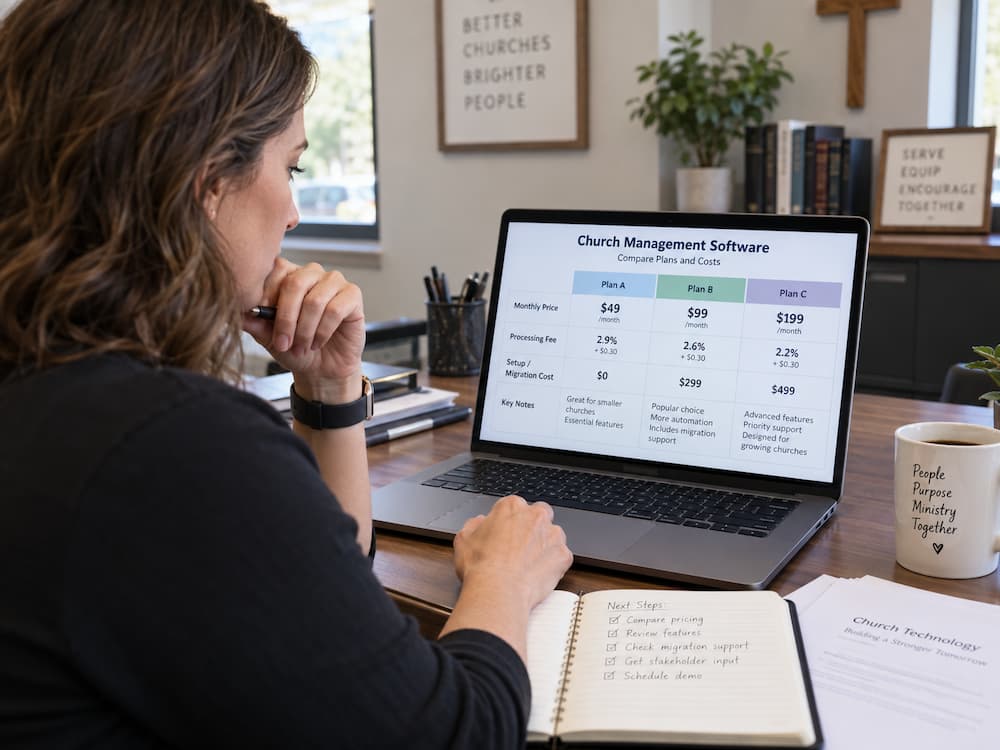
New Year, New Tools: How to Evaluate AI Tools Without Chasing Trends
Every new year brings new tech and new pressure. Before you chase the latest AI trend, learn how to evaluate tools wisely, protect your team’s time, and choose technology that truly serves your ministry.




Why Every New Year Brings New Tech Pressure for Churches
Every January, churches start asking the same questions.
What should we focus on this year? What needs to change? What could be better?
And now, almost inevitably, the conversation turns to technology. More specifically, it turns to AI.
Pastors are hearing about AI sermon tools. Communications leaders are seeing AI social platforms. Admin teams are getting emails about AI assistants, AI chatbots, and AI scheduling tools. It can start to feel like if you’re not using AI, you’re already behind.
But here’s the truth: not every new tool is a wise tool. And not every AI platform deserves a place in your ministry.
Innovation is good. Discernment is better.
The goal isn’t to use AI. The goal is to use it well.
The AI Gold Rush—and Why Churches Feel the Tension
We are clearly in the middle of an AI gold rush. Every software company is adding “AI-powered” to their messaging. Conferences are packed with sessions about it. Social feeds are full of demos and promises about how AI will change everything.
Church leaders feel that pressure too. You want to communicate better. You want to reach more people. You want to be wise with your time and your resources. So when you hear that a tool can save hours each week or make ministry easier, it’s tempting to jump in.
But churches aren’t startups. You don’t have massive teams, unlimited budgets, or room for constant experimentation. Every new tool you add comes with a cost. There’s the subscription, of course, but there’s also training, setup, troubleshooting, and ongoing management.
Over time, those costs add up. Tools that seemed exciting in January quietly get abandoned by March. Logins are forgotten. Processes get messy. And suddenly your team is juggling more platforms without actually feeling more supported.
That’s why being cautious with AI isn’t being behind. It’s being a good steward.
Why Trend-Chasing Is Especially Risky in Ministry
Shiny object syndrome is when you chase whatever is new and exciting, even if it doesn’t fit your actual needs. In business, that’s annoying. In ministry, it’s costly.
Most churches already operate with small staffs and full calendars. Volunteers are stretched. Pastors are pulled in multiple directions. Adding tools that don’t clearly help doesn’t lead to innovation; it leads to confusion.
Over time, this creates what many churches recognize all too well: a graveyard of half-used platforms and forgotten subscriptions. The intention was good, but the outcome is frustration.
Being careful with technology choices doesn’t mean you’re resistant to change. It means you care about clarity, simplicity, and sustainability.
Start With Ministry Problems, Not AI Possibilities
One of the biggest mistakes churches make is starting with the question, “What AI tools should we use?” That’s the wrong place to begin.
A better question is, “Where are we struggling right now?”
Every church has friction points. For some, it’s communication. Emails don’t get opened. Social media is inconsistent. Announcements feel rushed or unclear. For others, it’s administration. Notes fall through the cracks. Follow-ups get missed. Information is scattered across too many systems. And for many pastors, it’s the constant pressure of content creation and sermon prep.
AI should step into those real problems. It should relieve pressure, not create curiosity projects. If you can’t clearly say, “This tool will help us here,” it’s probably not the right tool.
A Five-Question Filter for Evaluating Any AI Tool
Before you sign up for a demo or add another subscription, it’s worth slowing down and asking a few simple questions.
Does this solve a real ministry problem?
First, does this solve a real problem we actually have? Not a hypothetical problem. Not a “this would be cool” problem. A real, visible, current issue. If the problem isn’t clear, the solution won’t be either.
Will it integrate with our existing tools?
Second, will it integrate with what we’re already using? The more disconnected tools you add, the more fragmented your systems become. That leads to duplicate data, missed communication, and frustrated staff. Tools that play well with your existing systems tend to get used. Tools that live in isolation tend to get ignored.
Will our team actually use it?
Third, will our team actually use it? This requires honesty. Think about your team’s comfort with technology, your capacity for training, and your volunteer turnover. If a tool is complicated or requires constant management, it better deliver serious value. Otherwise, it will quietly fade away.
Does it align with our theology and voice?
Fourth, does it align with our theology, values, and voice? This is especially important for churches. AI should support ministry, not replace it. It should assist leaders, not become the leader. Using AI to help generate ideas or organize content is one thing. Outsourcing spiritual leadership is another. Your church’s voice and culture matter, and any tool you use should respect that.
Is the return on investment clear?
Finally, is the return on investment clear? What will this save? What will it improve? What will actually be better because of this? If you can’t explain the benefit in one sentence, that’s a red flag.
Common AI Traps Churches Fall Into
One of the most common traps is adopting tools simply because other churches are using them. Social pressure is real, especially when you hear about success stories at conferences or in online groups. But what works for a large church with a dedicated tech team may be a burden for a smaller staff.
Another trap is buying tools without a clear owner. Every platform needs someone responsible for setup, training, and ongoing management. When no one owns it, no one is accountable, and the tool slowly dies.
There’s also the temptation to over-automate pastoral moments. AI can be great for admin, scheduling, and drafts, but it should never replace presence, prayer, and personal care. Ministry is relational, and no tool should get in the way of that.
Finally, many churches struggle with tool sprawl. Too many platforms create complexity. Different logins, different dashboards, different workflows. Over time, staff spend more time managing systems than serving people. Often, consolidation is smarter than expansion.
A Smarter Way for Churches to Try New Technology
Instead of rolling out a new AI tool across the whole church, start small. Test it with one staff member. Use it in one ministry. Run a short pilot and see what actually happens.
Pay attention to real results. Did it save time? Was it easy to use? Did people adopt it naturally, or did it require constant reminders? These questions matter more than feature lists.
And be willing to walk away. If something doesn’t deliver, it’s okay to say no. It’s okay to stop. That’s not failure. That’s wisdom.
Where AI Can Actually Help Churches Today
When used wisely, AI can be a powerful multiplier. It can support sermon research, help draft devotionals, and organize small group materials. It can make communication faster by assisting with email drafts, social captions, and announcement summaries. It can reduce administrative load by summarizing meetings, helping with scheduling, and organizing tasks.
The key is remembering that AI is not the mission. It is a support tool. When it works well, it frees leaders to spend more time with people and less time on platforms.
AI Works Best Inside a Healthy Digital Strategy
AI is most effective when it’s part of a broader, thoughtful digital strategy. Strong foundations make everything easier. A clear website. Simple online giving. Consistent communication. Integrated systems. Clean data.
When those pieces are in place, AI can enhance them. When they’re not, AI just adds noise.
Technology should simplify ministry, not complicate it.
A Simple Gut Check Before You Say Yes
Before you adopt any AI tool, it’s worth asking yourself a few quick questions. What problem does this solve? Who will own it? How will we measure success? What will we stop doing if we start this?
If those answers are fuzzy, pause.
Innovation With Intention: Choosing Tools That Serve the Mission
You don’t need every tool. You don’t need to move at Silicon Valley speed. You don’t need to chase every trend.
The new year doesn’t require new technology. It requires wise decisions.
AI can absolutely support ministry. It can save time. It can reduce administrative burden. It can help small teams do more with less. But it is still just a tool.
The mission hasn’t changed. People are still the mission.
And the healthiest churches won’t be the ones with the most technology. They’ll be the ones who use technology intentionally, thoughtfully, and in service of real ministry.
Sign Up for Product Updates

Stephen Altrogge lives in Tallahassee, Florida. He is a dad to three wonderful girls and has written for publications like The Gospel Coalition, Church Leaders, Crosswalk, and many more. When he’s not writing, you’ll find him reading or watching The Lord Of the Rings for the 10th time.
Why Every New Year Brings New Tech Pressure for Churches
Every January, churches start asking the same questions.
What should we focus on this year? What needs to change? What could be better?
And now, almost inevitably, the conversation turns to technology. More specifically, it turns to AI.
Pastors are hearing about AI sermon tools. Communications leaders are seeing AI social platforms. Admin teams are getting emails about AI assistants, AI chatbots, and AI scheduling tools. It can start to feel like if you’re not using AI, you’re already behind.
But here’s the truth: not every new tool is a wise tool. And not every AI platform deserves a place in your ministry.
Innovation is good. Discernment is better.
The goal isn’t to use AI. The goal is to use it well.
The AI Gold Rush—and Why Churches Feel the Tension
We are clearly in the middle of an AI gold rush. Every software company is adding “AI-powered” to their messaging. Conferences are packed with sessions about it. Social feeds are full of demos and promises about how AI will change everything.
Church leaders feel that pressure too. You want to communicate better. You want to reach more people. You want to be wise with your time and your resources. So when you hear that a tool can save hours each week or make ministry easier, it’s tempting to jump in.
But churches aren’t startups. You don’t have massive teams, unlimited budgets, or room for constant experimentation. Every new tool you add comes with a cost. There’s the subscription, of course, but there’s also training, setup, troubleshooting, and ongoing management.
Over time, those costs add up. Tools that seemed exciting in January quietly get abandoned by March. Logins are forgotten. Processes get messy. And suddenly your team is juggling more platforms without actually feeling more supported.
That’s why being cautious with AI isn’t being behind. It’s being a good steward.
Why Trend-Chasing Is Especially Risky in Ministry
Shiny object syndrome is when you chase whatever is new and exciting, even if it doesn’t fit your actual needs. In business, that’s annoying. In ministry, it’s costly.
Most churches already operate with small staffs and full calendars. Volunteers are stretched. Pastors are pulled in multiple directions. Adding tools that don’t clearly help doesn’t lead to innovation; it leads to confusion.
Over time, this creates what many churches recognize all too well: a graveyard of half-used platforms and forgotten subscriptions. The intention was good, but the outcome is frustration.
Being careful with technology choices doesn’t mean you’re resistant to change. It means you care about clarity, simplicity, and sustainability.
Start With Ministry Problems, Not AI Possibilities
One of the biggest mistakes churches make is starting with the question, “What AI tools should we use?” That’s the wrong place to begin.
A better question is, “Where are we struggling right now?”
Every church has friction points. For some, it’s communication. Emails don’t get opened. Social media is inconsistent. Announcements feel rushed or unclear. For others, it’s administration. Notes fall through the cracks. Follow-ups get missed. Information is scattered across too many systems. And for many pastors, it’s the constant pressure of content creation and sermon prep.
AI should step into those real problems. It should relieve pressure, not create curiosity projects. If you can’t clearly say, “This tool will help us here,” it’s probably not the right tool.
A Five-Question Filter for Evaluating Any AI Tool
Before you sign up for a demo or add another subscription, it’s worth slowing down and asking a few simple questions.
Does this solve a real ministry problem?
First, does this solve a real problem we actually have? Not a hypothetical problem. Not a “this would be cool” problem. A real, visible, current issue. If the problem isn’t clear, the solution won’t be either.
Will it integrate with our existing tools?
Second, will it integrate with what we’re already using? The more disconnected tools you add, the more fragmented your systems become. That leads to duplicate data, missed communication, and frustrated staff. Tools that play well with your existing systems tend to get used. Tools that live in isolation tend to get ignored.
Will our team actually use it?
Third, will our team actually use it? This requires honesty. Think about your team’s comfort with technology, your capacity for training, and your volunteer turnover. If a tool is complicated or requires constant management, it better deliver serious value. Otherwise, it will quietly fade away.
Does it align with our theology and voice?
Fourth, does it align with our theology, values, and voice? This is especially important for churches. AI should support ministry, not replace it. It should assist leaders, not become the leader. Using AI to help generate ideas or organize content is one thing. Outsourcing spiritual leadership is another. Your church’s voice and culture matter, and any tool you use should respect that.
Is the return on investment clear?
Finally, is the return on investment clear? What will this save? What will it improve? What will actually be better because of this? If you can’t explain the benefit in one sentence, that’s a red flag.
Common AI Traps Churches Fall Into
One of the most common traps is adopting tools simply because other churches are using them. Social pressure is real, especially when you hear about success stories at conferences or in online groups. But what works for a large church with a dedicated tech team may be a burden for a smaller staff.
Another trap is buying tools without a clear owner. Every platform needs someone responsible for setup, training, and ongoing management. When no one owns it, no one is accountable, and the tool slowly dies.
There’s also the temptation to over-automate pastoral moments. AI can be great for admin, scheduling, and drafts, but it should never replace presence, prayer, and personal care. Ministry is relational, and no tool should get in the way of that.
Finally, many churches struggle with tool sprawl. Too many platforms create complexity. Different logins, different dashboards, different workflows. Over time, staff spend more time managing systems than serving people. Often, consolidation is smarter than expansion.
A Smarter Way for Churches to Try New Technology
Instead of rolling out a new AI tool across the whole church, start small. Test it with one staff member. Use it in one ministry. Run a short pilot and see what actually happens.
Pay attention to real results. Did it save time? Was it easy to use? Did people adopt it naturally, or did it require constant reminders? These questions matter more than feature lists.
And be willing to walk away. If something doesn’t deliver, it’s okay to say no. It’s okay to stop. That’s not failure. That’s wisdom.
Where AI Can Actually Help Churches Today
When used wisely, AI can be a powerful multiplier. It can support sermon research, help draft devotionals, and organize small group materials. It can make communication faster by assisting with email drafts, social captions, and announcement summaries. It can reduce administrative load by summarizing meetings, helping with scheduling, and organizing tasks.
The key is remembering that AI is not the mission. It is a support tool. When it works well, it frees leaders to spend more time with people and less time on platforms.
AI Works Best Inside a Healthy Digital Strategy
AI is most effective when it’s part of a broader, thoughtful digital strategy. Strong foundations make everything easier. A clear website. Simple online giving. Consistent communication. Integrated systems. Clean data.
When those pieces are in place, AI can enhance them. When they’re not, AI just adds noise.
Technology should simplify ministry, not complicate it.
A Simple Gut Check Before You Say Yes
Before you adopt any AI tool, it’s worth asking yourself a few quick questions. What problem does this solve? Who will own it? How will we measure success? What will we stop doing if we start this?
If those answers are fuzzy, pause.
Innovation With Intention: Choosing Tools That Serve the Mission
You don’t need every tool. You don’t need to move at Silicon Valley speed. You don’t need to chase every trend.
The new year doesn’t require new technology. It requires wise decisions.
AI can absolutely support ministry. It can save time. It can reduce administrative burden. It can help small teams do more with less. But it is still just a tool.
The mission hasn’t changed. People are still the mission.
And the healthiest churches won’t be the ones with the most technology. They’ll be the ones who use technology intentionally, thoughtfully, and in service of real ministry.
podcast transcript
Stephen Altrogge lives in Tallahassee, Florida. He is a dad to three wonderful girls and has written for publications like The Gospel Coalition, Church Leaders, Crosswalk, and many more. When he’s not writing, you’ll find him reading or watching The Lord Of the Rings for the 10th time.
Why Every New Year Brings New Tech Pressure for Churches
Every January, churches start asking the same questions.
What should we focus on this year? What needs to change? What could be better?
And now, almost inevitably, the conversation turns to technology. More specifically, it turns to AI.
Pastors are hearing about AI sermon tools. Communications leaders are seeing AI social platforms. Admin teams are getting emails about AI assistants, AI chatbots, and AI scheduling tools. It can start to feel like if you’re not using AI, you’re already behind.
But here’s the truth: not every new tool is a wise tool. And not every AI platform deserves a place in your ministry.
Innovation is good. Discernment is better.
The goal isn’t to use AI. The goal is to use it well.
The AI Gold Rush—and Why Churches Feel the Tension
We are clearly in the middle of an AI gold rush. Every software company is adding “AI-powered” to their messaging. Conferences are packed with sessions about it. Social feeds are full of demos and promises about how AI will change everything.
Church leaders feel that pressure too. You want to communicate better. You want to reach more people. You want to be wise with your time and your resources. So when you hear that a tool can save hours each week or make ministry easier, it’s tempting to jump in.
But churches aren’t startups. You don’t have massive teams, unlimited budgets, or room for constant experimentation. Every new tool you add comes with a cost. There’s the subscription, of course, but there’s also training, setup, troubleshooting, and ongoing management.
Over time, those costs add up. Tools that seemed exciting in January quietly get abandoned by March. Logins are forgotten. Processes get messy. And suddenly your team is juggling more platforms without actually feeling more supported.
That’s why being cautious with AI isn’t being behind. It’s being a good steward.
Why Trend-Chasing Is Especially Risky in Ministry
Shiny object syndrome is when you chase whatever is new and exciting, even if it doesn’t fit your actual needs. In business, that’s annoying. In ministry, it’s costly.
Most churches already operate with small staffs and full calendars. Volunteers are stretched. Pastors are pulled in multiple directions. Adding tools that don’t clearly help doesn’t lead to innovation; it leads to confusion.
Over time, this creates what many churches recognize all too well: a graveyard of half-used platforms and forgotten subscriptions. The intention was good, but the outcome is frustration.
Being careful with technology choices doesn’t mean you’re resistant to change. It means you care about clarity, simplicity, and sustainability.
Start With Ministry Problems, Not AI Possibilities
One of the biggest mistakes churches make is starting with the question, “What AI tools should we use?” That’s the wrong place to begin.
A better question is, “Where are we struggling right now?”
Every church has friction points. For some, it’s communication. Emails don’t get opened. Social media is inconsistent. Announcements feel rushed or unclear. For others, it’s administration. Notes fall through the cracks. Follow-ups get missed. Information is scattered across too many systems. And for many pastors, it’s the constant pressure of content creation and sermon prep.
AI should step into those real problems. It should relieve pressure, not create curiosity projects. If you can’t clearly say, “This tool will help us here,” it’s probably not the right tool.
A Five-Question Filter for Evaluating Any AI Tool
Before you sign up for a demo or add another subscription, it’s worth slowing down and asking a few simple questions.
Does this solve a real ministry problem?
First, does this solve a real problem we actually have? Not a hypothetical problem. Not a “this would be cool” problem. A real, visible, current issue. If the problem isn’t clear, the solution won’t be either.
Will it integrate with our existing tools?
Second, will it integrate with what we’re already using? The more disconnected tools you add, the more fragmented your systems become. That leads to duplicate data, missed communication, and frustrated staff. Tools that play well with your existing systems tend to get used. Tools that live in isolation tend to get ignored.
Will our team actually use it?
Third, will our team actually use it? This requires honesty. Think about your team’s comfort with technology, your capacity for training, and your volunteer turnover. If a tool is complicated or requires constant management, it better deliver serious value. Otherwise, it will quietly fade away.
Does it align with our theology and voice?
Fourth, does it align with our theology, values, and voice? This is especially important for churches. AI should support ministry, not replace it. It should assist leaders, not become the leader. Using AI to help generate ideas or organize content is one thing. Outsourcing spiritual leadership is another. Your church’s voice and culture matter, and any tool you use should respect that.
Is the return on investment clear?
Finally, is the return on investment clear? What will this save? What will it improve? What will actually be better because of this? If you can’t explain the benefit in one sentence, that’s a red flag.
Common AI Traps Churches Fall Into
One of the most common traps is adopting tools simply because other churches are using them. Social pressure is real, especially when you hear about success stories at conferences or in online groups. But what works for a large church with a dedicated tech team may be a burden for a smaller staff.
Another trap is buying tools without a clear owner. Every platform needs someone responsible for setup, training, and ongoing management. When no one owns it, no one is accountable, and the tool slowly dies.
There’s also the temptation to over-automate pastoral moments. AI can be great for admin, scheduling, and drafts, but it should never replace presence, prayer, and personal care. Ministry is relational, and no tool should get in the way of that.
Finally, many churches struggle with tool sprawl. Too many platforms create complexity. Different logins, different dashboards, different workflows. Over time, staff spend more time managing systems than serving people. Often, consolidation is smarter than expansion.
A Smarter Way for Churches to Try New Technology
Instead of rolling out a new AI tool across the whole church, start small. Test it with one staff member. Use it in one ministry. Run a short pilot and see what actually happens.
Pay attention to real results. Did it save time? Was it easy to use? Did people adopt it naturally, or did it require constant reminders? These questions matter more than feature lists.
And be willing to walk away. If something doesn’t deliver, it’s okay to say no. It’s okay to stop. That’s not failure. That’s wisdom.
Where AI Can Actually Help Churches Today
When used wisely, AI can be a powerful multiplier. It can support sermon research, help draft devotionals, and organize small group materials. It can make communication faster by assisting with email drafts, social captions, and announcement summaries. It can reduce administrative load by summarizing meetings, helping with scheduling, and organizing tasks.
The key is remembering that AI is not the mission. It is a support tool. When it works well, it frees leaders to spend more time with people and less time on platforms.
AI Works Best Inside a Healthy Digital Strategy
AI is most effective when it’s part of a broader, thoughtful digital strategy. Strong foundations make everything easier. A clear website. Simple online giving. Consistent communication. Integrated systems. Clean data.
When those pieces are in place, AI can enhance them. When they’re not, AI just adds noise.
Technology should simplify ministry, not complicate it.
A Simple Gut Check Before You Say Yes
Before you adopt any AI tool, it’s worth asking yourself a few quick questions. What problem does this solve? Who will own it? How will we measure success? What will we stop doing if we start this?
If those answers are fuzzy, pause.
Innovation With Intention: Choosing Tools That Serve the Mission
You don’t need every tool. You don’t need to move at Silicon Valley speed. You don’t need to chase every trend.
The new year doesn’t require new technology. It requires wise decisions.
AI can absolutely support ministry. It can save time. It can reduce administrative burden. It can help small teams do more with less. But it is still just a tool.
The mission hasn’t changed. People are still the mission.
And the healthiest churches won’t be the ones with the most technology. They’ll be the ones who use technology intentionally, thoughtfully, and in service of real ministry.
VIDEO transcript
Why Every New Year Brings New Tech Pressure for Churches
Every January, churches start asking the same questions.
What should we focus on this year? What needs to change? What could be better?
And now, almost inevitably, the conversation turns to technology. More specifically, it turns to AI.
Pastors are hearing about AI sermon tools. Communications leaders are seeing AI social platforms. Admin teams are getting emails about AI assistants, AI chatbots, and AI scheduling tools. It can start to feel like if you’re not using AI, you’re already behind.
But here’s the truth: not every new tool is a wise tool. And not every AI platform deserves a place in your ministry.
Innovation is good. Discernment is better.
The goal isn’t to use AI. The goal is to use it well.
The AI Gold Rush—and Why Churches Feel the Tension
We are clearly in the middle of an AI gold rush. Every software company is adding “AI-powered” to their messaging. Conferences are packed with sessions about it. Social feeds are full of demos and promises about how AI will change everything.
Church leaders feel that pressure too. You want to communicate better. You want to reach more people. You want to be wise with your time and your resources. So when you hear that a tool can save hours each week or make ministry easier, it’s tempting to jump in.
But churches aren’t startups. You don’t have massive teams, unlimited budgets, or room for constant experimentation. Every new tool you add comes with a cost. There’s the subscription, of course, but there’s also training, setup, troubleshooting, and ongoing management.
Over time, those costs add up. Tools that seemed exciting in January quietly get abandoned by March. Logins are forgotten. Processes get messy. And suddenly your team is juggling more platforms without actually feeling more supported.
That’s why being cautious with AI isn’t being behind. It’s being a good steward.
Why Trend-Chasing Is Especially Risky in Ministry
Shiny object syndrome is when you chase whatever is new and exciting, even if it doesn’t fit your actual needs. In business, that’s annoying. In ministry, it’s costly.
Most churches already operate with small staffs and full calendars. Volunteers are stretched. Pastors are pulled in multiple directions. Adding tools that don’t clearly help doesn’t lead to innovation; it leads to confusion.
Over time, this creates what many churches recognize all too well: a graveyard of half-used platforms and forgotten subscriptions. The intention was good, but the outcome is frustration.
Being careful with technology choices doesn’t mean you’re resistant to change. It means you care about clarity, simplicity, and sustainability.
Start With Ministry Problems, Not AI Possibilities
One of the biggest mistakes churches make is starting with the question, “What AI tools should we use?” That’s the wrong place to begin.
A better question is, “Where are we struggling right now?”
Every church has friction points. For some, it’s communication. Emails don’t get opened. Social media is inconsistent. Announcements feel rushed or unclear. For others, it’s administration. Notes fall through the cracks. Follow-ups get missed. Information is scattered across too many systems. And for many pastors, it’s the constant pressure of content creation and sermon prep.
AI should step into those real problems. It should relieve pressure, not create curiosity projects. If you can’t clearly say, “This tool will help us here,” it’s probably not the right tool.
A Five-Question Filter for Evaluating Any AI Tool
Before you sign up for a demo or add another subscription, it’s worth slowing down and asking a few simple questions.
Does this solve a real ministry problem?
First, does this solve a real problem we actually have? Not a hypothetical problem. Not a “this would be cool” problem. A real, visible, current issue. If the problem isn’t clear, the solution won’t be either.
Will it integrate with our existing tools?
Second, will it integrate with what we’re already using? The more disconnected tools you add, the more fragmented your systems become. That leads to duplicate data, missed communication, and frustrated staff. Tools that play well with your existing systems tend to get used. Tools that live in isolation tend to get ignored.
Will our team actually use it?
Third, will our team actually use it? This requires honesty. Think about your team’s comfort with technology, your capacity for training, and your volunteer turnover. If a tool is complicated or requires constant management, it better deliver serious value. Otherwise, it will quietly fade away.
Does it align with our theology and voice?
Fourth, does it align with our theology, values, and voice? This is especially important for churches. AI should support ministry, not replace it. It should assist leaders, not become the leader. Using AI to help generate ideas or organize content is one thing. Outsourcing spiritual leadership is another. Your church’s voice and culture matter, and any tool you use should respect that.
Is the return on investment clear?
Finally, is the return on investment clear? What will this save? What will it improve? What will actually be better because of this? If you can’t explain the benefit in one sentence, that’s a red flag.
Common AI Traps Churches Fall Into
One of the most common traps is adopting tools simply because other churches are using them. Social pressure is real, especially when you hear about success stories at conferences or in online groups. But what works for a large church with a dedicated tech team may be a burden for a smaller staff.
Another trap is buying tools without a clear owner. Every platform needs someone responsible for setup, training, and ongoing management. When no one owns it, no one is accountable, and the tool slowly dies.
There’s also the temptation to over-automate pastoral moments. AI can be great for admin, scheduling, and drafts, but it should never replace presence, prayer, and personal care. Ministry is relational, and no tool should get in the way of that.
Finally, many churches struggle with tool sprawl. Too many platforms create complexity. Different logins, different dashboards, different workflows. Over time, staff spend more time managing systems than serving people. Often, consolidation is smarter than expansion.
A Smarter Way for Churches to Try New Technology
Instead of rolling out a new AI tool across the whole church, start small. Test it with one staff member. Use it in one ministry. Run a short pilot and see what actually happens.
Pay attention to real results. Did it save time? Was it easy to use? Did people adopt it naturally, or did it require constant reminders? These questions matter more than feature lists.
And be willing to walk away. If something doesn’t deliver, it’s okay to say no. It’s okay to stop. That’s not failure. That’s wisdom.
Where AI Can Actually Help Churches Today
When used wisely, AI can be a powerful multiplier. It can support sermon research, help draft devotionals, and organize small group materials. It can make communication faster by assisting with email drafts, social captions, and announcement summaries. It can reduce administrative load by summarizing meetings, helping with scheduling, and organizing tasks.
The key is remembering that AI is not the mission. It is a support tool. When it works well, it frees leaders to spend more time with people and less time on platforms.
AI Works Best Inside a Healthy Digital Strategy
AI is most effective when it’s part of a broader, thoughtful digital strategy. Strong foundations make everything easier. A clear website. Simple online giving. Consistent communication. Integrated systems. Clean data.
When those pieces are in place, AI can enhance them. When they’re not, AI just adds noise.
Technology should simplify ministry, not complicate it.
A Simple Gut Check Before You Say Yes
Before you adopt any AI tool, it’s worth asking yourself a few quick questions. What problem does this solve? Who will own it? How will we measure success? What will we stop doing if we start this?
If those answers are fuzzy, pause.
Innovation With Intention: Choosing Tools That Serve the Mission
You don’t need every tool. You don’t need to move at Silicon Valley speed. You don’t need to chase every trend.
The new year doesn’t require new technology. It requires wise decisions.
AI can absolutely support ministry. It can save time. It can reduce administrative burden. It can help small teams do more with less. But it is still just a tool.
The mission hasn’t changed. People are still the mission.
And the healthiest churches won’t be the ones with the most technology. They’ll be the ones who use technology intentionally, thoughtfully, and in service of real ministry.
Sign Up for Product Updates
Stephen Altrogge lives in Tallahassee, Florida. He is a dad to three wonderful girls and has written for publications like The Gospel Coalition, Church Leaders, Crosswalk, and many more. When he’s not writing, you’ll find him reading or watching The Lord Of the Rings for the 10th time.

You Might Also Like
More Resources

From increasing giving, managing your congregation, and engaging your church, our collection of resources will keep you up-to-date on the latest church and ministry trends.
Free Resources






.jpg)