Does AI Have a Place in Worship? Yes! Kind Of
AI can write worship songs in seconds, but should it? This thoughtful look explores where artificial intelligence can support worship creativity without replacing the Spirit-led, human heart of true worship.
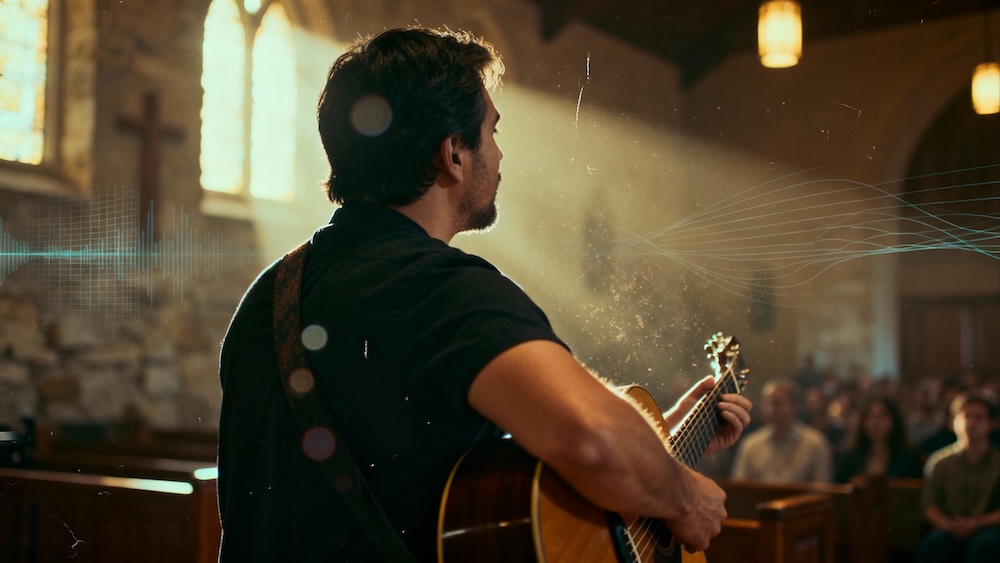



The other day, I created a song about pickles for my 15-year-old daughter, who loves pickles. I also recorded the song with a full band and published it online. I did all this in less than two minutes using an AI app called Suno. If you want, you can listen to the song here.
So, yeah, AI can now create fully polished songs. And they sound pretty darn good, given that they're entirely AI-made.
This got me thinking about the use of AI in church worship (the singing part for those of you who want to split hairs).
Is there any place for AI in worship? How do God-given creativity and artificial intelligence work together?
Let’s get into it.
Understanding God-Given Creativity
Creativity isn’t a random talent. Being able to juggle bananas while singing the “Star Spangled Banner” is a random talent (not really random because God created you, but you get the point).
Creativity is a reflection of God’s image in you. Genesis 1:27 says that God made us in His image. And what’s the first thing God does in scripture? He creates. Earth, oceans, galaxies, elephants, Mt. Everest, forests, the Sun, bananas for you to juggle, and His highest creation: humans.
Because God creates, we create. When we write lyrics, compose melodies, design cool visuals, or arrange a song, we’re reflecting the glory and image of God. We’re not just making something new. We’re highlighting the nature of God and directing people to focus on Him. Creativity is one way we imitate God and express His glory in the world.
In Exodus 31, God filled Bezalel and Oholiab with His Spirit to create the Tabernacle. Every detail, color, and carving was an act of worship. That same Spirit empowers your creativity today. Arranging lights, creating slides, writing music, and composing a full worship set are all ways of using creativity to help people encounter God.
If you wanted to, you could write 100 worship songs in five minutes using ChatGPT. But that’s not creativity, and it’s not honoring to God. The songs come from a soulless, emotionless machine, not from a heart connected to God and led by His Spirit.
What AI Can (and Can’t) Do In Worship
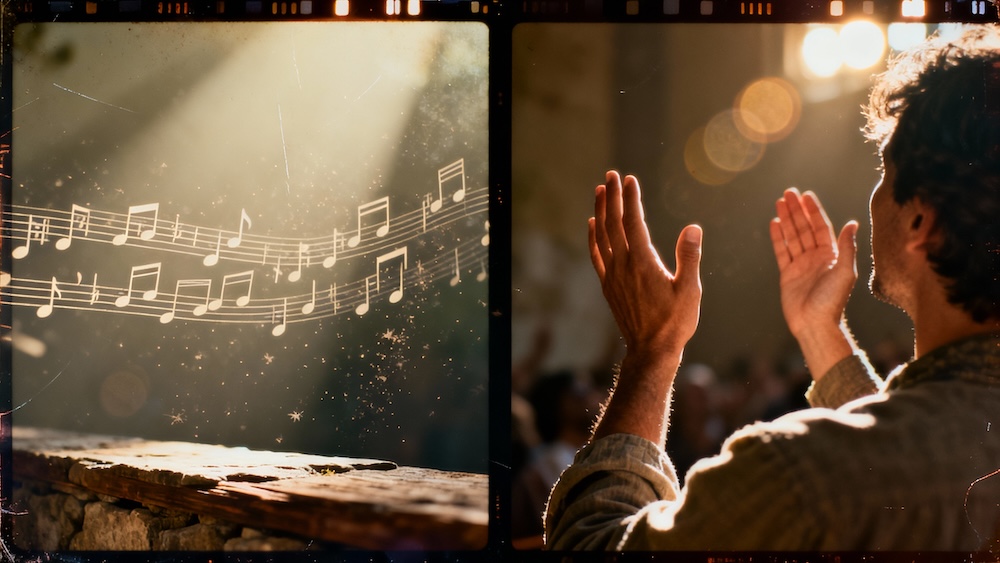
Without question, AI can be really helpful. It can suggest new chord progressions if you’re struggling to write a song. It can analyze your past setlists and offer suggestions for new songs that would fit nicely in future setlists. It can also handle many automated tasks that eat up time that would be better spent on other ministry pursuits.
If you use AI wisely, AI tools can free up time so that you can focus on the most important aspects of creativity, like brainstorming, collaboration, and holing up in a room so you can do the hard, prayerful work of bringing raw materials together into something beautiful.
But AI is also seriously limited. It’s a machine. Computer code. It can’t feel anything, it can’t respond to the Holy Spirit, and it doesn’t know what it’s like to struggle in the valley or rejoice on the mountain.
What AI does is recognize patterns based on the information already given to it. It has analyzed thousands upon thousands of worship songs and hymns and knows which words and patterns are most commonly used when writing them.
It’s very good at guessing what concepts and ideas go together and will give you that information if you ask it the right way. It’s just a tool, like a thesaurus, or a web browser, or a guitar. It should be used as a tool, and nothing more.
Worship songs, sets, and arrangements need to be created by you, empowered by the Holy Spirit. AI can assist you in some ways, but it should never be relied upon for the heavy lifting.
How AI Can Be a Helpful Tool for Worship Creatives
Okay, let’s get down to brass tacks (whatever that means). Let’s talk about how to practically use AI in ways that honor God.
Brainstorming Worship Themes and Ideas
One thing AI is really good at is generating lots of ideas in seconds. So if you’re struggling to figure out themes for worship sets, AI can be really helpful. A prompt like “suggest themes related to Advent” or “what are some worship songs related to sadness?” could result in many possibilities, which might spark your mind.
You can use AI to help you craft song lyrics, but I’m really hesitant to suggest using it that way. Here’s why.
Over the years, I’ve had the enormous privilege of writing and collaborating on many worship songs, including Behold Our God. While writing that song, I (along with Ryan, Megan, and Jon) spent hours wrestling with the lyrics, praying that God would help us.
I have a very distinct memory of sitting in Starbucks during a break and busting my brain against a mental wall to figure out a lyric we were stuck on. Then it just popped into my head. I don’t remember exactly which line it was, but I know God put it in my brain.
After we finished writing the song, I knew that something holy had happened. It’s hard to articulate why I knew it, but I just did. I’m literally getting goosebumps as I think back on the process. If you’re interested in the full story (and want to see a picture of me lying on the ground with my guitar), you can get it here.
If AI existed at the time, could we have used it to write the song? I guess. But I don’t think the outcome would be the same. That song (and everything I’ve ever written) was the result of God-given creativity. I did use a rhyming dictionary to help a little, but that was it.
That song needed to be written by real people who had experienced what it’s like to be in awe of God. AI just can’t do that.
So yes, you can use AI to help write song lyrics. But the more you rely on it, the less God is involved. That’s not a shortcut I want to take.
Researching Scripture and Theological Connections
I feel much better about using AI to help find Biblical connections. Sometimes, you know the theme you want to express in a song or setlist, but you’re not sure where to start biblically.
AI can quickly point you to verses and passages related to your theme. You could say something like, “Give me 15 Bible verses about hope,” then explore and pray about those verses and how God wants to use them.
AI doesn’t take you out of the process. Rather, it points you in the right direction. It’s your responsibility to start moving.
What you don’t want to do is have ChatGPT fully write out 15 calls to worship that you then copy and paste into your worship set. That’s both dishonest and dishonoring to God. Never present something created by AI as your own.
Experimenting With Sounds and Musical Styles
Most musicians (including me) gravitate toward certain sounds and styles we like. Once we settle on what we like, we tend to stay there. For a long time. Same chord progressions. Same sounds and transitions between songs. After a while, things can become pretty ho-hum.
AI tools can suggest new musical directions to explore. It can give you new, fresh chord progressions. It can help you rearrange existing songs to make them sound different and interesting.
It’s like having a musical brainstorming partner that never gets tired of trying things. You might discover combinations you’d never think to play yourself.
Personal and Musical Insights for Worship Leaders
Another way to use AI is to determine what makes you unique, and also areas for growth. For example, if you’re a songwriter, you could upload all (or a sample) of your songs to AI, and it could tell you what themes you gravitate towards. It could also point out themes you haven’t touched.
You could also upload six months' worth of worship setlists and ask AI to highlight themes you’ve already done, and suggest new songs and setlists around different themes.
It’s like having a mirror for your creative style. You can intentionally lean into your strengths or challenge yourself to explore new creative dimensions.
Keeping Worship Human and Holy
Worship is, and always will be, a sacred, human experience. It involves the heart, mind, and body. Unchangeable truth and emotions collide to create something holy and pleasing to God.
AI generates output. Words, ideas, connections, etc. But that’s it. It can enhance creativity, just as a paintbrush in an artist's hand can add to a painting.
Worship helps actual people encounter the living God. If you replace either with AI, you don’t have worship.
Here are some suggestions to help you keep worship human and holy:
- Spend time in prayer before you create. Invite God into your process from the start.
- Collaborate with other people, not just programs. True creativity grows in community.
- Reflect regularly on why you create. Is it to impress, or to express your devotion to God?
- Take breaks from technology. Let silence, Scripture, books, experiences, and nature refresh your imagination.
A creative atheist could probably mimic existing worship songs well enough to write their own. But God isn’t involved in the process. It’s not worship. It’s not honoring to God.
The best way to ensure your creative process honors the Lord is to stay personally close to God. Abide in Christ. Read God’s Word, pray, and fellowship with believers. When your heart is full of love for God, so will your creativity.
Created to Create: A Better Way Forward With AI
Creativity and worship are not about cranking out as much stuff as you can in the shortest amount of time. They’re about producing something that glorifies God and helps His people truly worship Him.
AI can help if you use it wisely. It can help you when you’re stuck and spark new ideas. It can point you in creative directions you’ve never gone before.
But ultimately, true creativity and worship come from the heart and help people love God more deeply. No matter how advanced technology becomes, it will never be able to do that.
Sign Up for Product Updates

Stephen Altrogge lives in Tallahassee, Florida. He is a dad to three wonderful girls and has written for publications like The Gospel Coalition, Church Leaders, Crosswalk, and many more. When he’s not writing, you’ll find him reading or watching The Lord Of the Rings for the 10th time.
The other day, I created a song about pickles for my 15-year-old daughter, who loves pickles. I also recorded the song with a full band and published it online. I did all this in less than two minutes using an AI app called Suno. If you want, you can listen to the song here.
So, yeah, AI can now create fully polished songs. And they sound pretty darn good, given that they're entirely AI-made.
This got me thinking about the use of AI in church worship (the singing part for those of you who want to split hairs).
Is there any place for AI in worship? How do God-given creativity and artificial intelligence work together?
Let’s get into it.
Understanding God-Given Creativity
Creativity isn’t a random talent. Being able to juggle bananas while singing the “Star Spangled Banner” is a random talent (not really random because God created you, but you get the point).
Creativity is a reflection of God’s image in you. Genesis 1:27 says that God made us in His image. And what’s the first thing God does in scripture? He creates. Earth, oceans, galaxies, elephants, Mt. Everest, forests, the Sun, bananas for you to juggle, and His highest creation: humans.
Because God creates, we create. When we write lyrics, compose melodies, design cool visuals, or arrange a song, we’re reflecting the glory and image of God. We’re not just making something new. We’re highlighting the nature of God and directing people to focus on Him. Creativity is one way we imitate God and express His glory in the world.
In Exodus 31, God filled Bezalel and Oholiab with His Spirit to create the Tabernacle. Every detail, color, and carving was an act of worship. That same Spirit empowers your creativity today. Arranging lights, creating slides, writing music, and composing a full worship set are all ways of using creativity to help people encounter God.
If you wanted to, you could write 100 worship songs in five minutes using ChatGPT. But that’s not creativity, and it’s not honoring to God. The songs come from a soulless, emotionless machine, not from a heart connected to God and led by His Spirit.
What AI Can (and Can’t) Do In Worship
Without question, AI can be really helpful. It can suggest new chord progressions if you’re struggling to write a song. It can analyze your past setlists and offer suggestions for new songs that would fit nicely in future setlists. It can also handle many automated tasks that eat up time that would be better spent on other ministry pursuits.
If you use AI wisely, AI tools can free up time so that you can focus on the most important aspects of creativity, like brainstorming, collaboration, and holing up in a room so you can do the hard, prayerful work of bringing raw materials together into something beautiful.
But AI is also seriously limited. It’s a machine. Computer code. It can’t feel anything, it can’t respond to the Holy Spirit, and it doesn’t know what it’s like to struggle in the valley or rejoice on the mountain.
What AI does is recognize patterns based on the information already given to it. It has analyzed thousands upon thousands of worship songs and hymns and knows which words and patterns are most commonly used when writing them.
It’s very good at guessing what concepts and ideas go together and will give you that information if you ask it the right way. It’s just a tool, like a thesaurus, or a web browser, or a guitar. It should be used as a tool, and nothing more.
Worship songs, sets, and arrangements need to be created by you, empowered by the Holy Spirit. AI can assist you in some ways, but it should never be relied upon for the heavy lifting.
How AI Can Be a Helpful Tool for Worship Creatives
Okay, let’s get down to brass tacks (whatever that means). Let’s talk about how to practically use AI in ways that honor God.
Brainstorming Worship Themes and Ideas
One thing AI is really good at is generating lots of ideas in seconds. So if you’re struggling to figure out themes for worship sets, AI can be really helpful. A prompt like “suggest themes related to Advent” or “what are some worship songs related to sadness?” could result in many possibilities, which might spark your mind.
You can use AI to help you craft song lyrics, but I’m really hesitant to suggest using it that way. Here’s why.
Over the years, I’ve had the enormous privilege of writing and collaborating on many worship songs, including Behold Our God. While writing that song, I (along with Ryan, Megan, and Jon) spent hours wrestling with the lyrics, praying that God would help us.
I have a very distinct memory of sitting in Starbucks during a break and busting my brain against a mental wall to figure out a lyric we were stuck on. Then it just popped into my head. I don’t remember exactly which line it was, but I know God put it in my brain.
After we finished writing the song, I knew that something holy had happened. It’s hard to articulate why I knew it, but I just did. I’m literally getting goosebumps as I think back on the process. If you’re interested in the full story (and want to see a picture of me lying on the ground with my guitar), you can get it here.
If AI existed at the time, could we have used it to write the song? I guess. But I don’t think the outcome would be the same. That song (and everything I’ve ever written) was the result of God-given creativity. I did use a rhyming dictionary to help a little, but that was it.
That song needed to be written by real people who had experienced what it’s like to be in awe of God. AI just can’t do that.
So yes, you can use AI to help write song lyrics. But the more you rely on it, the less God is involved. That’s not a shortcut I want to take.
Researching Scripture and Theological Connections
I feel much better about using AI to help find Biblical connections. Sometimes, you know the theme you want to express in a song or setlist, but you’re not sure where to start biblically.
AI can quickly point you to verses and passages related to your theme. You could say something like, “Give me 15 Bible verses about hope,” then explore and pray about those verses and how God wants to use them.
AI doesn’t take you out of the process. Rather, it points you in the right direction. It’s your responsibility to start moving.
What you don’t want to do is have ChatGPT fully write out 15 calls to worship that you then copy and paste into your worship set. That’s both dishonest and dishonoring to God. Never present something created by AI as your own.
Experimenting With Sounds and Musical Styles
Most musicians (including me) gravitate toward certain sounds and styles we like. Once we settle on what we like, we tend to stay there. For a long time. Same chord progressions. Same sounds and transitions between songs. After a while, things can become pretty ho-hum.
AI tools can suggest new musical directions to explore. It can give you new, fresh chord progressions. It can help you rearrange existing songs to make them sound different and interesting.
It’s like having a musical brainstorming partner that never gets tired of trying things. You might discover combinations you’d never think to play yourself.
Personal and Musical Insights for Worship Leaders
Another way to use AI is to determine what makes you unique, and also areas for growth. For example, if you’re a songwriter, you could upload all (or a sample) of your songs to AI, and it could tell you what themes you gravitate towards. It could also point out themes you haven’t touched.
You could also upload six months' worth of worship setlists and ask AI to highlight themes you’ve already done, and suggest new songs and setlists around different themes.
It’s like having a mirror for your creative style. You can intentionally lean into your strengths or challenge yourself to explore new creative dimensions.
Keeping Worship Human and Holy
Worship is, and always will be, a sacred, human experience. It involves the heart, mind, and body. Unchangeable truth and emotions collide to create something holy and pleasing to God.
AI generates output. Words, ideas, connections, etc. But that’s it. It can enhance creativity, just as a paintbrush in an artist's hand can add to a painting.
Worship helps actual people encounter the living God. If you replace either with AI, you don’t have worship.
Here are some suggestions to help you keep worship human and holy:
- Spend time in prayer before you create. Invite God into your process from the start.
- Collaborate with other people, not just programs. True creativity grows in community.
- Reflect regularly on why you create. Is it to impress, or to express your devotion to God?
- Take breaks from technology. Let silence, Scripture, books, experiences, and nature refresh your imagination.
A creative atheist could probably mimic existing worship songs well enough to write their own. But God isn’t involved in the process. It’s not worship. It’s not honoring to God.
The best way to ensure your creative process honors the Lord is to stay personally close to God. Abide in Christ. Read God’s Word, pray, and fellowship with believers. When your heart is full of love for God, so will your creativity.
Created to Create: A Better Way Forward With AI
Creativity and worship are not about cranking out as much stuff as you can in the shortest amount of time. They’re about producing something that glorifies God and helps His people truly worship Him.
AI can help if you use it wisely. It can help you when you’re stuck and spark new ideas. It can point you in creative directions you’ve never gone before.
But ultimately, true creativity and worship come from the heart and help people love God more deeply. No matter how advanced technology becomes, it will never be able to do that.
podcast transcript
Stephen Altrogge lives in Tallahassee, Florida. He is a dad to three wonderful girls and has written for publications like The Gospel Coalition, Church Leaders, Crosswalk, and many more. When he’s not writing, you’ll find him reading or watching The Lord Of the Rings for the 10th time.
The other day, I created a song about pickles for my 15-year-old daughter, who loves pickles. I also recorded the song with a full band and published it online. I did all this in less than two minutes using an AI app called Suno. If you want, you can listen to the song here.
So, yeah, AI can now create fully polished songs. And they sound pretty darn good, given that they're entirely AI-made.
This got me thinking about the use of AI in church worship (the singing part for those of you who want to split hairs).
Is there any place for AI in worship? How do God-given creativity and artificial intelligence work together?
Let’s get into it.
Understanding God-Given Creativity
Creativity isn’t a random talent. Being able to juggle bananas while singing the “Star Spangled Banner” is a random talent (not really random because God created you, but you get the point).
Creativity is a reflection of God’s image in you. Genesis 1:27 says that God made us in His image. And what’s the first thing God does in scripture? He creates. Earth, oceans, galaxies, elephants, Mt. Everest, forests, the Sun, bananas for you to juggle, and His highest creation: humans.
Because God creates, we create. When we write lyrics, compose melodies, design cool visuals, or arrange a song, we’re reflecting the glory and image of God. We’re not just making something new. We’re highlighting the nature of God and directing people to focus on Him. Creativity is one way we imitate God and express His glory in the world.
In Exodus 31, God filled Bezalel and Oholiab with His Spirit to create the Tabernacle. Every detail, color, and carving was an act of worship. That same Spirit empowers your creativity today. Arranging lights, creating slides, writing music, and composing a full worship set are all ways of using creativity to help people encounter God.
If you wanted to, you could write 100 worship songs in five minutes using ChatGPT. But that’s not creativity, and it’s not honoring to God. The songs come from a soulless, emotionless machine, not from a heart connected to God and led by His Spirit.
What AI Can (and Can’t) Do In Worship
Without question, AI can be really helpful. It can suggest new chord progressions if you’re struggling to write a song. It can analyze your past setlists and offer suggestions for new songs that would fit nicely in future setlists. It can also handle many automated tasks that eat up time that would be better spent on other ministry pursuits.
If you use AI wisely, AI tools can free up time so that you can focus on the most important aspects of creativity, like brainstorming, collaboration, and holing up in a room so you can do the hard, prayerful work of bringing raw materials together into something beautiful.
But AI is also seriously limited. It’s a machine. Computer code. It can’t feel anything, it can’t respond to the Holy Spirit, and it doesn’t know what it’s like to struggle in the valley or rejoice on the mountain.
What AI does is recognize patterns based on the information already given to it. It has analyzed thousands upon thousands of worship songs and hymns and knows which words and patterns are most commonly used when writing them.
It’s very good at guessing what concepts and ideas go together and will give you that information if you ask it the right way. It’s just a tool, like a thesaurus, or a web browser, or a guitar. It should be used as a tool, and nothing more.
Worship songs, sets, and arrangements need to be created by you, empowered by the Holy Spirit. AI can assist you in some ways, but it should never be relied upon for the heavy lifting.
How AI Can Be a Helpful Tool for Worship Creatives
Okay, let’s get down to brass tacks (whatever that means). Let’s talk about how to practically use AI in ways that honor God.
Brainstorming Worship Themes and Ideas
One thing AI is really good at is generating lots of ideas in seconds. So if you’re struggling to figure out themes for worship sets, AI can be really helpful. A prompt like “suggest themes related to Advent” or “what are some worship songs related to sadness?” could result in many possibilities, which might spark your mind.
You can use AI to help you craft song lyrics, but I’m really hesitant to suggest using it that way. Here’s why.
Over the years, I’ve had the enormous privilege of writing and collaborating on many worship songs, including Behold Our God. While writing that song, I (along with Ryan, Megan, and Jon) spent hours wrestling with the lyrics, praying that God would help us.
I have a very distinct memory of sitting in Starbucks during a break and busting my brain against a mental wall to figure out a lyric we were stuck on. Then it just popped into my head. I don’t remember exactly which line it was, but I know God put it in my brain.
After we finished writing the song, I knew that something holy had happened. It’s hard to articulate why I knew it, but I just did. I’m literally getting goosebumps as I think back on the process. If you’re interested in the full story (and want to see a picture of me lying on the ground with my guitar), you can get it here.
If AI existed at the time, could we have used it to write the song? I guess. But I don’t think the outcome would be the same. That song (and everything I’ve ever written) was the result of God-given creativity. I did use a rhyming dictionary to help a little, but that was it.
That song needed to be written by real people who had experienced what it’s like to be in awe of God. AI just can’t do that.
So yes, you can use AI to help write song lyrics. But the more you rely on it, the less God is involved. That’s not a shortcut I want to take.
Researching Scripture and Theological Connections
I feel much better about using AI to help find Biblical connections. Sometimes, you know the theme you want to express in a song or setlist, but you’re not sure where to start biblically.
AI can quickly point you to verses and passages related to your theme. You could say something like, “Give me 15 Bible verses about hope,” then explore and pray about those verses and how God wants to use them.
AI doesn’t take you out of the process. Rather, it points you in the right direction. It’s your responsibility to start moving.
What you don’t want to do is have ChatGPT fully write out 15 calls to worship that you then copy and paste into your worship set. That’s both dishonest and dishonoring to God. Never present something created by AI as your own.
Experimenting With Sounds and Musical Styles
Most musicians (including me) gravitate toward certain sounds and styles we like. Once we settle on what we like, we tend to stay there. For a long time. Same chord progressions. Same sounds and transitions between songs. After a while, things can become pretty ho-hum.
AI tools can suggest new musical directions to explore. It can give you new, fresh chord progressions. It can help you rearrange existing songs to make them sound different and interesting.
It’s like having a musical brainstorming partner that never gets tired of trying things. You might discover combinations you’d never think to play yourself.
Personal and Musical Insights for Worship Leaders
Another way to use AI is to determine what makes you unique, and also areas for growth. For example, if you’re a songwriter, you could upload all (or a sample) of your songs to AI, and it could tell you what themes you gravitate towards. It could also point out themes you haven’t touched.
You could also upload six months' worth of worship setlists and ask AI to highlight themes you’ve already done, and suggest new songs and setlists around different themes.
It’s like having a mirror for your creative style. You can intentionally lean into your strengths or challenge yourself to explore new creative dimensions.
Keeping Worship Human and Holy
Worship is, and always will be, a sacred, human experience. It involves the heart, mind, and body. Unchangeable truth and emotions collide to create something holy and pleasing to God.
AI generates output. Words, ideas, connections, etc. But that’s it. It can enhance creativity, just as a paintbrush in an artist's hand can add to a painting.
Worship helps actual people encounter the living God. If you replace either with AI, you don’t have worship.
Here are some suggestions to help you keep worship human and holy:
- Spend time in prayer before you create. Invite God into your process from the start.
- Collaborate with other people, not just programs. True creativity grows in community.
- Reflect regularly on why you create. Is it to impress, or to express your devotion to God?
- Take breaks from technology. Let silence, Scripture, books, experiences, and nature refresh your imagination.
A creative atheist could probably mimic existing worship songs well enough to write their own. But God isn’t involved in the process. It’s not worship. It’s not honoring to God.
The best way to ensure your creative process honors the Lord is to stay personally close to God. Abide in Christ. Read God’s Word, pray, and fellowship with believers. When your heart is full of love for God, so will your creativity.
Created to Create: A Better Way Forward With AI
Creativity and worship are not about cranking out as much stuff as you can in the shortest amount of time. They’re about producing something that glorifies God and helps His people truly worship Him.
AI can help if you use it wisely. It can help you when you’re stuck and spark new ideas. It can point you in creative directions you’ve never gone before.
But ultimately, true creativity and worship come from the heart and help people love God more deeply. No matter how advanced technology becomes, it will never be able to do that.
VIDEO transcript
The other day, I created a song about pickles for my 15-year-old daughter, who loves pickles. I also recorded the song with a full band and published it online. I did all this in less than two minutes using an AI app called Suno. If you want, you can listen to the song here.
So, yeah, AI can now create fully polished songs. And they sound pretty darn good, given that they're entirely AI-made.
This got me thinking about the use of AI in church worship (the singing part for those of you who want to split hairs).
Is there any place for AI in worship? How do God-given creativity and artificial intelligence work together?
Let’s get into it.
Understanding God-Given Creativity
Creativity isn’t a random talent. Being able to juggle bananas while singing the “Star Spangled Banner” is a random talent (not really random because God created you, but you get the point).
Creativity is a reflection of God’s image in you. Genesis 1:27 says that God made us in His image. And what’s the first thing God does in scripture? He creates. Earth, oceans, galaxies, elephants, Mt. Everest, forests, the Sun, bananas for you to juggle, and His highest creation: humans.
Because God creates, we create. When we write lyrics, compose melodies, design cool visuals, or arrange a song, we’re reflecting the glory and image of God. We’re not just making something new. We’re highlighting the nature of God and directing people to focus on Him. Creativity is one way we imitate God and express His glory in the world.
In Exodus 31, God filled Bezalel and Oholiab with His Spirit to create the Tabernacle. Every detail, color, and carving was an act of worship. That same Spirit empowers your creativity today. Arranging lights, creating slides, writing music, and composing a full worship set are all ways of using creativity to help people encounter God.
If you wanted to, you could write 100 worship songs in five minutes using ChatGPT. But that’s not creativity, and it’s not honoring to God. The songs come from a soulless, emotionless machine, not from a heart connected to God and led by His Spirit.
What AI Can (and Can’t) Do In Worship
Without question, AI can be really helpful. It can suggest new chord progressions if you’re struggling to write a song. It can analyze your past setlists and offer suggestions for new songs that would fit nicely in future setlists. It can also handle many automated tasks that eat up time that would be better spent on other ministry pursuits.
If you use AI wisely, AI tools can free up time so that you can focus on the most important aspects of creativity, like brainstorming, collaboration, and holing up in a room so you can do the hard, prayerful work of bringing raw materials together into something beautiful.
But AI is also seriously limited. It’s a machine. Computer code. It can’t feel anything, it can’t respond to the Holy Spirit, and it doesn’t know what it’s like to struggle in the valley or rejoice on the mountain.
What AI does is recognize patterns based on the information already given to it. It has analyzed thousands upon thousands of worship songs and hymns and knows which words and patterns are most commonly used when writing them.
It’s very good at guessing what concepts and ideas go together and will give you that information if you ask it the right way. It’s just a tool, like a thesaurus, or a web browser, or a guitar. It should be used as a tool, and nothing more.
Worship songs, sets, and arrangements need to be created by you, empowered by the Holy Spirit. AI can assist you in some ways, but it should never be relied upon for the heavy lifting.
How AI Can Be a Helpful Tool for Worship Creatives
Okay, let’s get down to brass tacks (whatever that means). Let’s talk about how to practically use AI in ways that honor God.
Brainstorming Worship Themes and Ideas
One thing AI is really good at is generating lots of ideas in seconds. So if you’re struggling to figure out themes for worship sets, AI can be really helpful. A prompt like “suggest themes related to Advent” or “what are some worship songs related to sadness?” could result in many possibilities, which might spark your mind.
You can use AI to help you craft song lyrics, but I’m really hesitant to suggest using it that way. Here’s why.
Over the years, I’ve had the enormous privilege of writing and collaborating on many worship songs, including Behold Our God. While writing that song, I (along with Ryan, Megan, and Jon) spent hours wrestling with the lyrics, praying that God would help us.
I have a very distinct memory of sitting in Starbucks during a break and busting my brain against a mental wall to figure out a lyric we were stuck on. Then it just popped into my head. I don’t remember exactly which line it was, but I know God put it in my brain.
After we finished writing the song, I knew that something holy had happened. It’s hard to articulate why I knew it, but I just did. I’m literally getting goosebumps as I think back on the process. If you’re interested in the full story (and want to see a picture of me lying on the ground with my guitar), you can get it here.
If AI existed at the time, could we have used it to write the song? I guess. But I don’t think the outcome would be the same. That song (and everything I’ve ever written) was the result of God-given creativity. I did use a rhyming dictionary to help a little, but that was it.
That song needed to be written by real people who had experienced what it’s like to be in awe of God. AI just can’t do that.
So yes, you can use AI to help write song lyrics. But the more you rely on it, the less God is involved. That’s not a shortcut I want to take.
Researching Scripture and Theological Connections
I feel much better about using AI to help find Biblical connections. Sometimes, you know the theme you want to express in a song or setlist, but you’re not sure where to start biblically.
AI can quickly point you to verses and passages related to your theme. You could say something like, “Give me 15 Bible verses about hope,” then explore and pray about those verses and how God wants to use them.
AI doesn’t take you out of the process. Rather, it points you in the right direction. It’s your responsibility to start moving.
What you don’t want to do is have ChatGPT fully write out 15 calls to worship that you then copy and paste into your worship set. That’s both dishonest and dishonoring to God. Never present something created by AI as your own.
Experimenting With Sounds and Musical Styles
Most musicians (including me) gravitate toward certain sounds and styles we like. Once we settle on what we like, we tend to stay there. For a long time. Same chord progressions. Same sounds and transitions between songs. After a while, things can become pretty ho-hum.
AI tools can suggest new musical directions to explore. It can give you new, fresh chord progressions. It can help you rearrange existing songs to make them sound different and interesting.
It’s like having a musical brainstorming partner that never gets tired of trying things. You might discover combinations you’d never think to play yourself.
Personal and Musical Insights for Worship Leaders
Another way to use AI is to determine what makes you unique, and also areas for growth. For example, if you’re a songwriter, you could upload all (or a sample) of your songs to AI, and it could tell you what themes you gravitate towards. It could also point out themes you haven’t touched.
You could also upload six months' worth of worship setlists and ask AI to highlight themes you’ve already done, and suggest new songs and setlists around different themes.
It’s like having a mirror for your creative style. You can intentionally lean into your strengths or challenge yourself to explore new creative dimensions.
Keeping Worship Human and Holy
Worship is, and always will be, a sacred, human experience. It involves the heart, mind, and body. Unchangeable truth and emotions collide to create something holy and pleasing to God.
AI generates output. Words, ideas, connections, etc. But that’s it. It can enhance creativity, just as a paintbrush in an artist's hand can add to a painting.
Worship helps actual people encounter the living God. If you replace either with AI, you don’t have worship.
Here are some suggestions to help you keep worship human and holy:
- Spend time in prayer before you create. Invite God into your process from the start.
- Collaborate with other people, not just programs. True creativity grows in community.
- Reflect regularly on why you create. Is it to impress, or to express your devotion to God?
- Take breaks from technology. Let silence, Scripture, books, experiences, and nature refresh your imagination.
A creative atheist could probably mimic existing worship songs well enough to write their own. But God isn’t involved in the process. It’s not worship. It’s not honoring to God.
The best way to ensure your creative process honors the Lord is to stay personally close to God. Abide in Christ. Read God’s Word, pray, and fellowship with believers. When your heart is full of love for God, so will your creativity.
Created to Create: A Better Way Forward With AI
Creativity and worship are not about cranking out as much stuff as you can in the shortest amount of time. They’re about producing something that glorifies God and helps His people truly worship Him.
AI can help if you use it wisely. It can help you when you’re stuck and spark new ideas. It can point you in creative directions you’ve never gone before.
But ultimately, true creativity and worship come from the heart and help people love God more deeply. No matter how advanced technology becomes, it will never be able to do that.
Sign Up for Product Updates
Stephen Altrogge lives in Tallahassee, Florida. He is a dad to three wonderful girls and has written for publications like The Gospel Coalition, Church Leaders, Crosswalk, and many more. When he’s not writing, you’ll find him reading or watching The Lord Of the Rings for the 10th time.

You Might Also Like
More Resources

From increasing giving, managing your congregation, and engaging your church, our collection of resources will keep you up-to-date on the latest church and ministry trends.
Free Resources


.jpg)