Why 70% of Your Congregation Isn’t Fully Engaged—and How to Change That
Learn how to increase church member engagement through clear discipleship pathways, volunteer opportunities, guest follow-up, generosity, and shared ministry ownership.




There is a group in nearly every church that leaders think about constantly.
They attend often enough to consider the church home. They may know the songs, recognize the staff, and stay connected to a few friends. But they have not yet found a meaningful place to serve, developed a consistent practice of generosity, or begun to see the church’s mission as their mission.
Calling them “uncommitted” is tempting and rarely helpful.
Many are not resisting ministry. They are waiting—sometimes without realizing it—for a clearer invitation into purpose, relationships, and responsibility. The challenge is not filling more volunteer slots or producing a stronger giving appeal. It is closing the distance between attending church and owning its mission.
That was the central tension in Tithely’s recent webinar, “Why 70% of Your Congregation Isn’t Fully Engaged and What to Do About It,” featuring Jeremy Malick, founder of Church Coach Ministries, and Pierce Eaton, senior pastor of First Baptist Church of Texas City. Their conversation surfaced a truth worth exploring beyond the webinar: engagement grows when discipleship, culture, and practical systems reinforce one another.
Watch the webinar
Watch the full conversation with Jeremy Malick and Pierce Eaton for church stories, practical examples, and the complete Q&A.
The 70% is not a staffing pool
When a church sees the same dependable 15 or 20 people carrying most of the ministry, the natural response is to recruit harder. Leaders make more announcements, send more emails, and ask reliable volunteers to take on one more responsibility.
That may fill an immediate opening, but it can deepen the underlying problem. The most committed people become exhausted while everyone else learns that ministry belongs to a small, highly motivated group.
Ephesians 4 offers a better picture: church leaders equip the saints for the work of ministry. The congregation is not an audience from which the staff occasionally recruits help. The congregation is the ministry body.
This shift changes the question. Instead of asking, “How can we get more people to help us run our programs?” ask, “How can we help every person recognize where God has already placed them to serve?”
That service may happen on a welcome team, in a small group, or in children’s ministry. It may also happen at a jobsite, in a neighborhood, or beside a child’s soccer field. Healthy engagement connects Sunday participation to a whole-life calling.
Start with heart alignment, not a sign-up sheet
Sustainable engagement begins before the clipboard comes out. It begins with prayer and a shared understanding of the church’s mission in its community.
Jeremy encourages churches to pray what he calls a dangerous prayer: “Lord, if You have a divine moment for me today, help me hear Your voice and respond in obedience.” That prayer moves ministry from abstraction to attentiveness. It gives every person a next step that is both spiritual and practical.
Corporate prayer matters, too. When a congregation prays together about welcoming neighbors, reaching people far from God, and serving nearby needs, hearts turn in the same direction. A volunteer initiative can feel like an institutional demand. A prayer-shaped response to God’s work feels like discipleship.
This is also why guilt is a poor engagement strategy. Shame may produce a short burst of activity, but it rarely produces joyful service or generosity. Churches can speak clearly about biblical obedience while remaining gentle, honest, and patient—especially with people who have been hurt by manipulative appeals in the past.
Make hospitality a culture, not a department
Guest engagement is one of the clearest places to see the difference between a ministry team and a ministry culture.
A church may have excellent greeters and still feel difficult to enter. First-time guests arrive with questions they may never say aloud: Where do my children go? Am I dressed correctly? Will anyone notice that I do not know what happens next? Will I be singled out? If that anxiety remains high, even an excellent sermon can be hard to receive.
The first several minutes on campus therefore belong to everyone, not only the welcome team. A warm handoff at children’s check-in, a member who notices someone standing alone, clear signage, and a natural conversation before worship all communicate, “You are safe here, and we expected you.”
At First Baptist Church of Texas City, the change began with whole-church training. The congregation learned how to recognize and engage guests, and leaders kept reinforcing the vision from the platform. Hospitality stopped being something a small team performed and became part of the church’s identity.
That is the work of Church Coach Ministries’ Assimilation Training. Over four months, Jeremy’s team helps a church build a plan for its context, identify and equip lay leaders, recruit the wider congregation, and launch teams for guest experience, connection, follow-up, media, and administration. If your church welcomes guests but struggles to help them belong—or if guest care still rests on a few dependable people—explore Assimilation Training and start a conversation with Jeremy’s team.
Technology should support that human care. A clear church website can answer a guest’s first questions before Sunday. Tithely Church Management can organize people, volunteers, forms, and follow-up workflows so a conversation does not disappear into a stack of connection cards. The tool is not the relationship; it helps the church keep its relational promises.
For more practical guidance, see Tithely’s resources on building a church visitor follow-up strategy and attracting church visitors online.
Build pathways people can actually follow
The goal is not to force everyone through one rigid sequence. It is to make every next step visible, personal, and easy to take.
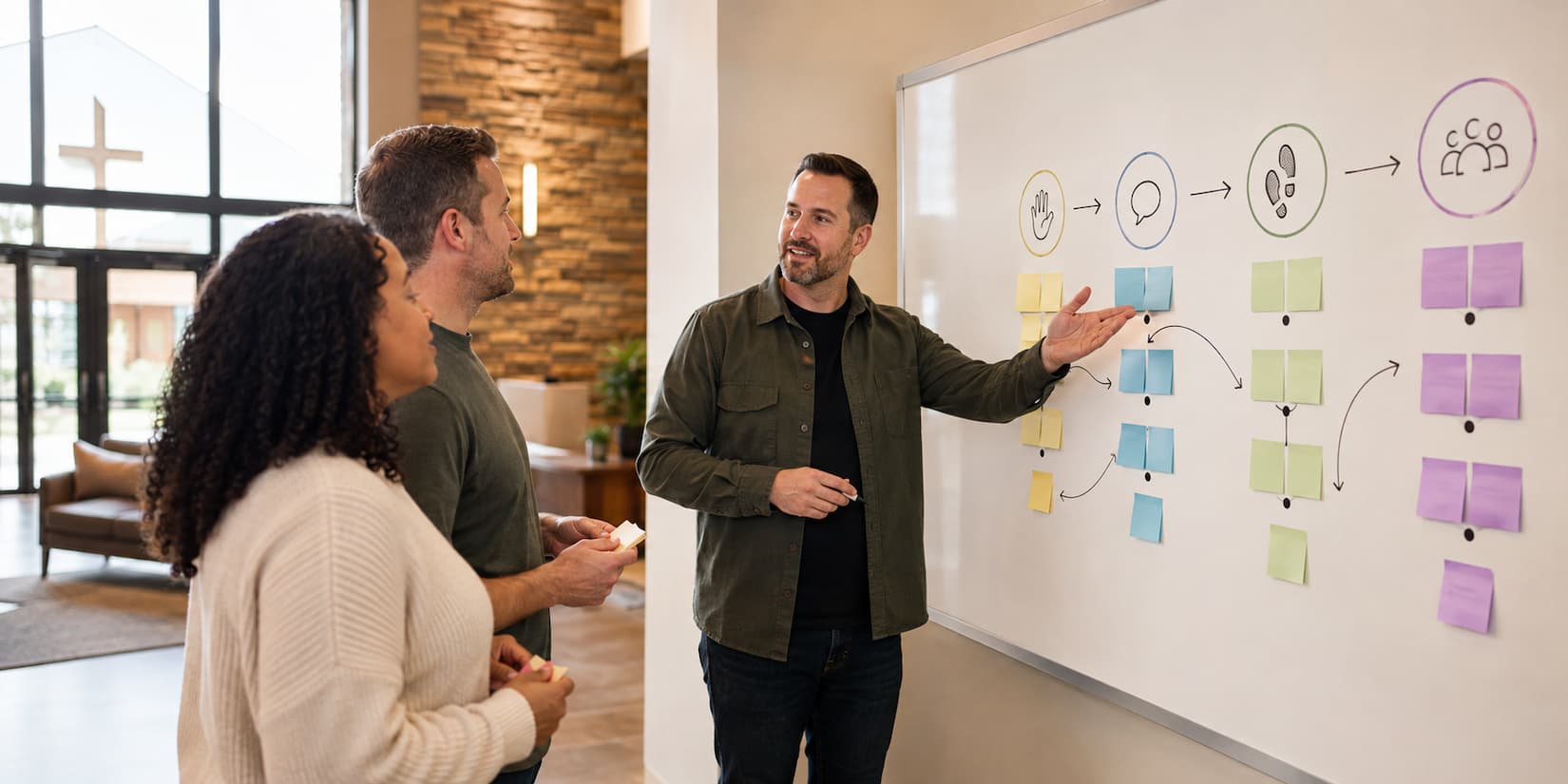
Start by mapping the journey from a person’s point of view:
- Can I tell what my next step is - Avoid presenting 20 unrelated opportunities. Offer a small number of clear invitations tied to purpose.
- Can I respond immediately - Use a simple form, QR code, app action, or conversation—not a vague instruction to “find someone later.”
- Will a real person contact me - Assign ownership and a reasonable follow-up window.
- Will I be prepared - Give people training, a defined role, and a leader who knows their name.
- Can I grow from here - Create a route from participation to responsibility and, eventually, leadership.
For a practical overview of systems that support these pathways, see Tithely’s guide to what church management software does in real ministry.
Let stories carry the vision
Every church has a “Bob”—the long-time attender who is skeptical of the new process, does not want a name tag, and sees no reason to change. Chasing Bob through the lobby usually creates friction. Ignoring him creates distance.
There is a third option: move forward faithfully, invite without coercion, and make God’s work visible.
Stories help people interpret change. Share how a guest was welcomed, a volunteer discovered a gift, or a small group surrounded a family in a difficult week. Repeated vision tells people where the church is going; credible stories show the journey is worthwhile.
Over time, reluctant people often step closer because they see God at work through ordinary people. Keep those stories in view through Sunday services, email, text messaging, groups, and your church app—always connecting the invitation with a person, a purpose, and an outcome.
Treat generosity as discipleship—and remove unnecessary friction
The same heart-first principle applies to giving.
If a small share of the congregation provides most of the financial support, the solution is not simply to ask existing givers for more. A healthier goal is to help more people understand generosity as part of an obedient, worshipful life.
That conversation must be handled with integrity. Giving is not a transaction that guarantees a particular blessing, and generosity should never be extracted through shame. Churches can teach Scripture, acknowledge past harm, invite prayerful response, and celebrate the ministry generosity makes possible.
Jeremy’s two-session God’s Economy Stewardship Training is designed for exactly this heart-level work. Rather than centering on a fundraising target, the course helps people examine obedience, financial strongholds, and the fuller biblical meaning of abundance—including righteousness, relationships, ministry, and worship. Church Coach Ministries equips a trusted leader from within the congregation to facilitate the sessions and provides leader and participant materials.
Ready for a stewardship conversation that is transformational rather than transactional? Reach out to Church Coach Ministries to explore God’s Economy and use code TITHELY for $300 off the course.
At the same time, spiritual formation and practical accessibility are not competitors. A person may sincerely want to give and still forget a checkbook, miss a Sunday, or struggle to find the giving page. Once the heart is ready, unnecessary friction should not block the response.
Tithely Giving provides online, mobile, text, and recurring giving options, along with reporting that reduces administrative work. Recurring giving can help a good intention become a consistent practice. The point is not to turn discipleship into a checkout flow. It is to make giving simple after someone has decided to give.
For a deeper look at this balance, read How to Increase Church Giving Without Another Stewardship Sermon and How Digital Giving Increases Generosity.
Measure movement, not just attendance
Sunday attendance matters, but it cannot tell you whether people are moving toward belonging and ownership.
Choose a small set of indicators that reflects your discipleship pathway, such as:
· first-time guests who receive personal follow-up;
· people moving from attendance into a group;
· first-time and returning volunteers;
· new leaders being developed;
· households beginning a giving practice; and
· people serving beyond the church campus.
Numbers do not replace pastoral wisdom; they help direct it. If connection forms do not lead to groups, a handoff may be broken. If volunteer interest is high but retention is low, training or leadership may need attention. If generosity teaching is clear but participation remains flat, the giving experience may contain avoidable obstacles.
Measurement helps leaders see where people are getting lost. Tithely’s article on measuring church success beyond attendance explores healthier signs of ministry impact.
A 30-day starting plan
Begin with one movement:
Week 1: Listen and pray - Ask where people experience confusion, disconnection, or friction. Pray for your community and specific people who are not yet connected.
Week 2: Map one pathway - Choose guest follow-up, volunteer onboarding, group connection, or generosity. Write down every step, assign an owner, and remove anything that is unclear or redundant.
Week 3: Equip a broader team - Train people not only in tasks, but in the ministry purpose behind them. Give them language, boundaries, and a clear leader.
Week 4: Invite and tell stories - Make one focused invitation, provide an immediate response mechanism, and share evidence of how God is already using people in that area.
Celebrate movement, repair weak handoffs, and repeat.
The goal is shared ownership
Fully engaged people are not merely busier church members. They are disciples who understand that God has placed them where they are for a purpose.
When that conviction becomes part of a church’s culture, the burden of ministry begins to spread from a few shoulders across the body. Guests encounter more than a polished welcome team; they meet a welcoming church. Generosity becomes more than an appeal; it becomes worship. Pastors stop carrying every ministry function and begin equipping new ministers.
Systems cannot create that transformation. But thoughtful systems can protect it, reinforce it, and make room for it to grow.
Your next step depends on where the pathway is breaking. If guests are arriving but not connecting, start with Assimilation Training. If giving conversations feel transactional or reach the same people every time, bring God’s Economy to your church. If disconnected tools make it harder to follow up, communicate, schedule volunteers, and support generosity, explore Tithely All Access. Coaching can help shape the ministry culture; connected technology can help your team carry it consistently.
The 70% is not a problem to solve. It is a group of people to shepherd—and an enormous field of God-given potential waiting to be equipped.
Sign Up for Product Updates

Laura is a writer and ministry leader with experience in church communications, administration, worship ministry, and nonprofit support. She is passionate about helping people grow in their faith through biblical truth, practical encouragement, and honest conversations about the messy middle of everyday life.
When she's not writing, she's spending time with her family and hoping for the swift return of side parts and high-waisted skinny jeans.
There is a group in nearly every church that leaders think about constantly.
They attend often enough to consider the church home. They may know the songs, recognize the staff, and stay connected to a few friends. But they have not yet found a meaningful place to serve, developed a consistent practice of generosity, or begun to see the church’s mission as their mission.
Calling them “uncommitted” is tempting and rarely helpful.
Many are not resisting ministry. They are waiting—sometimes without realizing it—for a clearer invitation into purpose, relationships, and responsibility. The challenge is not filling more volunteer slots or producing a stronger giving appeal. It is closing the distance between attending church and owning its mission.
That was the central tension in Tithely’s recent webinar, “Why 70% of Your Congregation Isn’t Fully Engaged and What to Do About It,” featuring Jeremy Malick, founder of Church Coach Ministries, and Pierce Eaton, senior pastor of First Baptist Church of Texas City. Their conversation surfaced a truth worth exploring beyond the webinar: engagement grows when discipleship, culture, and practical systems reinforce one another.
Watch the webinar
Watch the full conversation with Jeremy Malick and Pierce Eaton for church stories, practical examples, and the complete Q&A.
The 70% is not a staffing pool
When a church sees the same dependable 15 or 20 people carrying most of the ministry, the natural response is to recruit harder. Leaders make more announcements, send more emails, and ask reliable volunteers to take on one more responsibility.
That may fill an immediate opening, but it can deepen the underlying problem. The most committed people become exhausted while everyone else learns that ministry belongs to a small, highly motivated group.
Ephesians 4 offers a better picture: church leaders equip the saints for the work of ministry. The congregation is not an audience from which the staff occasionally recruits help. The congregation is the ministry body.
This shift changes the question. Instead of asking, “How can we get more people to help us run our programs?” ask, “How can we help every person recognize where God has already placed them to serve?”
That service may happen on a welcome team, in a small group, or in children’s ministry. It may also happen at a jobsite, in a neighborhood, or beside a child’s soccer field. Healthy engagement connects Sunday participation to a whole-life calling.
Start with heart alignment, not a sign-up sheet
Sustainable engagement begins before the clipboard comes out. It begins with prayer and a shared understanding of the church’s mission in its community.
Jeremy encourages churches to pray what he calls a dangerous prayer: “Lord, if You have a divine moment for me today, help me hear Your voice and respond in obedience.” That prayer moves ministry from abstraction to attentiveness. It gives every person a next step that is both spiritual and practical.
Corporate prayer matters, too. When a congregation prays together about welcoming neighbors, reaching people far from God, and serving nearby needs, hearts turn in the same direction. A volunteer initiative can feel like an institutional demand. A prayer-shaped response to God’s work feels like discipleship.
This is also why guilt is a poor engagement strategy. Shame may produce a short burst of activity, but it rarely produces joyful service or generosity. Churches can speak clearly about biblical obedience while remaining gentle, honest, and patient—especially with people who have been hurt by manipulative appeals in the past.
Make hospitality a culture, not a department
Guest engagement is one of the clearest places to see the difference between a ministry team and a ministry culture.
A church may have excellent greeters and still feel difficult to enter. First-time guests arrive with questions they may never say aloud: Where do my children go? Am I dressed correctly? Will anyone notice that I do not know what happens next? Will I be singled out? If that anxiety remains high, even an excellent sermon can be hard to receive.
The first several minutes on campus therefore belong to everyone, not only the welcome team. A warm handoff at children’s check-in, a member who notices someone standing alone, clear signage, and a natural conversation before worship all communicate, “You are safe here, and we expected you.”
At First Baptist Church of Texas City, the change began with whole-church training. The congregation learned how to recognize and engage guests, and leaders kept reinforcing the vision from the platform. Hospitality stopped being something a small team performed and became part of the church’s identity.
That is the work of Church Coach Ministries’ Assimilation Training. Over four months, Jeremy’s team helps a church build a plan for its context, identify and equip lay leaders, recruit the wider congregation, and launch teams for guest experience, connection, follow-up, media, and administration. If your church welcomes guests but struggles to help them belong—or if guest care still rests on a few dependable people—explore Assimilation Training and start a conversation with Jeremy’s team.
Technology should support that human care. A clear church website can answer a guest’s first questions before Sunday. Tithely Church Management can organize people, volunteers, forms, and follow-up workflows so a conversation does not disappear into a stack of connection cards. The tool is not the relationship; it helps the church keep its relational promises.
For more practical guidance, see Tithely’s resources on building a church visitor follow-up strategy and attracting church visitors online.
Build pathways people can actually follow
The goal is not to force everyone through one rigid sequence. It is to make every next step visible, personal, and easy to take.
Start by mapping the journey from a person’s point of view:
- Can I tell what my next step is - Avoid presenting 20 unrelated opportunities. Offer a small number of clear invitations tied to purpose.
- Can I respond immediately - Use a simple form, QR code, app action, or conversation—not a vague instruction to “find someone later.”
- Will a real person contact me - Assign ownership and a reasonable follow-up window.
- Will I be prepared - Give people training, a defined role, and a leader who knows their name.
- Can I grow from here - Create a route from participation to responsibility and, eventually, leadership.
For a practical overview of systems that support these pathways, see Tithely’s guide to what church management software does in real ministry.
Let stories carry the vision
Every church has a “Bob”—the long-time attender who is skeptical of the new process, does not want a name tag, and sees no reason to change. Chasing Bob through the lobby usually creates friction. Ignoring him creates distance.
There is a third option: move forward faithfully, invite without coercion, and make God’s work visible.
Stories help people interpret change. Share how a guest was welcomed, a volunteer discovered a gift, or a small group surrounded a family in a difficult week. Repeated vision tells people where the church is going; credible stories show the journey is worthwhile.
Over time, reluctant people often step closer because they see God at work through ordinary people. Keep those stories in view through Sunday services, email, text messaging, groups, and your church app—always connecting the invitation with a person, a purpose, and an outcome.
Treat generosity as discipleship—and remove unnecessary friction
The same heart-first principle applies to giving.
If a small share of the congregation provides most of the financial support, the solution is not simply to ask existing givers for more. A healthier goal is to help more people understand generosity as part of an obedient, worshipful life.
That conversation must be handled with integrity. Giving is not a transaction that guarantees a particular blessing, and generosity should never be extracted through shame. Churches can teach Scripture, acknowledge past harm, invite prayerful response, and celebrate the ministry generosity makes possible.
Jeremy’s two-session God’s Economy Stewardship Training is designed for exactly this heart-level work. Rather than centering on a fundraising target, the course helps people examine obedience, financial strongholds, and the fuller biblical meaning of abundance—including righteousness, relationships, ministry, and worship. Church Coach Ministries equips a trusted leader from within the congregation to facilitate the sessions and provides leader and participant materials.
Ready for a stewardship conversation that is transformational rather than transactional? Reach out to Church Coach Ministries to explore God’s Economy and use code TITHELY for $300 off the course.
At the same time, spiritual formation and practical accessibility are not competitors. A person may sincerely want to give and still forget a checkbook, miss a Sunday, or struggle to find the giving page. Once the heart is ready, unnecessary friction should not block the response.
Tithely Giving provides online, mobile, text, and recurring giving options, along with reporting that reduces administrative work. Recurring giving can help a good intention become a consistent practice. The point is not to turn discipleship into a checkout flow. It is to make giving simple after someone has decided to give.
For a deeper look at this balance, read How to Increase Church Giving Without Another Stewardship Sermon and How Digital Giving Increases Generosity.
Measure movement, not just attendance
Sunday attendance matters, but it cannot tell you whether people are moving toward belonging and ownership.
Choose a small set of indicators that reflects your discipleship pathway, such as:
· first-time guests who receive personal follow-up;
· people moving from attendance into a group;
· first-time and returning volunteers;
· new leaders being developed;
· households beginning a giving practice; and
· people serving beyond the church campus.
Numbers do not replace pastoral wisdom; they help direct it. If connection forms do not lead to groups, a handoff may be broken. If volunteer interest is high but retention is low, training or leadership may need attention. If generosity teaching is clear but participation remains flat, the giving experience may contain avoidable obstacles.
Measurement helps leaders see where people are getting lost. Tithely’s article on measuring church success beyond attendance explores healthier signs of ministry impact.
A 30-day starting plan
Begin with one movement:
Week 1: Listen and pray - Ask where people experience confusion, disconnection, or friction. Pray for your community and specific people who are not yet connected.
Week 2: Map one pathway - Choose guest follow-up, volunteer onboarding, group connection, or generosity. Write down every step, assign an owner, and remove anything that is unclear or redundant.
Week 3: Equip a broader team - Train people not only in tasks, but in the ministry purpose behind them. Give them language, boundaries, and a clear leader.
Week 4: Invite and tell stories - Make one focused invitation, provide an immediate response mechanism, and share evidence of how God is already using people in that area.
Celebrate movement, repair weak handoffs, and repeat.
The goal is shared ownership
Fully engaged people are not merely busier church members. They are disciples who understand that God has placed them where they are for a purpose.
When that conviction becomes part of a church’s culture, the burden of ministry begins to spread from a few shoulders across the body. Guests encounter more than a polished welcome team; they meet a welcoming church. Generosity becomes more than an appeal; it becomes worship. Pastors stop carrying every ministry function and begin equipping new ministers.
Systems cannot create that transformation. But thoughtful systems can protect it, reinforce it, and make room for it to grow.
Your next step depends on where the pathway is breaking. If guests are arriving but not connecting, start with Assimilation Training. If giving conversations feel transactional or reach the same people every time, bring God’s Economy to your church. If disconnected tools make it harder to follow up, communicate, schedule volunteers, and support generosity, explore Tithely All Access. Coaching can help shape the ministry culture; connected technology can help your team carry it consistently.
The 70% is not a problem to solve. It is a group of people to shepherd—and an enormous field of God-given potential waiting to be equipped.
podcast transcript
Laura is a writer and ministry leader with experience in church communications, administration, worship ministry, and nonprofit support. She is passionate about helping people grow in their faith through biblical truth, practical encouragement, and honest conversations about the messy middle of everyday life.
When she's not writing, she's spending time with her family and hoping for the swift return of side parts and high-waisted skinny jeans.
There is a group in nearly every church that leaders think about constantly.
They attend often enough to consider the church home. They may know the songs, recognize the staff, and stay connected to a few friends. But they have not yet found a meaningful place to serve, developed a consistent practice of generosity, or begun to see the church’s mission as their mission.
Calling them “uncommitted” is tempting and rarely helpful.
Many are not resisting ministry. They are waiting—sometimes without realizing it—for a clearer invitation into purpose, relationships, and responsibility. The challenge is not filling more volunteer slots or producing a stronger giving appeal. It is closing the distance between attending church and owning its mission.
That was the central tension in Tithely’s recent webinar, “Why 70% of Your Congregation Isn’t Fully Engaged and What to Do About It,” featuring Jeremy Malick, founder of Church Coach Ministries, and Pierce Eaton, senior pastor of First Baptist Church of Texas City. Their conversation surfaced a truth worth exploring beyond the webinar: engagement grows when discipleship, culture, and practical systems reinforce one another.
Watch the webinar
Watch the full conversation with Jeremy Malick and Pierce Eaton for church stories, practical examples, and the complete Q&A.
The 70% is not a staffing pool
When a church sees the same dependable 15 or 20 people carrying most of the ministry, the natural response is to recruit harder. Leaders make more announcements, send more emails, and ask reliable volunteers to take on one more responsibility.
That may fill an immediate opening, but it can deepen the underlying problem. The most committed people become exhausted while everyone else learns that ministry belongs to a small, highly motivated group.
Ephesians 4 offers a better picture: church leaders equip the saints for the work of ministry. The congregation is not an audience from which the staff occasionally recruits help. The congregation is the ministry body.
This shift changes the question. Instead of asking, “How can we get more people to help us run our programs?” ask, “How can we help every person recognize where God has already placed them to serve?”
That service may happen on a welcome team, in a small group, or in children’s ministry. It may also happen at a jobsite, in a neighborhood, or beside a child’s soccer field. Healthy engagement connects Sunday participation to a whole-life calling.
Start with heart alignment, not a sign-up sheet
Sustainable engagement begins before the clipboard comes out. It begins with prayer and a shared understanding of the church’s mission in its community.
Jeremy encourages churches to pray what he calls a dangerous prayer: “Lord, if You have a divine moment for me today, help me hear Your voice and respond in obedience.” That prayer moves ministry from abstraction to attentiveness. It gives every person a next step that is both spiritual and practical.
Corporate prayer matters, too. When a congregation prays together about welcoming neighbors, reaching people far from God, and serving nearby needs, hearts turn in the same direction. A volunteer initiative can feel like an institutional demand. A prayer-shaped response to God’s work feels like discipleship.
This is also why guilt is a poor engagement strategy. Shame may produce a short burst of activity, but it rarely produces joyful service or generosity. Churches can speak clearly about biblical obedience while remaining gentle, honest, and patient—especially with people who have been hurt by manipulative appeals in the past.
Make hospitality a culture, not a department
Guest engagement is one of the clearest places to see the difference between a ministry team and a ministry culture.
A church may have excellent greeters and still feel difficult to enter. First-time guests arrive with questions they may never say aloud: Where do my children go? Am I dressed correctly? Will anyone notice that I do not know what happens next? Will I be singled out? If that anxiety remains high, even an excellent sermon can be hard to receive.
The first several minutes on campus therefore belong to everyone, not only the welcome team. A warm handoff at children’s check-in, a member who notices someone standing alone, clear signage, and a natural conversation before worship all communicate, “You are safe here, and we expected you.”
At First Baptist Church of Texas City, the change began with whole-church training. The congregation learned how to recognize and engage guests, and leaders kept reinforcing the vision from the platform. Hospitality stopped being something a small team performed and became part of the church’s identity.
That is the work of Church Coach Ministries’ Assimilation Training. Over four months, Jeremy’s team helps a church build a plan for its context, identify and equip lay leaders, recruit the wider congregation, and launch teams for guest experience, connection, follow-up, media, and administration. If your church welcomes guests but struggles to help them belong—or if guest care still rests on a few dependable people—explore Assimilation Training and start a conversation with Jeremy’s team.
Technology should support that human care. A clear church website can answer a guest’s first questions before Sunday. Tithely Church Management can organize people, volunteers, forms, and follow-up workflows so a conversation does not disappear into a stack of connection cards. The tool is not the relationship; it helps the church keep its relational promises.
For more practical guidance, see Tithely’s resources on building a church visitor follow-up strategy and attracting church visitors online.
Build pathways people can actually follow
The goal is not to force everyone through one rigid sequence. It is to make every next step visible, personal, and easy to take.
Start by mapping the journey from a person’s point of view:
- Can I tell what my next step is - Avoid presenting 20 unrelated opportunities. Offer a small number of clear invitations tied to purpose.
- Can I respond immediately - Use a simple form, QR code, app action, or conversation—not a vague instruction to “find someone later.”
- Will a real person contact me - Assign ownership and a reasonable follow-up window.
- Will I be prepared - Give people training, a defined role, and a leader who knows their name.
- Can I grow from here - Create a route from participation to responsibility and, eventually, leadership.
For a practical overview of systems that support these pathways, see Tithely’s guide to what church management software does in real ministry.
Let stories carry the vision
Every church has a “Bob”—the long-time attender who is skeptical of the new process, does not want a name tag, and sees no reason to change. Chasing Bob through the lobby usually creates friction. Ignoring him creates distance.
There is a third option: move forward faithfully, invite without coercion, and make God’s work visible.
Stories help people interpret change. Share how a guest was welcomed, a volunteer discovered a gift, or a small group surrounded a family in a difficult week. Repeated vision tells people where the church is going; credible stories show the journey is worthwhile.
Over time, reluctant people often step closer because they see God at work through ordinary people. Keep those stories in view through Sunday services, email, text messaging, groups, and your church app—always connecting the invitation with a person, a purpose, and an outcome.
Treat generosity as discipleship—and remove unnecessary friction
The same heart-first principle applies to giving.
If a small share of the congregation provides most of the financial support, the solution is not simply to ask existing givers for more. A healthier goal is to help more people understand generosity as part of an obedient, worshipful life.
That conversation must be handled with integrity. Giving is not a transaction that guarantees a particular blessing, and generosity should never be extracted through shame. Churches can teach Scripture, acknowledge past harm, invite prayerful response, and celebrate the ministry generosity makes possible.
Jeremy’s two-session God’s Economy Stewardship Training is designed for exactly this heart-level work. Rather than centering on a fundraising target, the course helps people examine obedience, financial strongholds, and the fuller biblical meaning of abundance—including righteousness, relationships, ministry, and worship. Church Coach Ministries equips a trusted leader from within the congregation to facilitate the sessions and provides leader and participant materials.
Ready for a stewardship conversation that is transformational rather than transactional? Reach out to Church Coach Ministries to explore God’s Economy and use code TITHELY for $300 off the course.
At the same time, spiritual formation and practical accessibility are not competitors. A person may sincerely want to give and still forget a checkbook, miss a Sunday, or struggle to find the giving page. Once the heart is ready, unnecessary friction should not block the response.
Tithely Giving provides online, mobile, text, and recurring giving options, along with reporting that reduces administrative work. Recurring giving can help a good intention become a consistent practice. The point is not to turn discipleship into a checkout flow. It is to make giving simple after someone has decided to give.
For a deeper look at this balance, read How to Increase Church Giving Without Another Stewardship Sermon and How Digital Giving Increases Generosity.
Measure movement, not just attendance
Sunday attendance matters, but it cannot tell you whether people are moving toward belonging and ownership.
Choose a small set of indicators that reflects your discipleship pathway, such as:
· first-time guests who receive personal follow-up;
· people moving from attendance into a group;
· first-time and returning volunteers;
· new leaders being developed;
· households beginning a giving practice; and
· people serving beyond the church campus.
Numbers do not replace pastoral wisdom; they help direct it. If connection forms do not lead to groups, a handoff may be broken. If volunteer interest is high but retention is low, training or leadership may need attention. If generosity teaching is clear but participation remains flat, the giving experience may contain avoidable obstacles.
Measurement helps leaders see where people are getting lost. Tithely’s article on measuring church success beyond attendance explores healthier signs of ministry impact.
A 30-day starting plan
Begin with one movement:
Week 1: Listen and pray - Ask where people experience confusion, disconnection, or friction. Pray for your community and specific people who are not yet connected.
Week 2: Map one pathway - Choose guest follow-up, volunteer onboarding, group connection, or generosity. Write down every step, assign an owner, and remove anything that is unclear or redundant.
Week 3: Equip a broader team - Train people not only in tasks, but in the ministry purpose behind them. Give them language, boundaries, and a clear leader.
Week 4: Invite and tell stories - Make one focused invitation, provide an immediate response mechanism, and share evidence of how God is already using people in that area.
Celebrate movement, repair weak handoffs, and repeat.
The goal is shared ownership
Fully engaged people are not merely busier church members. They are disciples who understand that God has placed them where they are for a purpose.
When that conviction becomes part of a church’s culture, the burden of ministry begins to spread from a few shoulders across the body. Guests encounter more than a polished welcome team; they meet a welcoming church. Generosity becomes more than an appeal; it becomes worship. Pastors stop carrying every ministry function and begin equipping new ministers.
Systems cannot create that transformation. But thoughtful systems can protect it, reinforce it, and make room for it to grow.
Your next step depends on where the pathway is breaking. If guests are arriving but not connecting, start with Assimilation Training. If giving conversations feel transactional or reach the same people every time, bring God’s Economy to your church. If disconnected tools make it harder to follow up, communicate, schedule volunteers, and support generosity, explore Tithely All Access. Coaching can help shape the ministry culture; connected technology can help your team carry it consistently.
The 70% is not a problem to solve. It is a group of people to shepherd—and an enormous field of God-given potential waiting to be equipped.
VIDEO transcript
There is a group in nearly every church that leaders think about constantly.
They attend often enough to consider the church home. They may know the songs, recognize the staff, and stay connected to a few friends. But they have not yet found a meaningful place to serve, developed a consistent practice of generosity, or begun to see the church’s mission as their mission.
Calling them “uncommitted” is tempting and rarely helpful.
Many are not resisting ministry. They are waiting—sometimes without realizing it—for a clearer invitation into purpose, relationships, and responsibility. The challenge is not filling more volunteer slots or producing a stronger giving appeal. It is closing the distance between attending church and owning its mission.
That was the central tension in Tithely’s recent webinar, “Why 70% of Your Congregation Isn’t Fully Engaged and What to Do About It,” featuring Jeremy Malick, founder of Church Coach Ministries, and Pierce Eaton, senior pastor of First Baptist Church of Texas City. Their conversation surfaced a truth worth exploring beyond the webinar: engagement grows when discipleship, culture, and practical systems reinforce one another.
Watch the webinar
Watch the full conversation with Jeremy Malick and Pierce Eaton for church stories, practical examples, and the complete Q&A.
The 70% is not a staffing pool
When a church sees the same dependable 15 or 20 people carrying most of the ministry, the natural response is to recruit harder. Leaders make more announcements, send more emails, and ask reliable volunteers to take on one more responsibility.
That may fill an immediate opening, but it can deepen the underlying problem. The most committed people become exhausted while everyone else learns that ministry belongs to a small, highly motivated group.
Ephesians 4 offers a better picture: church leaders equip the saints for the work of ministry. The congregation is not an audience from which the staff occasionally recruits help. The congregation is the ministry body.
This shift changes the question. Instead of asking, “How can we get more people to help us run our programs?” ask, “How can we help every person recognize where God has already placed them to serve?”
That service may happen on a welcome team, in a small group, or in children’s ministry. It may also happen at a jobsite, in a neighborhood, or beside a child’s soccer field. Healthy engagement connects Sunday participation to a whole-life calling.
Start with heart alignment, not a sign-up sheet
Sustainable engagement begins before the clipboard comes out. It begins with prayer and a shared understanding of the church’s mission in its community.
Jeremy encourages churches to pray what he calls a dangerous prayer: “Lord, if You have a divine moment for me today, help me hear Your voice and respond in obedience.” That prayer moves ministry from abstraction to attentiveness. It gives every person a next step that is both spiritual and practical.
Corporate prayer matters, too. When a congregation prays together about welcoming neighbors, reaching people far from God, and serving nearby needs, hearts turn in the same direction. A volunteer initiative can feel like an institutional demand. A prayer-shaped response to God’s work feels like discipleship.
This is also why guilt is a poor engagement strategy. Shame may produce a short burst of activity, but it rarely produces joyful service or generosity. Churches can speak clearly about biblical obedience while remaining gentle, honest, and patient—especially with people who have been hurt by manipulative appeals in the past.
Make hospitality a culture, not a department
Guest engagement is one of the clearest places to see the difference between a ministry team and a ministry culture.
A church may have excellent greeters and still feel difficult to enter. First-time guests arrive with questions they may never say aloud: Where do my children go? Am I dressed correctly? Will anyone notice that I do not know what happens next? Will I be singled out? If that anxiety remains high, even an excellent sermon can be hard to receive.
The first several minutes on campus therefore belong to everyone, not only the welcome team. A warm handoff at children’s check-in, a member who notices someone standing alone, clear signage, and a natural conversation before worship all communicate, “You are safe here, and we expected you.”
At First Baptist Church of Texas City, the change began with whole-church training. The congregation learned how to recognize and engage guests, and leaders kept reinforcing the vision from the platform. Hospitality stopped being something a small team performed and became part of the church’s identity.
That is the work of Church Coach Ministries’ Assimilation Training. Over four months, Jeremy’s team helps a church build a plan for its context, identify and equip lay leaders, recruit the wider congregation, and launch teams for guest experience, connection, follow-up, media, and administration. If your church welcomes guests but struggles to help them belong—or if guest care still rests on a few dependable people—explore Assimilation Training and start a conversation with Jeremy’s team.
Technology should support that human care. A clear church website can answer a guest’s first questions before Sunday. Tithely Church Management can organize people, volunteers, forms, and follow-up workflows so a conversation does not disappear into a stack of connection cards. The tool is not the relationship; it helps the church keep its relational promises.
For more practical guidance, see Tithely’s resources on building a church visitor follow-up strategy and attracting church visitors online.
Build pathways people can actually follow
The goal is not to force everyone through one rigid sequence. It is to make every next step visible, personal, and easy to take.
Start by mapping the journey from a person’s point of view:
- Can I tell what my next step is - Avoid presenting 20 unrelated opportunities. Offer a small number of clear invitations tied to purpose.
- Can I respond immediately - Use a simple form, QR code, app action, or conversation—not a vague instruction to “find someone later.”
- Will a real person contact me - Assign ownership and a reasonable follow-up window.
- Will I be prepared - Give people training, a defined role, and a leader who knows their name.
- Can I grow from here - Create a route from participation to responsibility and, eventually, leadership.
For a practical overview of systems that support these pathways, see Tithely’s guide to what church management software does in real ministry.
Let stories carry the vision
Every church has a “Bob”—the long-time attender who is skeptical of the new process, does not want a name tag, and sees no reason to change. Chasing Bob through the lobby usually creates friction. Ignoring him creates distance.
There is a third option: move forward faithfully, invite without coercion, and make God’s work visible.
Stories help people interpret change. Share how a guest was welcomed, a volunteer discovered a gift, or a small group surrounded a family in a difficult week. Repeated vision tells people where the church is going; credible stories show the journey is worthwhile.
Over time, reluctant people often step closer because they see God at work through ordinary people. Keep those stories in view through Sunday services, email, text messaging, groups, and your church app—always connecting the invitation with a person, a purpose, and an outcome.
Treat generosity as discipleship—and remove unnecessary friction
The same heart-first principle applies to giving.
If a small share of the congregation provides most of the financial support, the solution is not simply to ask existing givers for more. A healthier goal is to help more people understand generosity as part of an obedient, worshipful life.
That conversation must be handled with integrity. Giving is not a transaction that guarantees a particular blessing, and generosity should never be extracted through shame. Churches can teach Scripture, acknowledge past harm, invite prayerful response, and celebrate the ministry generosity makes possible.
Jeremy’s two-session God’s Economy Stewardship Training is designed for exactly this heart-level work. Rather than centering on a fundraising target, the course helps people examine obedience, financial strongholds, and the fuller biblical meaning of abundance—including righteousness, relationships, ministry, and worship. Church Coach Ministries equips a trusted leader from within the congregation to facilitate the sessions and provides leader and participant materials.
Ready for a stewardship conversation that is transformational rather than transactional? Reach out to Church Coach Ministries to explore God’s Economy and use code TITHELY for $300 off the course.
At the same time, spiritual formation and practical accessibility are not competitors. A person may sincerely want to give and still forget a checkbook, miss a Sunday, or struggle to find the giving page. Once the heart is ready, unnecessary friction should not block the response.
Tithely Giving provides online, mobile, text, and recurring giving options, along with reporting that reduces administrative work. Recurring giving can help a good intention become a consistent practice. The point is not to turn discipleship into a checkout flow. It is to make giving simple after someone has decided to give.
For a deeper look at this balance, read How to Increase Church Giving Without Another Stewardship Sermon and How Digital Giving Increases Generosity.
Measure movement, not just attendance
Sunday attendance matters, but it cannot tell you whether people are moving toward belonging and ownership.
Choose a small set of indicators that reflects your discipleship pathway, such as:
· first-time guests who receive personal follow-up;
· people moving from attendance into a group;
· first-time and returning volunteers;
· new leaders being developed;
· households beginning a giving practice; and
· people serving beyond the church campus.
Numbers do not replace pastoral wisdom; they help direct it. If connection forms do not lead to groups, a handoff may be broken. If volunteer interest is high but retention is low, training or leadership may need attention. If generosity teaching is clear but participation remains flat, the giving experience may contain avoidable obstacles.
Measurement helps leaders see where people are getting lost. Tithely’s article on measuring church success beyond attendance explores healthier signs of ministry impact.
A 30-day starting plan
Begin with one movement:
Week 1: Listen and pray - Ask where people experience confusion, disconnection, or friction. Pray for your community and specific people who are not yet connected.
Week 2: Map one pathway - Choose guest follow-up, volunteer onboarding, group connection, or generosity. Write down every step, assign an owner, and remove anything that is unclear or redundant.
Week 3: Equip a broader team - Train people not only in tasks, but in the ministry purpose behind them. Give them language, boundaries, and a clear leader.
Week 4: Invite and tell stories - Make one focused invitation, provide an immediate response mechanism, and share evidence of how God is already using people in that area.
Celebrate movement, repair weak handoffs, and repeat.
The goal is shared ownership
Fully engaged people are not merely busier church members. They are disciples who understand that God has placed them where they are for a purpose.
When that conviction becomes part of a church’s culture, the burden of ministry begins to spread from a few shoulders across the body. Guests encounter more than a polished welcome team; they meet a welcoming church. Generosity becomes more than an appeal; it becomes worship. Pastors stop carrying every ministry function and begin equipping new ministers.
Systems cannot create that transformation. But thoughtful systems can protect it, reinforce it, and make room for it to grow.
Your next step depends on where the pathway is breaking. If guests are arriving but not connecting, start with Assimilation Training. If giving conversations feel transactional or reach the same people every time, bring God’s Economy to your church. If disconnected tools make it harder to follow up, communicate, schedule volunteers, and support generosity, explore Tithely All Access. Coaching can help shape the ministry culture; connected technology can help your team carry it consistently.
The 70% is not a problem to solve. It is a group of people to shepherd—and an enormous field of God-given potential waiting to be equipped.
Sign Up for Product Updates
Laura is a writer and ministry leader with experience in church communications, administration, worship ministry, and nonprofit support. She is passionate about helping people grow in their faith through biblical truth, practical encouragement, and honest conversations about the messy middle of everyday life.
When she's not writing, she's spending time with her family and hoping for the swift return of side parts and high-waisted skinny jeans.

You Might Also Like
More Resources

From increasing giving, managing your congregation, and engaging your church, our collection of resources will keep you up-to-date on the latest church and ministry trends.
Free Resources





.jpg)