Church Bookkeeping: A Pastor's Practical Guide to Managing Ministry Finances
You were called to shepherd people, not spreadsheets. Here's how to think about church bookkeeping — what makes it different, how to keep it trustworthy, and how to choose software that fits your ministry.




Almost every pastor we talk to describes the same moment. The church grows, the giving picks up, the paid staff expands past two people, and suddenly the casual way you've been tracking money doesn't feel casual anymore. It feels fragile. One volunteer leaves, one bank statement gets misfiled, and you realize the financial health of the ministry has been held together by one person's memory.
That's the moment church bookkeeping stops being a back-office chore and starts being a leadership issue.
This guide is written for the pastor who never signed up to be a finance director. We'll cover what makes church bookkeeping different from business bookkeeping, the handful of principles that keep it trustworthy, how to decide whether to do it yourself or bring in help, and what to look for in the software that runs it all.
What makes church bookkeeping different?
If you hand your church's books to a general business bookkeeper, the first thing they'll notice is that the numbers don't behave the way they expect. Churches aren't unusual out of stubbornness — they're unusual because the IRS and most donors think about church money differently than business money.
Four things set church bookkeeping apart:
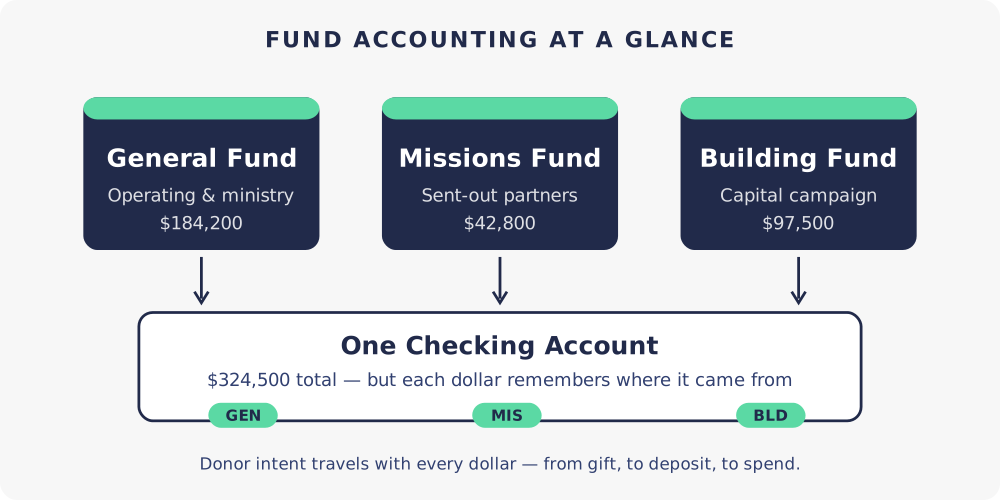
Fund accounting. A business tracks one pile of cash. A church tracks many. The General Fund covers the day-to-day ministry. The Missions Fund holds gifts designated for the people you've sent out. The Building Fund holds the capital campaign dollars. They all sit in the same checking account at the bank, but on the books they're separate buckets — and money given to one cannot be spent on another. Mixing them isn't just bad hygiene; it's a potential violation of donor intent.
Donor designations. When a member writes "Missions" in the memo of their check, that designation follows the dollar. Your bookkeeping has to respect it, year-round, and be able to prove it.
Clergy compensation. Pastors have a tax situation almost no one else in American tax code shares — including the housing allowance, dual-status treatment for Social Security, and the option to opt out of SECA. Your payroll has to handle this correctly or you put your pastors in a painful spot with the IRS.
Nonprofit reporting. Most churches are exempt from filing a Form 990, but the financial statements your board and denominational body expect look more like a nonprofit's than a small business's. They're built around funds, not profit and loss.
What church bookkeeping actually covers
Strip away the jargon and church bookkeeping is six jobs:
- Recording every gift — and keeping a running record by donor for year-end statements.
- Recording non-contribution income — facility rentals, book sales, bookstore, ministry fees.
- Paying the bills — vendors, utilities, curriculum, reimbursements.
- Running payroll — with the right handling of clergy housing and benefits.
- Reconciling the accounts — making sure the bank, the giving platform, and the bookkeeping software all agree each month.
- Reporting to leadership — fund balances, budget vs. actual, giving trends.
If any one of those jobs is held together by a single volunteer's memory or a spreadsheet only one person can read, that's your weakest link. Fix that one first.
The five principles that keep church bookkeeping trustworthy
You don't need a CPA's full playbook to run a trustworthy set of books. You need five commitments, held consistently:
1. Separation of duties. The person who counts the offering shouldn't be the person who deposits it, and neither of them should be the person who reconciles the bank statement. Small churches can feel boxed in here, but even a two-person pairing beats a one-person setup.
2. Two sets of eyes on every transaction. Every deposit gets counted by two unrelated people. Every check over a threshold gets a second signature. Every month-end reconciliation gets reviewed by someone who didn't prepare it.
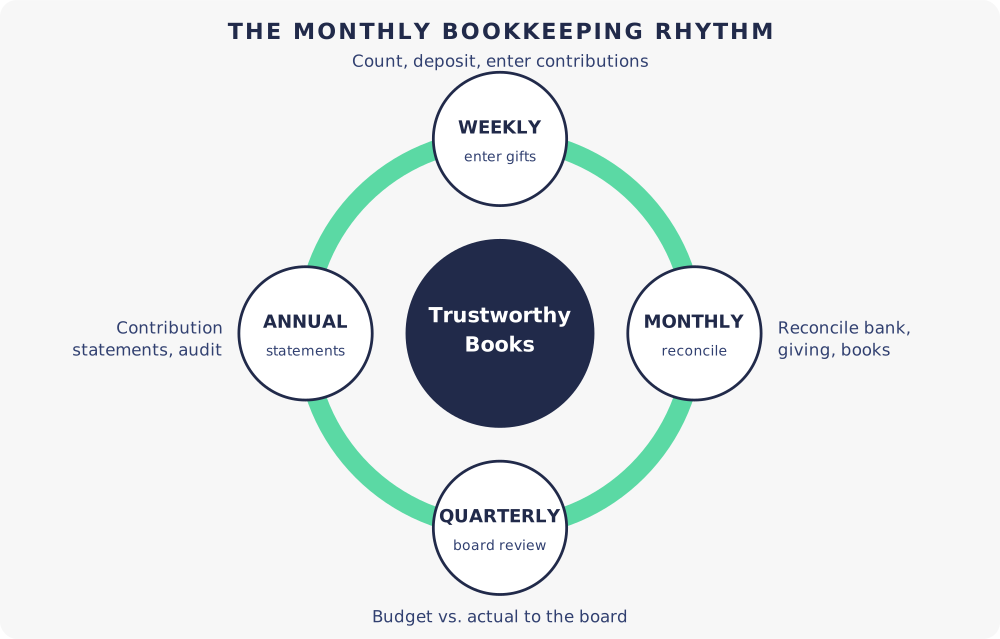
3. Monthly reconciliation — of everything. Bank statement, giving platform, bookkeeping software. All three should agree at the end of every month. If they don't, you find the gap now, not at a board meeting nine months later.
4. Board-reviewed financials. Your elders, deacons, or finance committee should see fund balances, budget vs. actual, and a giving trend every month. Not buried in a packet — on the agenda.
5. A written financial policy. One document. Who can approve what, what the check-signing thresholds are, how designated gifts are handled, what happens when a designated fund is overfunded. Written down, approved by the board, followed without exception.
Integrity is not what you do when everyone's watching. It's the system you build so that no one has to.
DIY, in-house staff, or outsourced?
There is no single right model. There are four common ones, and the right fit depends on the size of your church and the complexity of your finances.
Volunteer treasurer. Works for very small churches with simple giving. The risk: succession. What happens when your treasurer moves, steps away, or gets overwhelmed? Have an answer before you need one.
Part-time bookkeeper on staff. Often the right next step — 10 to 20 hours a week of paid, accountable work. Expect to pay $25–$45 an hour depending on your region. Make sure the role has a backup.
Outsourced bookkeeping service. A nonprofit-specialized firm handles the books remotely, usually for a flat monthly fee. Expect $400–$1,500 a month depending on transaction volume. The upside: separation of duties built in, no single-point-of-failure. The downside: you have to trust their workflow and response times.
Full-time financial staff. For churches with annual budgets north of roughly $1M, a dedicated finance lead or executive pastor with finance oversight makes sense. By this point, you're past bookkeeping and into financial management.
Red flag across every model: if only one person knows how the system works, the system doesn't work. Documentation and cross-training are not optional.
What to look for in church bookkeeping software
Most churches end up with software that was designed for small businesses, patched to pretend it understands funds. It kind of works — until year-end, or an audit, or a pastor transition.
When you're evaluating church bookkeeping software, the short list of features that actually matter:
- Fund accounting that's native, not bolted on. You should be able to see fund balances without building a report from scratch every time.
- Direct integration with your giving platform. If your giving software and your bookkeeping software don't talk, you're about to hire a person to make them talk.
- Payroll that understands clergy. Housing allowance, dual-status taxation, SECA. If your payroll tool treats your pastor like a regular W-2 employee, you have a problem waiting to happen.
- Automatic contribution statements. January should not be a crisis.
- Role-based access and an audit trail. Who saw what, who changed what, when.
- A reporting layer your elders can actually read. If leadership can't understand the monthly report, you can't expect governance.
A simple monthly bookkeeping checklist
The pastor's monthly bookkeeping checklist
- Every Sunday: count the offering with two unrelated people; deposit within 48 hours.
- Every week: enter contributions and reconcile them against the giving platform.
- Every two weeks: process accounts payable and pay staff.
- Mid-month: review designated and restricted fund balances for overages or shortfalls.
- Month-end: reconcile bank statement, giving platform, and bookkeeping software. All three agree.
- First of the month: deliver a one-page financial summary to the elders or finance committee.
- Quarterly: review the financial policy against reality. What's drifting?
- Annually: issue contribution statements in the first two weeks of January.
Common mistakes — and how to avoid them
Commingling funds. The missions money gets "borrowed" to cover payroll in a tight month. It's almost always well-intentioned and almost always a slow-motion crisis. Don't do it. If you need to, raise the short-term gap explicitly with the board.
Losing donor intent. A gift is marked "Building" on Sunday, entered as "General" on Tuesday, and no one catches it until next June. Build a system where designated gifts are tagged once, at the point of entry, and never re-classified without a paper trail.
Letting the pastor touch the money. Not because pastors can't be trusted — but because pastors should never be put in a position where they have to prove they can be trusted. Separation of duties protects the pastor as much as it protects the church.
Skipping the board review. Monthly financials that never make it to the agenda are financials no one owns. Put them on the agenda. Every month.
The January crisis. Year-end contribution statements are the most visible thing your bookkeeping produces. If they're late, wrong, or confusing, every donor notices. Automate them.
Frequently asked questions
What does a church bookkeeper actually do?
A church bookkeeper records every gift and expense, runs payroll, reconciles accounts monthly, and produces financial reports for leadership. In a small church, one person does all of it. In a larger church, the role splits across a bookkeeper, a controller, and an executive pastor or finance lead.
Can we use QuickBooks for church bookkeeping?
Yes, with caveats. QuickBooks wasn't designed for fund accounting, so you'll build workarounds using classes and sub-accounts. It works for small churches with simple giving. Once you have multiple designated funds, active missions giving, and clergy payroll, a church-native platform saves you significant time.
How much should a church bookkeeper cost?
A part-time on-staff bookkeeper typically runs $25–$45 per hour. An outsourced bookkeeping service for a mid-sized church typically runs $400–$1,500 per month. A volunteer treasurer is free in dollars — and expensive in risk if the role isn't documented.
What are the basic principles of church bookkeeping?
Five: separation of duties, two sets of eyes on every transaction, monthly reconciliation of every account, board-reviewed financials, and a written financial policy. If all five are in place, you've built a trustworthy system.
Where Tithely fits in
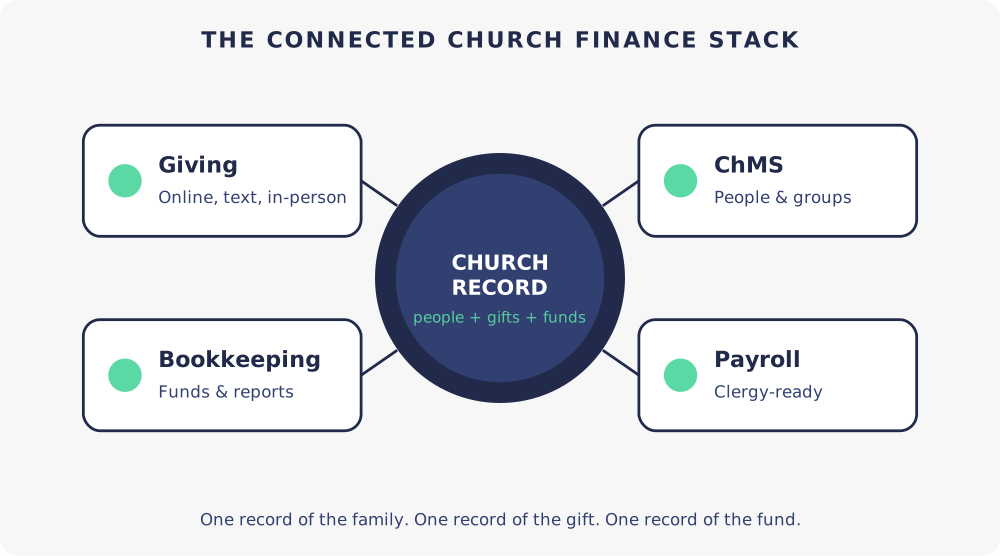
Tithely gives churches one connected place for giving, church management, and the people data your bookkeeping depends on. Gifts flow directly from your giving platform into your records — tagged by fund, tied to the donor, ready for year-end — so the rhythm this guide describes actually gets done without a second full-time job.
If you're evaluating how your finance stack should fit together, we'd love to show you how Tithely works with the bookkeeping tools you already trust.
See Tithely in action
Sign Up for Product Updates

Tithely provides the tools you need to engage with your church online, stay connected, increase generosity, and simplify the lives of your staff.
With tools like text and email messaging, custom church apps and websites, church management software, digital giving, and so much more… it’s no wonder why over 53,000 churches in 50 countries trust Tithely to help run their church.
Almost every pastor we talk to describes the same moment. The church grows, the giving picks up, the paid staff expands past two people, and suddenly the casual way you've been tracking money doesn't feel casual anymore. It feels fragile. One volunteer leaves, one bank statement gets misfiled, and you realize the financial health of the ministry has been held together by one person's memory.
That's the moment church bookkeeping stops being a back-office chore and starts being a leadership issue.
This guide is written for the pastor who never signed up to be a finance director. We'll cover what makes church bookkeeping different from business bookkeeping, the handful of principles that keep it trustworthy, how to decide whether to do it yourself or bring in help, and what to look for in the software that runs it all.
What makes church bookkeeping different?
If you hand your church's books to a general business bookkeeper, the first thing they'll notice is that the numbers don't behave the way they expect. Churches aren't unusual out of stubbornness — they're unusual because the IRS and most donors think about church money differently than business money.
Four things set church bookkeeping apart:
Fund accounting. A business tracks one pile of cash. A church tracks many. The General Fund covers the day-to-day ministry. The Missions Fund holds gifts designated for the people you've sent out. The Building Fund holds the capital campaign dollars. They all sit in the same checking account at the bank, but on the books they're separate buckets — and money given to one cannot be spent on another. Mixing them isn't just bad hygiene; it's a potential violation of donor intent.
Donor designations. When a member writes "Missions" in the memo of their check, that designation follows the dollar. Your bookkeeping has to respect it, year-round, and be able to prove it.
Clergy compensation. Pastors have a tax situation almost no one else in American tax code shares — including the housing allowance, dual-status treatment for Social Security, and the option to opt out of SECA. Your payroll has to handle this correctly or you put your pastors in a painful spot with the IRS.
Nonprofit reporting. Most churches are exempt from filing a Form 990, but the financial statements your board and denominational body expect look more like a nonprofit's than a small business's. They're built around funds, not profit and loss.
What church bookkeeping actually covers
Strip away the jargon and church bookkeeping is six jobs:
- Recording every gift — and keeping a running record by donor for year-end statements.
- Recording non-contribution income — facility rentals, book sales, bookstore, ministry fees.
- Paying the bills — vendors, utilities, curriculum, reimbursements.
- Running payroll — with the right handling of clergy housing and benefits.
- Reconciling the accounts — making sure the bank, the giving platform, and the bookkeeping software all agree each month.
- Reporting to leadership — fund balances, budget vs. actual, giving trends.
If any one of those jobs is held together by a single volunteer's memory or a spreadsheet only one person can read, that's your weakest link. Fix that one first.
The five principles that keep church bookkeeping trustworthy
You don't need a CPA's full playbook to run a trustworthy set of books. You need five commitments, held consistently:
1. Separation of duties. The person who counts the offering shouldn't be the person who deposits it, and neither of them should be the person who reconciles the bank statement. Small churches can feel boxed in here, but even a two-person pairing beats a one-person setup.
2. Two sets of eyes on every transaction. Every deposit gets counted by two unrelated people. Every check over a threshold gets a second signature. Every month-end reconciliation gets reviewed by someone who didn't prepare it.
3. Monthly reconciliation — of everything. Bank statement, giving platform, bookkeeping software. All three should agree at the end of every month. If they don't, you find the gap now, not at a board meeting nine months later.
4. Board-reviewed financials. Your elders, deacons, or finance committee should see fund balances, budget vs. actual, and a giving trend every month. Not buried in a packet — on the agenda.
5. A written financial policy. One document. Who can approve what, what the check-signing thresholds are, how designated gifts are handled, what happens when a designated fund is overfunded. Written down, approved by the board, followed without exception.
Integrity is not what you do when everyone's watching. It's the system you build so that no one has to.
DIY, in-house staff, or outsourced?
There is no single right model. There are four common ones, and the right fit depends on the size of your church and the complexity of your finances.
Volunteer treasurer. Works for very small churches with simple giving. The risk: succession. What happens when your treasurer moves, steps away, or gets overwhelmed? Have an answer before you need one.
Part-time bookkeeper on staff. Often the right next step — 10 to 20 hours a week of paid, accountable work. Expect to pay $25–$45 an hour depending on your region. Make sure the role has a backup.
Outsourced bookkeeping service. A nonprofit-specialized firm handles the books remotely, usually for a flat monthly fee. Expect $400–$1,500 a month depending on transaction volume. The upside: separation of duties built in, no single-point-of-failure. The downside: you have to trust their workflow and response times.
Full-time financial staff. For churches with annual budgets north of roughly $1M, a dedicated finance lead or executive pastor with finance oversight makes sense. By this point, you're past bookkeeping and into financial management.
Red flag across every model: if only one person knows how the system works, the system doesn't work. Documentation and cross-training are not optional.
What to look for in church bookkeeping software
Most churches end up with software that was designed for small businesses, patched to pretend it understands funds. It kind of works — until year-end, or an audit, or a pastor transition.
When you're evaluating church bookkeeping software, the short list of features that actually matter:
- Fund accounting that's native, not bolted on. You should be able to see fund balances without building a report from scratch every time.
- Direct integration with your giving platform. If your giving software and your bookkeeping software don't talk, you're about to hire a person to make them talk.
- Payroll that understands clergy. Housing allowance, dual-status taxation, SECA. If your payroll tool treats your pastor like a regular W-2 employee, you have a problem waiting to happen.
- Automatic contribution statements. January should not be a crisis.
- Role-based access and an audit trail. Who saw what, who changed what, when.
- A reporting layer your elders can actually read. If leadership can't understand the monthly report, you can't expect governance.
A simple monthly bookkeeping checklist
The pastor's monthly bookkeeping checklist
- Every Sunday: count the offering with two unrelated people; deposit within 48 hours.
- Every week: enter contributions and reconcile them against the giving platform.
- Every two weeks: process accounts payable and pay staff.
- Mid-month: review designated and restricted fund balances for overages or shortfalls.
- Month-end: reconcile bank statement, giving platform, and bookkeeping software. All three agree.
- First of the month: deliver a one-page financial summary to the elders or finance committee.
- Quarterly: review the financial policy against reality. What's drifting?
- Annually: issue contribution statements in the first two weeks of January.
Common mistakes — and how to avoid them
Commingling funds. The missions money gets "borrowed" to cover payroll in a tight month. It's almost always well-intentioned and almost always a slow-motion crisis. Don't do it. If you need to, raise the short-term gap explicitly with the board.
Losing donor intent. A gift is marked "Building" on Sunday, entered as "General" on Tuesday, and no one catches it until next June. Build a system where designated gifts are tagged once, at the point of entry, and never re-classified without a paper trail.
Letting the pastor touch the money. Not because pastors can't be trusted — but because pastors should never be put in a position where they have to prove they can be trusted. Separation of duties protects the pastor as much as it protects the church.
Skipping the board review. Monthly financials that never make it to the agenda are financials no one owns. Put them on the agenda. Every month.
The January crisis. Year-end contribution statements are the most visible thing your bookkeeping produces. If they're late, wrong, or confusing, every donor notices. Automate them.
Frequently asked questions
What does a church bookkeeper actually do?
A church bookkeeper records every gift and expense, runs payroll, reconciles accounts monthly, and produces financial reports for leadership. In a small church, one person does all of it. In a larger church, the role splits across a bookkeeper, a controller, and an executive pastor or finance lead.
Can we use QuickBooks for church bookkeeping?
Yes, with caveats. QuickBooks wasn't designed for fund accounting, so you'll build workarounds using classes and sub-accounts. It works for small churches with simple giving. Once you have multiple designated funds, active missions giving, and clergy payroll, a church-native platform saves you significant time.
How much should a church bookkeeper cost?
A part-time on-staff bookkeeper typically runs $25–$45 per hour. An outsourced bookkeeping service for a mid-sized church typically runs $400–$1,500 per month. A volunteer treasurer is free in dollars — and expensive in risk if the role isn't documented.
What are the basic principles of church bookkeeping?
Five: separation of duties, two sets of eyes on every transaction, monthly reconciliation of every account, board-reviewed financials, and a written financial policy. If all five are in place, you've built a trustworthy system.
Where Tithely fits in
Tithely gives churches one connected place for giving, church management, and the people data your bookkeeping depends on. Gifts flow directly from your giving platform into your records — tagged by fund, tied to the donor, ready for year-end — so the rhythm this guide describes actually gets done without a second full-time job.
If you're evaluating how your finance stack should fit together, we'd love to show you how Tithely works with the bookkeeping tools you already trust.
See Tithely in action
podcast transcript
Tithely provides the tools you need to engage with your church online, stay connected, increase generosity, and simplify the lives of your staff.
With tools like text and email messaging, custom church apps and websites, church management software, digital giving, and so much more… it’s no wonder why over 53,000 churches in 50 countries trust Tithely to help run their church.
Almost every pastor we talk to describes the same moment. The church grows, the giving picks up, the paid staff expands past two people, and suddenly the casual way you've been tracking money doesn't feel casual anymore. It feels fragile. One volunteer leaves, one bank statement gets misfiled, and you realize the financial health of the ministry has been held together by one person's memory.
That's the moment church bookkeeping stops being a back-office chore and starts being a leadership issue.
This guide is written for the pastor who never signed up to be a finance director. We'll cover what makes church bookkeeping different from business bookkeeping, the handful of principles that keep it trustworthy, how to decide whether to do it yourself or bring in help, and what to look for in the software that runs it all.
What makes church bookkeeping different?
If you hand your church's books to a general business bookkeeper, the first thing they'll notice is that the numbers don't behave the way they expect. Churches aren't unusual out of stubbornness — they're unusual because the IRS and most donors think about church money differently than business money.
Four things set church bookkeeping apart:
Fund accounting. A business tracks one pile of cash. A church tracks many. The General Fund covers the day-to-day ministry. The Missions Fund holds gifts designated for the people you've sent out. The Building Fund holds the capital campaign dollars. They all sit in the same checking account at the bank, but on the books they're separate buckets — and money given to one cannot be spent on another. Mixing them isn't just bad hygiene; it's a potential violation of donor intent.
Donor designations. When a member writes "Missions" in the memo of their check, that designation follows the dollar. Your bookkeeping has to respect it, year-round, and be able to prove it.
Clergy compensation. Pastors have a tax situation almost no one else in American tax code shares — including the housing allowance, dual-status treatment for Social Security, and the option to opt out of SECA. Your payroll has to handle this correctly or you put your pastors in a painful spot with the IRS.
Nonprofit reporting. Most churches are exempt from filing a Form 990, but the financial statements your board and denominational body expect look more like a nonprofit's than a small business's. They're built around funds, not profit and loss.
What church bookkeeping actually covers
Strip away the jargon and church bookkeeping is six jobs:
- Recording every gift — and keeping a running record by donor for year-end statements.
- Recording non-contribution income — facility rentals, book sales, bookstore, ministry fees.
- Paying the bills — vendors, utilities, curriculum, reimbursements.
- Running payroll — with the right handling of clergy housing and benefits.
- Reconciling the accounts — making sure the bank, the giving platform, and the bookkeeping software all agree each month.
- Reporting to leadership — fund balances, budget vs. actual, giving trends.
If any one of those jobs is held together by a single volunteer's memory or a spreadsheet only one person can read, that's your weakest link. Fix that one first.
The five principles that keep church bookkeeping trustworthy
You don't need a CPA's full playbook to run a trustworthy set of books. You need five commitments, held consistently:
1. Separation of duties. The person who counts the offering shouldn't be the person who deposits it, and neither of them should be the person who reconciles the bank statement. Small churches can feel boxed in here, but even a two-person pairing beats a one-person setup.
2. Two sets of eyes on every transaction. Every deposit gets counted by two unrelated people. Every check over a threshold gets a second signature. Every month-end reconciliation gets reviewed by someone who didn't prepare it.
3. Monthly reconciliation — of everything. Bank statement, giving platform, bookkeeping software. All three should agree at the end of every month. If they don't, you find the gap now, not at a board meeting nine months later.
4. Board-reviewed financials. Your elders, deacons, or finance committee should see fund balances, budget vs. actual, and a giving trend every month. Not buried in a packet — on the agenda.
5. A written financial policy. One document. Who can approve what, what the check-signing thresholds are, how designated gifts are handled, what happens when a designated fund is overfunded. Written down, approved by the board, followed without exception.
Integrity is not what you do when everyone's watching. It's the system you build so that no one has to.
DIY, in-house staff, or outsourced?
There is no single right model. There are four common ones, and the right fit depends on the size of your church and the complexity of your finances.
Volunteer treasurer. Works for very small churches with simple giving. The risk: succession. What happens when your treasurer moves, steps away, or gets overwhelmed? Have an answer before you need one.
Part-time bookkeeper on staff. Often the right next step — 10 to 20 hours a week of paid, accountable work. Expect to pay $25–$45 an hour depending on your region. Make sure the role has a backup.
Outsourced bookkeeping service. A nonprofit-specialized firm handles the books remotely, usually for a flat monthly fee. Expect $400–$1,500 a month depending on transaction volume. The upside: separation of duties built in, no single-point-of-failure. The downside: you have to trust their workflow and response times.
Full-time financial staff. For churches with annual budgets north of roughly $1M, a dedicated finance lead or executive pastor with finance oversight makes sense. By this point, you're past bookkeeping and into financial management.
Red flag across every model: if only one person knows how the system works, the system doesn't work. Documentation and cross-training are not optional.
What to look for in church bookkeeping software
Most churches end up with software that was designed for small businesses, patched to pretend it understands funds. It kind of works — until year-end, or an audit, or a pastor transition.
When you're evaluating church bookkeeping software, the short list of features that actually matter:
- Fund accounting that's native, not bolted on. You should be able to see fund balances without building a report from scratch every time.
- Direct integration with your giving platform. If your giving software and your bookkeeping software don't talk, you're about to hire a person to make them talk.
- Payroll that understands clergy. Housing allowance, dual-status taxation, SECA. If your payroll tool treats your pastor like a regular W-2 employee, you have a problem waiting to happen.
- Automatic contribution statements. January should not be a crisis.
- Role-based access and an audit trail. Who saw what, who changed what, when.
- A reporting layer your elders can actually read. If leadership can't understand the monthly report, you can't expect governance.
A simple monthly bookkeeping checklist
The pastor's monthly bookkeeping checklist
- Every Sunday: count the offering with two unrelated people; deposit within 48 hours.
- Every week: enter contributions and reconcile them against the giving platform.
- Every two weeks: process accounts payable and pay staff.
- Mid-month: review designated and restricted fund balances for overages or shortfalls.
- Month-end: reconcile bank statement, giving platform, and bookkeeping software. All three agree.
- First of the month: deliver a one-page financial summary to the elders or finance committee.
- Quarterly: review the financial policy against reality. What's drifting?
- Annually: issue contribution statements in the first two weeks of January.
Common mistakes — and how to avoid them
Commingling funds. The missions money gets "borrowed" to cover payroll in a tight month. It's almost always well-intentioned and almost always a slow-motion crisis. Don't do it. If you need to, raise the short-term gap explicitly with the board.
Losing donor intent. A gift is marked "Building" on Sunday, entered as "General" on Tuesday, and no one catches it until next June. Build a system where designated gifts are tagged once, at the point of entry, and never re-classified without a paper trail.
Letting the pastor touch the money. Not because pastors can't be trusted — but because pastors should never be put in a position where they have to prove they can be trusted. Separation of duties protects the pastor as much as it protects the church.
Skipping the board review. Monthly financials that never make it to the agenda are financials no one owns. Put them on the agenda. Every month.
The January crisis. Year-end contribution statements are the most visible thing your bookkeeping produces. If they're late, wrong, or confusing, every donor notices. Automate them.
Frequently asked questions
What does a church bookkeeper actually do?
A church bookkeeper records every gift and expense, runs payroll, reconciles accounts monthly, and produces financial reports for leadership. In a small church, one person does all of it. In a larger church, the role splits across a bookkeeper, a controller, and an executive pastor or finance lead.
Can we use QuickBooks for church bookkeeping?
Yes, with caveats. QuickBooks wasn't designed for fund accounting, so you'll build workarounds using classes and sub-accounts. It works for small churches with simple giving. Once you have multiple designated funds, active missions giving, and clergy payroll, a church-native platform saves you significant time.
How much should a church bookkeeper cost?
A part-time on-staff bookkeeper typically runs $25–$45 per hour. An outsourced bookkeeping service for a mid-sized church typically runs $400–$1,500 per month. A volunteer treasurer is free in dollars — and expensive in risk if the role isn't documented.
What are the basic principles of church bookkeeping?
Five: separation of duties, two sets of eyes on every transaction, monthly reconciliation of every account, board-reviewed financials, and a written financial policy. If all five are in place, you've built a trustworthy system.
Where Tithely fits in
Tithely gives churches one connected place for giving, church management, and the people data your bookkeeping depends on. Gifts flow directly from your giving platform into your records — tagged by fund, tied to the donor, ready for year-end — so the rhythm this guide describes actually gets done without a second full-time job.
If you're evaluating how your finance stack should fit together, we'd love to show you how Tithely works with the bookkeeping tools you already trust.
See Tithely in action
VIDEO transcript
Almost every pastor we talk to describes the same moment. The church grows, the giving picks up, the paid staff expands past two people, and suddenly the casual way you've been tracking money doesn't feel casual anymore. It feels fragile. One volunteer leaves, one bank statement gets misfiled, and you realize the financial health of the ministry has been held together by one person's memory.
That's the moment church bookkeeping stops being a back-office chore and starts being a leadership issue.
This guide is written for the pastor who never signed up to be a finance director. We'll cover what makes church bookkeeping different from business bookkeeping, the handful of principles that keep it trustworthy, how to decide whether to do it yourself or bring in help, and what to look for in the software that runs it all.
What makes church bookkeeping different?
If you hand your church's books to a general business bookkeeper, the first thing they'll notice is that the numbers don't behave the way they expect. Churches aren't unusual out of stubbornness — they're unusual because the IRS and most donors think about church money differently than business money.
Four things set church bookkeeping apart:
Fund accounting. A business tracks one pile of cash. A church tracks many. The General Fund covers the day-to-day ministry. The Missions Fund holds gifts designated for the people you've sent out. The Building Fund holds the capital campaign dollars. They all sit in the same checking account at the bank, but on the books they're separate buckets — and money given to one cannot be spent on another. Mixing them isn't just bad hygiene; it's a potential violation of donor intent.
Donor designations. When a member writes "Missions" in the memo of their check, that designation follows the dollar. Your bookkeeping has to respect it, year-round, and be able to prove it.
Clergy compensation. Pastors have a tax situation almost no one else in American tax code shares — including the housing allowance, dual-status treatment for Social Security, and the option to opt out of SECA. Your payroll has to handle this correctly or you put your pastors in a painful spot with the IRS.
Nonprofit reporting. Most churches are exempt from filing a Form 990, but the financial statements your board and denominational body expect look more like a nonprofit's than a small business's. They're built around funds, not profit and loss.
What church bookkeeping actually covers
Strip away the jargon and church bookkeeping is six jobs:
- Recording every gift — and keeping a running record by donor for year-end statements.
- Recording non-contribution income — facility rentals, book sales, bookstore, ministry fees.
- Paying the bills — vendors, utilities, curriculum, reimbursements.
- Running payroll — with the right handling of clergy housing and benefits.
- Reconciling the accounts — making sure the bank, the giving platform, and the bookkeeping software all agree each month.
- Reporting to leadership — fund balances, budget vs. actual, giving trends.
If any one of those jobs is held together by a single volunteer's memory or a spreadsheet only one person can read, that's your weakest link. Fix that one first.
The five principles that keep church bookkeeping trustworthy
You don't need a CPA's full playbook to run a trustworthy set of books. You need five commitments, held consistently:
1. Separation of duties. The person who counts the offering shouldn't be the person who deposits it, and neither of them should be the person who reconciles the bank statement. Small churches can feel boxed in here, but even a two-person pairing beats a one-person setup.
2. Two sets of eyes on every transaction. Every deposit gets counted by two unrelated people. Every check over a threshold gets a second signature. Every month-end reconciliation gets reviewed by someone who didn't prepare it.
3. Monthly reconciliation — of everything. Bank statement, giving platform, bookkeeping software. All three should agree at the end of every month. If they don't, you find the gap now, not at a board meeting nine months later.
4. Board-reviewed financials. Your elders, deacons, or finance committee should see fund balances, budget vs. actual, and a giving trend every month. Not buried in a packet — on the agenda.
5. A written financial policy. One document. Who can approve what, what the check-signing thresholds are, how designated gifts are handled, what happens when a designated fund is overfunded. Written down, approved by the board, followed without exception.
Integrity is not what you do when everyone's watching. It's the system you build so that no one has to.
DIY, in-house staff, or outsourced?
There is no single right model. There are four common ones, and the right fit depends on the size of your church and the complexity of your finances.
Volunteer treasurer. Works for very small churches with simple giving. The risk: succession. What happens when your treasurer moves, steps away, or gets overwhelmed? Have an answer before you need one.
Part-time bookkeeper on staff. Often the right next step — 10 to 20 hours a week of paid, accountable work. Expect to pay $25–$45 an hour depending on your region. Make sure the role has a backup.
Outsourced bookkeeping service. A nonprofit-specialized firm handles the books remotely, usually for a flat monthly fee. Expect $400–$1,500 a month depending on transaction volume. The upside: separation of duties built in, no single-point-of-failure. The downside: you have to trust their workflow and response times.
Full-time financial staff. For churches with annual budgets north of roughly $1M, a dedicated finance lead or executive pastor with finance oversight makes sense. By this point, you're past bookkeeping and into financial management.
Red flag across every model: if only one person knows how the system works, the system doesn't work. Documentation and cross-training are not optional.
What to look for in church bookkeeping software
Most churches end up with software that was designed for small businesses, patched to pretend it understands funds. It kind of works — until year-end, or an audit, or a pastor transition.
When you're evaluating church bookkeeping software, the short list of features that actually matter:
- Fund accounting that's native, not bolted on. You should be able to see fund balances without building a report from scratch every time.
- Direct integration with your giving platform. If your giving software and your bookkeeping software don't talk, you're about to hire a person to make them talk.
- Payroll that understands clergy. Housing allowance, dual-status taxation, SECA. If your payroll tool treats your pastor like a regular W-2 employee, you have a problem waiting to happen.
- Automatic contribution statements. January should not be a crisis.
- Role-based access and an audit trail. Who saw what, who changed what, when.
- A reporting layer your elders can actually read. If leadership can't understand the monthly report, you can't expect governance.
A simple monthly bookkeeping checklist
The pastor's monthly bookkeeping checklist
- Every Sunday: count the offering with two unrelated people; deposit within 48 hours.
- Every week: enter contributions and reconcile them against the giving platform.
- Every two weeks: process accounts payable and pay staff.
- Mid-month: review designated and restricted fund balances for overages or shortfalls.
- Month-end: reconcile bank statement, giving platform, and bookkeeping software. All three agree.
- First of the month: deliver a one-page financial summary to the elders or finance committee.
- Quarterly: review the financial policy against reality. What's drifting?
- Annually: issue contribution statements in the first two weeks of January.
Common mistakes — and how to avoid them
Commingling funds. The missions money gets "borrowed" to cover payroll in a tight month. It's almost always well-intentioned and almost always a slow-motion crisis. Don't do it. If you need to, raise the short-term gap explicitly with the board.
Losing donor intent. A gift is marked "Building" on Sunday, entered as "General" on Tuesday, and no one catches it until next June. Build a system where designated gifts are tagged once, at the point of entry, and never re-classified without a paper trail.
Letting the pastor touch the money. Not because pastors can't be trusted — but because pastors should never be put in a position where they have to prove they can be trusted. Separation of duties protects the pastor as much as it protects the church.
Skipping the board review. Monthly financials that never make it to the agenda are financials no one owns. Put them on the agenda. Every month.
The January crisis. Year-end contribution statements are the most visible thing your bookkeeping produces. If they're late, wrong, or confusing, every donor notices. Automate them.
Frequently asked questions
What does a church bookkeeper actually do?
A church bookkeeper records every gift and expense, runs payroll, reconciles accounts monthly, and produces financial reports for leadership. In a small church, one person does all of it. In a larger church, the role splits across a bookkeeper, a controller, and an executive pastor or finance lead.
Can we use QuickBooks for church bookkeeping?
Yes, with caveats. QuickBooks wasn't designed for fund accounting, so you'll build workarounds using classes and sub-accounts. It works for small churches with simple giving. Once you have multiple designated funds, active missions giving, and clergy payroll, a church-native platform saves you significant time.
How much should a church bookkeeper cost?
A part-time on-staff bookkeeper typically runs $25–$45 per hour. An outsourced bookkeeping service for a mid-sized church typically runs $400–$1,500 per month. A volunteer treasurer is free in dollars — and expensive in risk if the role isn't documented.
What are the basic principles of church bookkeeping?
Five: separation of duties, two sets of eyes on every transaction, monthly reconciliation of every account, board-reviewed financials, and a written financial policy. If all five are in place, you've built a trustworthy system.
Where Tithely fits in
Tithely gives churches one connected place for giving, church management, and the people data your bookkeeping depends on. Gifts flow directly from your giving platform into your records — tagged by fund, tied to the donor, ready for year-end — so the rhythm this guide describes actually gets done without a second full-time job.
If you're evaluating how your finance stack should fit together, we'd love to show you how Tithely works with the bookkeeping tools you already trust.
See Tithely in action
Sign Up for Product Updates
Tithely provides the tools you need to engage with your church online, stay connected, increase generosity, and simplify the lives of your staff.
With tools like text and email messaging, custom church apps and websites, church management software, digital giving, and so much more… it’s no wonder why over 53,000 churches in 50 countries trust Tithely to help run their church.

You Might Also Like
More Resources

From increasing giving, managing your congregation, and engaging your church, our collection of resources will keep you up-to-date on the latest church and ministry trends.
Free Resources