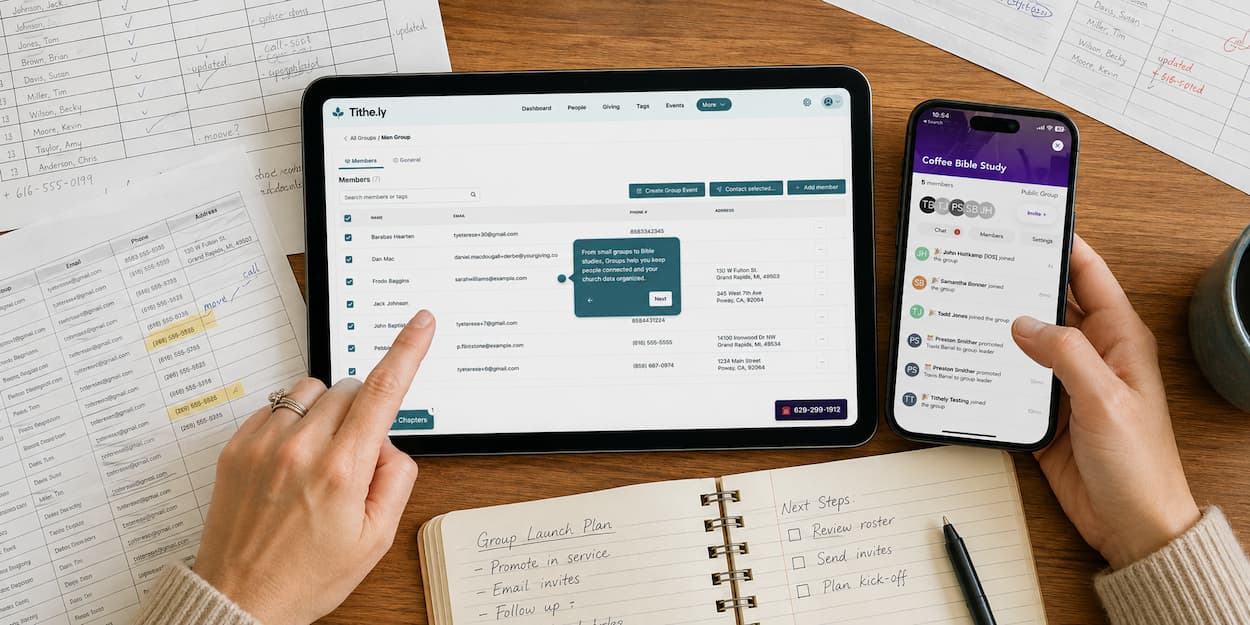
We Predicted the Church's Future Back in 2020. It's Now 2026. Let's See How We Did.
Remember when we said churches would ditch Facebook and Christians would wear AR glasses to track their Bible reading? Yeah. Let's talk about that.




In April 2020, three weeks into lockdown, we published a list of 7 predictions for how church technology would look by 2025. We were confident. We were bold. We were... let's find out.
Below is the original article, word for word, exactly as it ran. After each prediction, you'll find a 2026 grade, because nothing keeps you humble like your own content archive.
The Original Article (Published April 15, 2020)
COVID-19 has thrust churches on their heels, left to grab whatever technology might keep them from stumbling into non-existence completely.
All of a sudden, features such as on-website live-streaming, digital giving, church apps, and church management systems have become not luxury items for tech-forward churches, but safeguards for every church. If COVID-19 is the iceberg, church tech contains the lifeboats.
However, what most churches don’t know is that the world has been setting churches up for this transition for a long time — and it would have happened, COVID-19 or not. Even though COVID-19 is at the forefront of the world's frontal lobe, we should not attribute to COVID-19 what can just as substantially be attributed to culture.
Technology is changing the way the world works. We were primed for a revolutionary change before the pandemic and even now leaders are planning their return to church after COVID 19. Businesses have been revolutionized. Families and lifestyles have been reconceived and transformed by the iPhone. The church was one of the last remaining institutions to remain mostly unchanged.
However, the church is no exception.
As amazing church technology tools like Tithely continue to be adopted by tens of thousands of churches, the best practices for churches are changing.
How churches communicate with their congregants is transforming.
How visitors are using Google to find reputable churches is evolving.
How small groups and church events are organized and marketed is being consolidated into mobile-first models.
How churches raise money, automate tithing, and implement eCommerce tools into their fundraising strategies is progressing at light speed.
What is the consequence of the technological revolution in churches?
There is a clear and direct effect of technological adoption into successful church growth strategies:
- Church size.
- Church giving.
If you understand your congregation and your community and have a reliable and accurate marketing plan in place, then the skeleton key to your church’s success in these areas of growth and revenue is technology.
The downside for late-adopters is that they both have to ride the learning curve of technological adoption in their churches and they are forced to compete with similar early-adopting churches in their area who already have momentum in both domains—size and revenue—on their side.
In order to put the odds back on your side and break through your growth goals in both size and fundraising, you need to have your eye on what church technology is going to look like in 2025 so that you can become the kind of early-adopting church that has growth momentum on its side in five years.
Churches must realize that these new technological modalities of facilitating church ministry during COVID-19 are not emergency measures—they are the new normal.
Without further delay, here is what church technology will look like in 5 years, and how you can implement these technologies into your church management strategy today.
1. Church Management Software will become the new base of operations for church leaders
Tools like Tithe.y ChMS will become increasingly common among churches as a foundational tool for managing and tracking users across church websites, apps, giving, engagement, events, and text and email marketing.
While the current church technology market doesn’t offer any kind of enterprise solution that perfectly integrates all of these integrations, the closest thing is Tithely All Access, which does enable church leaders to manage all of these assets through a single suite of tools that automatically integrate with one another.
2. Digital giving will account for 80% or more of church giving
While the church has been classified by Andy Stanley into a business category closest to “Events Business,” which was accurate for a long time, in our digital and mobile-first age, there has emerged a better category: “Membership Business.” In one sense, it is both. In business terms, the church is an events-forward membership model.
Churches that are adopting technology are shifting their mental model for conceiving of what their church is from merely an events model to a membership model that includes events.
Because of this, tithing will come to be viewed as a membership “best practice” that is routed through a church’s app, which tracks engagement, gives push notifications, and enables users to remain plugged into the weekly happenings of their churches.
Because church members and visitors will be understood in terms of an actual membership model, and membership models are primarily eCommerce offerings such as online communities and digital courses, the “eCommerce” aspect will translate to churches in the form of digital giving.
Because engagement will be increasingly routed digitally through church apps, which enable native giving, then this mode of giving will be intuitive for Millennials and GenZ, who are building wealth exponentially and will be the primary population of church donors by 2025.
3. All church technology companies will offer a single sign-on solution for multiple technologies
The church giving company PushPay recently acquired the church management software CCB.
Anyone who is reading the tea leaves of church technology right now knows that the future of church technology is in a fully integrated, single sign-on solution to the needs of a church. Currently, the only tool that comes close to this is Tithely All Access.
If a church is looking for a technology that will scale into enormous growth and remain the #1 tool in church technology for the foreseeable future, they should use and implement Tithely All Access immediately.
4. Member engagement will be mobile-first
Wearable technology recently doubled its percentage of Apple’s quarterly revenue. Wearable technology that syncs with a mobile device is the next phase of mobile and mobile-adjacent technology. The more wearable technology grows—and it will continue to grow at a rapid pace—the more essential mobile technology will be to our lived, embodied, daily lives.
Because of this, churches will follow suit—sooner or later—by integrating their needs into tools that are crafted specifically for the needs of a church. Those needs prioritize member engagement and visitor acquisition. Segmented in this way, churches will be enabled to optimize their sites for new visitors and optimize their apps for engaged members.
This means that small group curriculum, sermon notes, digital giving, event registration, and church communications will all be routed through the mobile app. In that sense, individual church apps will take on a character more similar to Facebook than a single-application church app that functions like a website.
Member engagement will drive people to the app. Giving, church announcements, and event registration will be available only through the app, which will drive people to use the app for the exclusive access it offers to members such as small group engagement and event attendance.
5. A spiritual health analytics dashboard for every Christian
In Apple’s latest profit and loss statement, it showed that wearable technology took an enormous increase in its share of Apple's overall revenue. While we are now in the adolescence of mobile technology in our culture, by 2025, we will be in the adolescence of wearable technology—including AR glasses, which sync with their mobile and other wearable devices.
In other words, the barrier between the digital world and our physical world will become imperceptibly thin—especially for the youth.
This will look like:
• Augmented Reality glasses that can tell how much of the Bible you have read, and display notes
• Listening technology to track when and whether you have prayed
• Advanced screen time analytics displaying online internet health
Many more features will be conceived, but the point is that Christians will be able to automate the tracking and display of spiritual health analytics—there will be methods of quantifying sanctification with behavioral health technology that will help Christians get a better sense of how to cultivate a more healthy, rhythmic, and robust spiritual life.
6. An exodus from social media in its current form
Facebook, Instagram, and Twitter will become outmoded forms of pubic content distribution. People will opt for private interactive digital communities—going back to the increasing use of the membership model for conceiving of the nature of the church organization—and drift toward platforms that offer more privacy, security, communal segmentation, and intimacy (closer to what Facebook looked like when it originally launched).
The function of social media platforms as public utilities will continue as modes of distribution, but will not be the primary domain in which engagement is cultivated. Currently, social media is both the entry point and home of engagement for members, fans, and followers, but it will gradually lose its status as a home of engagement. Churches will follow suit and adopt the private membership model in order to own and cultivate its relationship with its own audience and with its own technology.
The primary downside of social media is that the companies themselves own the relationship. If your Facebook or Twitter pages were deleted tomorrow, you would have no way of retrieving those followers. But if you own the domain in which your church members engage—whether that is through a ChMS-supported app or website, then you own the emails, addresses, names, and ancillary information of all of those members.
If your church technology company went out of business tomorrow, you could migrate all of those members to a new platform on the same day. This benefit is incentivizing businesses and churches alike to move their follower base to a platform that contains a contact list that they own and operate. This is overall a good thing for churches and their relationships with their members.
7. Online church will grow.
Perhaps a better way of referring to the phenomenon which will grow is “remote church.” Because membership, which syncs across web and mobile, is mediated by an account which is registered with a church management software such as Tithely ChMS, users will be able to watch sermons, take notes, give, and engage from the comfort of their own homes.
Over to you
Church technology will take massive leaps forward in the next 5 years. As mobile technology grows, this signals one thing to churches: get on the bandwagon now. You don’t want to be the late-adopting church that is catching up with church tech 5 years from now. You want to have your digital infrastructure in place, set up for scale, and tilted toward maximum engagement and growth. If you want your church to grow in population size and engagement, start implementing these future realities as much as you can now through a membership model mindset so that when these become common practices among churches, your members and visitors are already giving your their buy-in. Remember:
- Church Management Software will become the new base of operations for church leaders.
- Digital giving will account for 80% or more of church giving.
- All church technology companies will offer a single sign-on solution for multiple technologies.
- Member engagement will be mobile-first.
- A spiritual health analytics dashboard for every Christian.
- An exodus from social media in its current form.
- Online church will grow.
Overall accuracy: about 65%. Not bad for a team of marketers three weeks into a global lockdown, but a good reminder that "the church will abandon Facebook" is exactly the kind of prediction that ages like milk.
If there's one thing that held up across all seven predictions, it's this: churches that leaned into technology early by using online giving, ChMS, and apps, are the ones now running smoother operations in 2026. That part, we'll take.
Sign Up for Product Updates

Tithely provides the tools you need to engage with your church online, stay connected, increase generosity, and simplify the lives of your staff.
With tools like text and email messaging, custom church apps and websites, church management software, digital giving, and so much more… it’s no wonder why over 53,000 churches in 50 countries trust Tithely to help run their church.
In April 2020, three weeks into lockdown, we published a list of 7 predictions for how church technology would look by 2025. We were confident. We were bold. We were... let's find out.
Below is the original article, word for word, exactly as it ran. After each prediction, you'll find a 2026 grade, because nothing keeps you humble like your own content archive.
The Original Article (Published April 15, 2020)
COVID-19 has thrust churches on their heels, left to grab whatever technology might keep them from stumbling into non-existence completely.
All of a sudden, features such as on-website live-streaming, digital giving, church apps, and church management systems have become not luxury items for tech-forward churches, but safeguards for every church. If COVID-19 is the iceberg, church tech contains the lifeboats.
However, what most churches don’t know is that the world has been setting churches up for this transition for a long time — and it would have happened, COVID-19 or not. Even though COVID-19 is at the forefront of the world's frontal lobe, we should not attribute to COVID-19 what can just as substantially be attributed to culture.
Technology is changing the way the world works. We were primed for a revolutionary change before the pandemic and even now leaders are planning their return to church after COVID 19. Businesses have been revolutionized. Families and lifestyles have been reconceived and transformed by the iPhone. The church was one of the last remaining institutions to remain mostly unchanged.
However, the church is no exception.
As amazing church technology tools like Tithely continue to be adopted by tens of thousands of churches, the best practices for churches are changing.
How churches communicate with their congregants is transforming.
How visitors are using Google to find reputable churches is evolving.
How small groups and church events are organized and marketed is being consolidated into mobile-first models.
How churches raise money, automate tithing, and implement eCommerce tools into their fundraising strategies is progressing at light speed.
What is the consequence of the technological revolution in churches?
There is a clear and direct effect of technological adoption into successful church growth strategies:
- Church size.
- Church giving.
If you understand your congregation and your community and have a reliable and accurate marketing plan in place, then the skeleton key to your church’s success in these areas of growth and revenue is technology.
The downside for late-adopters is that they both have to ride the learning curve of technological adoption in their churches and they are forced to compete with similar early-adopting churches in their area who already have momentum in both domains—size and revenue—on their side.
In order to put the odds back on your side and break through your growth goals in both size and fundraising, you need to have your eye on what church technology is going to look like in 2025 so that you can become the kind of early-adopting church that has growth momentum on its side in five years.
Churches must realize that these new technological modalities of facilitating church ministry during COVID-19 are not emergency measures—they are the new normal.
Without further delay, here is what church technology will look like in 5 years, and how you can implement these technologies into your church management strategy today.
1. Church Management Software will become the new base of operations for church leaders
Tools like Tithe.y ChMS will become increasingly common among churches as a foundational tool for managing and tracking users across church websites, apps, giving, engagement, events, and text and email marketing.
While the current church technology market doesn’t offer any kind of enterprise solution that perfectly integrates all of these integrations, the closest thing is Tithely All Access, which does enable church leaders to manage all of these assets through a single suite of tools that automatically integrate with one another.
2. Digital giving will account for 80% or more of church giving
While the church has been classified by Andy Stanley into a business category closest to “Events Business,” which was accurate for a long time, in our digital and mobile-first age, there has emerged a better category: “Membership Business.” In one sense, it is both. In business terms, the church is an events-forward membership model.
Churches that are adopting technology are shifting their mental model for conceiving of what their church is from merely an events model to a membership model that includes events.
Because of this, tithing will come to be viewed as a membership “best practice” that is routed through a church’s app, which tracks engagement, gives push notifications, and enables users to remain plugged into the weekly happenings of their churches.
Because church members and visitors will be understood in terms of an actual membership model, and membership models are primarily eCommerce offerings such as online communities and digital courses, the “eCommerce” aspect will translate to churches in the form of digital giving.
Because engagement will be increasingly routed digitally through church apps, which enable native giving, then this mode of giving will be intuitive for Millennials and GenZ, who are building wealth exponentially and will be the primary population of church donors by 2025.
3. All church technology companies will offer a single sign-on solution for multiple technologies
The church giving company PushPay recently acquired the church management software CCB.
Anyone who is reading the tea leaves of church technology right now knows that the future of church technology is in a fully integrated, single sign-on solution to the needs of a church. Currently, the only tool that comes close to this is Tithely All Access.
If a church is looking for a technology that will scale into enormous growth and remain the #1 tool in church technology for the foreseeable future, they should use and implement Tithely All Access immediately.
4. Member engagement will be mobile-first
Wearable technology recently doubled its percentage of Apple’s quarterly revenue. Wearable technology that syncs with a mobile device is the next phase of mobile and mobile-adjacent technology. The more wearable technology grows—and it will continue to grow at a rapid pace—the more essential mobile technology will be to our lived, embodied, daily lives.
Because of this, churches will follow suit—sooner or later—by integrating their needs into tools that are crafted specifically for the needs of a church. Those needs prioritize member engagement and visitor acquisition. Segmented in this way, churches will be enabled to optimize their sites for new visitors and optimize their apps for engaged members.
This means that small group curriculum, sermon notes, digital giving, event registration, and church communications will all be routed through the mobile app. In that sense, individual church apps will take on a character more similar to Facebook than a single-application church app that functions like a website.
Member engagement will drive people to the app. Giving, church announcements, and event registration will be available only through the app, which will drive people to use the app for the exclusive access it offers to members such as small group engagement and event attendance.
5. A spiritual health analytics dashboard for every Christian
In Apple’s latest profit and loss statement, it showed that wearable technology took an enormous increase in its share of Apple's overall revenue. While we are now in the adolescence of mobile technology in our culture, by 2025, we will be in the adolescence of wearable technology—including AR glasses, which sync with their mobile and other wearable devices.
In other words, the barrier between the digital world and our physical world will become imperceptibly thin—especially for the youth.
This will look like:
• Augmented Reality glasses that can tell how much of the Bible you have read, and display notes
• Listening technology to track when and whether you have prayed
• Advanced screen time analytics displaying online internet health
Many more features will be conceived, but the point is that Christians will be able to automate the tracking and display of spiritual health analytics—there will be methods of quantifying sanctification with behavioral health technology that will help Christians get a better sense of how to cultivate a more healthy, rhythmic, and robust spiritual life.
6. An exodus from social media in its current form
Facebook, Instagram, and Twitter will become outmoded forms of pubic content distribution. People will opt for private interactive digital communities—going back to the increasing use of the membership model for conceiving of the nature of the church organization—and drift toward platforms that offer more privacy, security, communal segmentation, and intimacy (closer to what Facebook looked like when it originally launched).
The function of social media platforms as public utilities will continue as modes of distribution, but will not be the primary domain in which engagement is cultivated. Currently, social media is both the entry point and home of engagement for members, fans, and followers, but it will gradually lose its status as a home of engagement. Churches will follow suit and adopt the private membership model in order to own and cultivate its relationship with its own audience and with its own technology.
The primary downside of social media is that the companies themselves own the relationship. If your Facebook or Twitter pages were deleted tomorrow, you would have no way of retrieving those followers. But if you own the domain in which your church members engage—whether that is through a ChMS-supported app or website, then you own the emails, addresses, names, and ancillary information of all of those members.
If your church technology company went out of business tomorrow, you could migrate all of those members to a new platform on the same day. This benefit is incentivizing businesses and churches alike to move their follower base to a platform that contains a contact list that they own and operate. This is overall a good thing for churches and their relationships with their members.
7. Online church will grow.
Perhaps a better way of referring to the phenomenon which will grow is “remote church.” Because membership, which syncs across web and mobile, is mediated by an account which is registered with a church management software such as Tithely ChMS, users will be able to watch sermons, take notes, give, and engage from the comfort of their own homes.
Over to you
Church technology will take massive leaps forward in the next 5 years. As mobile technology grows, this signals one thing to churches: get on the bandwagon now. You don’t want to be the late-adopting church that is catching up with church tech 5 years from now. You want to have your digital infrastructure in place, set up for scale, and tilted toward maximum engagement and growth. If you want your church to grow in population size and engagement, start implementing these future realities as much as you can now through a membership model mindset so that when these become common practices among churches, your members and visitors are already giving your their buy-in. Remember:
- Church Management Software will become the new base of operations for church leaders.
- Digital giving will account for 80% or more of church giving.
- All church technology companies will offer a single sign-on solution for multiple technologies.
- Member engagement will be mobile-first.
- A spiritual health analytics dashboard for every Christian.
- An exodus from social media in its current form.
- Online church will grow.
Overall accuracy: about 65%. Not bad for a team of marketers three weeks into a global lockdown, but a good reminder that "the church will abandon Facebook" is exactly the kind of prediction that ages like milk.
If there's one thing that held up across all seven predictions, it's this: churches that leaned into technology early by using online giving, ChMS, and apps, are the ones now running smoother operations in 2026. That part, we'll take.
podcast transcript
Tithely provides the tools you need to engage with your church online, stay connected, increase generosity, and simplify the lives of your staff.
With tools like text and email messaging, custom church apps and websites, church management software, digital giving, and so much more… it’s no wonder why over 53,000 churches in 50 countries trust Tithely to help run their church.
In April 2020, three weeks into lockdown, we published a list of 7 predictions for how church technology would look by 2025. We were confident. We were bold. We were... let's find out.
Below is the original article, word for word, exactly as it ran. After each prediction, you'll find a 2026 grade, because nothing keeps you humble like your own content archive.
The Original Article (Published April 15, 2020)
COVID-19 has thrust churches on their heels, left to grab whatever technology might keep them from stumbling into non-existence completely.
All of a sudden, features such as on-website live-streaming, digital giving, church apps, and church management systems have become not luxury items for tech-forward churches, but safeguards for every church. If COVID-19 is the iceberg, church tech contains the lifeboats.
However, what most churches don’t know is that the world has been setting churches up for this transition for a long time — and it would have happened, COVID-19 or not. Even though COVID-19 is at the forefront of the world's frontal lobe, we should not attribute to COVID-19 what can just as substantially be attributed to culture.
Technology is changing the way the world works. We were primed for a revolutionary change before the pandemic and even now leaders are planning their return to church after COVID 19. Businesses have been revolutionized. Families and lifestyles have been reconceived and transformed by the iPhone. The church was one of the last remaining institutions to remain mostly unchanged.
However, the church is no exception.
As amazing church technology tools like Tithely continue to be adopted by tens of thousands of churches, the best practices for churches are changing.
How churches communicate with their congregants is transforming.
How visitors are using Google to find reputable churches is evolving.
How small groups and church events are organized and marketed is being consolidated into mobile-first models.
How churches raise money, automate tithing, and implement eCommerce tools into their fundraising strategies is progressing at light speed.
What is the consequence of the technological revolution in churches?
There is a clear and direct effect of technological adoption into successful church growth strategies:
- Church size.
- Church giving.
If you understand your congregation and your community and have a reliable and accurate marketing plan in place, then the skeleton key to your church’s success in these areas of growth and revenue is technology.
The downside for late-adopters is that they both have to ride the learning curve of technological adoption in their churches and they are forced to compete with similar early-adopting churches in their area who already have momentum in both domains—size and revenue—on their side.
In order to put the odds back on your side and break through your growth goals in both size and fundraising, you need to have your eye on what church technology is going to look like in 2025 so that you can become the kind of early-adopting church that has growth momentum on its side in five years.
Churches must realize that these new technological modalities of facilitating church ministry during COVID-19 are not emergency measures—they are the new normal.
Without further delay, here is what church technology will look like in 5 years, and how you can implement these technologies into your church management strategy today.
1. Church Management Software will become the new base of operations for church leaders
Tools like Tithe.y ChMS will become increasingly common among churches as a foundational tool for managing and tracking users across church websites, apps, giving, engagement, events, and text and email marketing.
While the current church technology market doesn’t offer any kind of enterprise solution that perfectly integrates all of these integrations, the closest thing is Tithely All Access, which does enable church leaders to manage all of these assets through a single suite of tools that automatically integrate with one another.
2. Digital giving will account for 80% or more of church giving
While the church has been classified by Andy Stanley into a business category closest to “Events Business,” which was accurate for a long time, in our digital and mobile-first age, there has emerged a better category: “Membership Business.” In one sense, it is both. In business terms, the church is an events-forward membership model.
Churches that are adopting technology are shifting their mental model for conceiving of what their church is from merely an events model to a membership model that includes events.
Because of this, tithing will come to be viewed as a membership “best practice” that is routed through a church’s app, which tracks engagement, gives push notifications, and enables users to remain plugged into the weekly happenings of their churches.
Because church members and visitors will be understood in terms of an actual membership model, and membership models are primarily eCommerce offerings such as online communities and digital courses, the “eCommerce” aspect will translate to churches in the form of digital giving.
Because engagement will be increasingly routed digitally through church apps, which enable native giving, then this mode of giving will be intuitive for Millennials and GenZ, who are building wealth exponentially and will be the primary population of church donors by 2025.
3. All church technology companies will offer a single sign-on solution for multiple technologies
The church giving company PushPay recently acquired the church management software CCB.
Anyone who is reading the tea leaves of church technology right now knows that the future of church technology is in a fully integrated, single sign-on solution to the needs of a church. Currently, the only tool that comes close to this is Tithely All Access.
If a church is looking for a technology that will scale into enormous growth and remain the #1 tool in church technology for the foreseeable future, they should use and implement Tithely All Access immediately.
4. Member engagement will be mobile-first
Wearable technology recently doubled its percentage of Apple’s quarterly revenue. Wearable technology that syncs with a mobile device is the next phase of mobile and mobile-adjacent technology. The more wearable technology grows—and it will continue to grow at a rapid pace—the more essential mobile technology will be to our lived, embodied, daily lives.
Because of this, churches will follow suit—sooner or later—by integrating their needs into tools that are crafted specifically for the needs of a church. Those needs prioritize member engagement and visitor acquisition. Segmented in this way, churches will be enabled to optimize their sites for new visitors and optimize their apps for engaged members.
This means that small group curriculum, sermon notes, digital giving, event registration, and church communications will all be routed through the mobile app. In that sense, individual church apps will take on a character more similar to Facebook than a single-application church app that functions like a website.
Member engagement will drive people to the app. Giving, church announcements, and event registration will be available only through the app, which will drive people to use the app for the exclusive access it offers to members such as small group engagement and event attendance.
5. A spiritual health analytics dashboard for every Christian
In Apple’s latest profit and loss statement, it showed that wearable technology took an enormous increase in its share of Apple's overall revenue. While we are now in the adolescence of mobile technology in our culture, by 2025, we will be in the adolescence of wearable technology—including AR glasses, which sync with their mobile and other wearable devices.
In other words, the barrier between the digital world and our physical world will become imperceptibly thin—especially for the youth.
This will look like:
• Augmented Reality glasses that can tell how much of the Bible you have read, and display notes
• Listening technology to track when and whether you have prayed
• Advanced screen time analytics displaying online internet health
Many more features will be conceived, but the point is that Christians will be able to automate the tracking and display of spiritual health analytics—there will be methods of quantifying sanctification with behavioral health technology that will help Christians get a better sense of how to cultivate a more healthy, rhythmic, and robust spiritual life.
6. An exodus from social media in its current form
Facebook, Instagram, and Twitter will become outmoded forms of pubic content distribution. People will opt for private interactive digital communities—going back to the increasing use of the membership model for conceiving of the nature of the church organization—and drift toward platforms that offer more privacy, security, communal segmentation, and intimacy (closer to what Facebook looked like when it originally launched).
The function of social media platforms as public utilities will continue as modes of distribution, but will not be the primary domain in which engagement is cultivated. Currently, social media is both the entry point and home of engagement for members, fans, and followers, but it will gradually lose its status as a home of engagement. Churches will follow suit and adopt the private membership model in order to own and cultivate its relationship with its own audience and with its own technology.
The primary downside of social media is that the companies themselves own the relationship. If your Facebook or Twitter pages were deleted tomorrow, you would have no way of retrieving those followers. But if you own the domain in which your church members engage—whether that is through a ChMS-supported app or website, then you own the emails, addresses, names, and ancillary information of all of those members.
If your church technology company went out of business tomorrow, you could migrate all of those members to a new platform on the same day. This benefit is incentivizing businesses and churches alike to move their follower base to a platform that contains a contact list that they own and operate. This is overall a good thing for churches and their relationships with their members.
7. Online church will grow.
Perhaps a better way of referring to the phenomenon which will grow is “remote church.” Because membership, which syncs across web and mobile, is mediated by an account which is registered with a church management software such as Tithely ChMS, users will be able to watch sermons, take notes, give, and engage from the comfort of their own homes.
Over to you
Church technology will take massive leaps forward in the next 5 years. As mobile technology grows, this signals one thing to churches: get on the bandwagon now. You don’t want to be the late-adopting church that is catching up with church tech 5 years from now. You want to have your digital infrastructure in place, set up for scale, and tilted toward maximum engagement and growth. If you want your church to grow in population size and engagement, start implementing these future realities as much as you can now through a membership model mindset so that when these become common practices among churches, your members and visitors are already giving your their buy-in. Remember:
- Church Management Software will become the new base of operations for church leaders.
- Digital giving will account for 80% or more of church giving.
- All church technology companies will offer a single sign-on solution for multiple technologies.
- Member engagement will be mobile-first.
- A spiritual health analytics dashboard for every Christian.
- An exodus from social media in its current form.
- Online church will grow.
Overall accuracy: about 65%. Not bad for a team of marketers three weeks into a global lockdown, but a good reminder that "the church will abandon Facebook" is exactly the kind of prediction that ages like milk.
If there's one thing that held up across all seven predictions, it's this: churches that leaned into technology early by using online giving, ChMS, and apps, are the ones now running smoother operations in 2026. That part, we'll take.
VIDEO transcript
In April 2020, three weeks into lockdown, we published a list of 7 predictions for how church technology would look by 2025. We were confident. We were bold. We were... let's find out.
Below is the original article, word for word, exactly as it ran. After each prediction, you'll find a 2026 grade, because nothing keeps you humble like your own content archive.
The Original Article (Published April 15, 2020)
COVID-19 has thrust churches on their heels, left to grab whatever technology might keep them from stumbling into non-existence completely.
All of a sudden, features such as on-website live-streaming, digital giving, church apps, and church management systems have become not luxury items for tech-forward churches, but safeguards for every church. If COVID-19 is the iceberg, church tech contains the lifeboats.
However, what most churches don’t know is that the world has been setting churches up for this transition for a long time — and it would have happened, COVID-19 or not. Even though COVID-19 is at the forefront of the world's frontal lobe, we should not attribute to COVID-19 what can just as substantially be attributed to culture.
Technology is changing the way the world works. We were primed for a revolutionary change before the pandemic and even now leaders are planning their return to church after COVID 19. Businesses have been revolutionized. Families and lifestyles have been reconceived and transformed by the iPhone. The church was one of the last remaining institutions to remain mostly unchanged.
However, the church is no exception.
As amazing church technology tools like Tithely continue to be adopted by tens of thousands of churches, the best practices for churches are changing.
How churches communicate with their congregants is transforming.
How visitors are using Google to find reputable churches is evolving.
How small groups and church events are organized and marketed is being consolidated into mobile-first models.
How churches raise money, automate tithing, and implement eCommerce tools into their fundraising strategies is progressing at light speed.
What is the consequence of the technological revolution in churches?
There is a clear and direct effect of technological adoption into successful church growth strategies:
- Church size.
- Church giving.
If you understand your congregation and your community and have a reliable and accurate marketing plan in place, then the skeleton key to your church’s success in these areas of growth and revenue is technology.
The downside for late-adopters is that they both have to ride the learning curve of technological adoption in their churches and they are forced to compete with similar early-adopting churches in their area who already have momentum in both domains—size and revenue—on their side.
In order to put the odds back on your side and break through your growth goals in both size and fundraising, you need to have your eye on what church technology is going to look like in 2025 so that you can become the kind of early-adopting church that has growth momentum on its side in five years.
Churches must realize that these new technological modalities of facilitating church ministry during COVID-19 are not emergency measures—they are the new normal.
Without further delay, here is what church technology will look like in 5 years, and how you can implement these technologies into your church management strategy today.
1. Church Management Software will become the new base of operations for church leaders
Tools like Tithe.y ChMS will become increasingly common among churches as a foundational tool for managing and tracking users across church websites, apps, giving, engagement, events, and text and email marketing.
While the current church technology market doesn’t offer any kind of enterprise solution that perfectly integrates all of these integrations, the closest thing is Tithely All Access, which does enable church leaders to manage all of these assets through a single suite of tools that automatically integrate with one another.
2. Digital giving will account for 80% or more of church giving
While the church has been classified by Andy Stanley into a business category closest to “Events Business,” which was accurate for a long time, in our digital and mobile-first age, there has emerged a better category: “Membership Business.” In one sense, it is both. In business terms, the church is an events-forward membership model.
Churches that are adopting technology are shifting their mental model for conceiving of what their church is from merely an events model to a membership model that includes events.
Because of this, tithing will come to be viewed as a membership “best practice” that is routed through a church’s app, which tracks engagement, gives push notifications, and enables users to remain plugged into the weekly happenings of their churches.
Because church members and visitors will be understood in terms of an actual membership model, and membership models are primarily eCommerce offerings such as online communities and digital courses, the “eCommerce” aspect will translate to churches in the form of digital giving.
Because engagement will be increasingly routed digitally through church apps, which enable native giving, then this mode of giving will be intuitive for Millennials and GenZ, who are building wealth exponentially and will be the primary population of church donors by 2025.
3. All church technology companies will offer a single sign-on solution for multiple technologies
The church giving company PushPay recently acquired the church management software CCB.
Anyone who is reading the tea leaves of church technology right now knows that the future of church technology is in a fully integrated, single sign-on solution to the needs of a church. Currently, the only tool that comes close to this is Tithely All Access.
If a church is looking for a technology that will scale into enormous growth and remain the #1 tool in church technology for the foreseeable future, they should use and implement Tithely All Access immediately.
4. Member engagement will be mobile-first
Wearable technology recently doubled its percentage of Apple’s quarterly revenue. Wearable technology that syncs with a mobile device is the next phase of mobile and mobile-adjacent technology. The more wearable technology grows—and it will continue to grow at a rapid pace—the more essential mobile technology will be to our lived, embodied, daily lives.
Because of this, churches will follow suit—sooner or later—by integrating their needs into tools that are crafted specifically for the needs of a church. Those needs prioritize member engagement and visitor acquisition. Segmented in this way, churches will be enabled to optimize their sites for new visitors and optimize their apps for engaged members.
This means that small group curriculum, sermon notes, digital giving, event registration, and church communications will all be routed through the mobile app. In that sense, individual church apps will take on a character more similar to Facebook than a single-application church app that functions like a website.
Member engagement will drive people to the app. Giving, church announcements, and event registration will be available only through the app, which will drive people to use the app for the exclusive access it offers to members such as small group engagement and event attendance.
5. A spiritual health analytics dashboard for every Christian
In Apple’s latest profit and loss statement, it showed that wearable technology took an enormous increase in its share of Apple's overall revenue. While we are now in the adolescence of mobile technology in our culture, by 2025, we will be in the adolescence of wearable technology—including AR glasses, which sync with their mobile and other wearable devices.
In other words, the barrier between the digital world and our physical world will become imperceptibly thin—especially for the youth.
This will look like:
• Augmented Reality glasses that can tell how much of the Bible you have read, and display notes
• Listening technology to track when and whether you have prayed
• Advanced screen time analytics displaying online internet health
Many more features will be conceived, but the point is that Christians will be able to automate the tracking and display of spiritual health analytics—there will be methods of quantifying sanctification with behavioral health technology that will help Christians get a better sense of how to cultivate a more healthy, rhythmic, and robust spiritual life.
6. An exodus from social media in its current form
Facebook, Instagram, and Twitter will become outmoded forms of pubic content distribution. People will opt for private interactive digital communities—going back to the increasing use of the membership model for conceiving of the nature of the church organization—and drift toward platforms that offer more privacy, security, communal segmentation, and intimacy (closer to what Facebook looked like when it originally launched).
The function of social media platforms as public utilities will continue as modes of distribution, but will not be the primary domain in which engagement is cultivated. Currently, social media is both the entry point and home of engagement for members, fans, and followers, but it will gradually lose its status as a home of engagement. Churches will follow suit and adopt the private membership model in order to own and cultivate its relationship with its own audience and with its own technology.
The primary downside of social media is that the companies themselves own the relationship. If your Facebook or Twitter pages were deleted tomorrow, you would have no way of retrieving those followers. But if you own the domain in which your church members engage—whether that is through a ChMS-supported app or website, then you own the emails, addresses, names, and ancillary information of all of those members.
If your church technology company went out of business tomorrow, you could migrate all of those members to a new platform on the same day. This benefit is incentivizing businesses and churches alike to move their follower base to a platform that contains a contact list that they own and operate. This is overall a good thing for churches and their relationships with their members.
7. Online church will grow.
Perhaps a better way of referring to the phenomenon which will grow is “remote church.” Because membership, which syncs across web and mobile, is mediated by an account which is registered with a church management software such as Tithely ChMS, users will be able to watch sermons, take notes, give, and engage from the comfort of their own homes.
Over to you
Church technology will take massive leaps forward in the next 5 years. As mobile technology grows, this signals one thing to churches: get on the bandwagon now. You don’t want to be the late-adopting church that is catching up with church tech 5 years from now. You want to have your digital infrastructure in place, set up for scale, and tilted toward maximum engagement and growth. If you want your church to grow in population size and engagement, start implementing these future realities as much as you can now through a membership model mindset so that when these become common practices among churches, your members and visitors are already giving your their buy-in. Remember:
- Church Management Software will become the new base of operations for church leaders.
- Digital giving will account for 80% or more of church giving.
- All church technology companies will offer a single sign-on solution for multiple technologies.
- Member engagement will be mobile-first.
- A spiritual health analytics dashboard for every Christian.
- An exodus from social media in its current form.
- Online church will grow.
Overall accuracy: about 65%. Not bad for a team of marketers three weeks into a global lockdown, but a good reminder that "the church will abandon Facebook" is exactly the kind of prediction that ages like milk.
If there's one thing that held up across all seven predictions, it's this: churches that leaned into technology early by using online giving, ChMS, and apps, are the ones now running smoother operations in 2026. That part, we'll take.
Sign Up for Product Updates
Tithely provides the tools you need to engage with your church online, stay connected, increase generosity, and simplify the lives of your staff.
With tools like text and email messaging, custom church apps and websites, church management software, digital giving, and so much more… it’s no wonder why over 53,000 churches in 50 countries trust Tithely to help run their church.

You Might Also Like
More Resources

From increasing giving, managing your congregation, and engaging your church, our collection of resources will keep you up-to-date on the latest church and ministry trends.
Free Resources


.jpg)


.jpg)