5 Tips to Get People to Show Up To Church On Time
Five practical, culture-shaping strategies churches can use to reduce chronic lateness, create urgency around start times, and still extend grace to people who arrive after the service has begun.




It’s 9:15. The church service begins. You look out and where are all the people?
Fast forward fifteen minutes and you take another look and the place is packed.
What’s up with this?!? Whatever happened to punctuality?
Can people just show up for church on time? I mean, come on! Is it that hard?!? For crying out loud!
We’re all frustrated by the fact that people just show up whenever. And, of course, some of this just can’t be helped. People are gonna do what people are gonna do. However, there are some things that we can do to help correct and manage a culture of tardiness.
So here you go: 5 tips for getting people to show up to your church on time.
1. Start on Time
Yes. It’s true. I know you are shocked.
If we want people to show up on time…we have to start on time.
Inconsistency in our start time is the number one factor in people showing up late. Why? Because we inadvertently communicate that the start time doesn’t actually matter.
So, if we want to correct a culture of tardiness, we must put in the hard work of preparation and practice to ensure that we start our services when we say we will. Two ideas for actually pulling this off:
First, plan everything you do, down to the minute.
We plan out every detail of our service, which is great for a timely service. However, the extra step that is needed is planning everything that happens before the service down to the minute.
Our practices, cue-to-cues, and pre-service elements are all planned and timed as well. Perhaps a little more planning of your pre-service elements would help with consistently starting on time.
Secondly, who is directing your service? Who decides when the doors open and the music begins?
If this decision is made by committee you should probably narrow it down to a person. If the person is not a detail oriented, schedule-driven person, you may want to reassign this role.
Just sayin’.
2. Make the First 10 Minutes Compelling
Here’s a great question to ask your team: Are the first ten minutes of our service compelling?
In other words, maybe people are not showing up on time because they don’t believe the first ten minutes are really all that valuable. Here are a few questions to ask when considering what your first ten minutes look like:
- Is it important? Is what you are doing or what you are saying absolutely necessary? Do people need to know this or are you just filling space?
- Does it connect? People want to know and be known. What you do in the first ten minutes will be engaging if it helps people know each other, someone on the stage or even the community in which your church exists?
- Does it create FOMO? There is a way to structure the first ten minutes of a service so that it creates FOMO (fear of missing out). In other words, people won’t want to miss the first ten minutes either because it is so important or so entertaining. In our student ministry, we did this with funny videos. We created an expectation. Students didn’t want to miss the funny video so they showed up on time. Perhaps there is a way to create a little FOMO in the first ten minutes of your church service.
3. Close Stuff
Another simple way to fight a culture of tardiness is to introduce subtle and not so subtle measures to demonstrate that timeliness matters.
One subtle example is to close the doors to your auditorium when the service starts. This subtly communicates to people, “Hey, you’re late and that’s a little awkward.”
A not so subtle measure is to close your children’s ministry fifteen minutes into the service.
No, I’m actually serious.
Think about it. It’s pretty disruptive to introduce a new kid into a children’s ministry environment this late into the game. Closing the doors fifteen minutes in communicates value to your timely families your children’s ministry volunteers and it says “we value starting on time” in a big way.
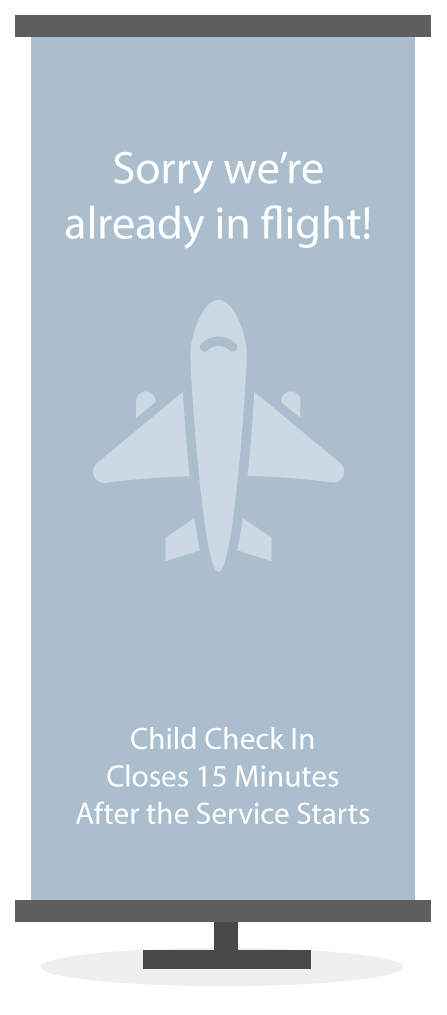
We do this at our church and it works very well. After fifteen minutes in, we place large banners at the entrance of our children’s ministry area briefly explaining that the kid’s ministry has already started and we give late families crayons and a coloring page for their kids.
I know what you’re thinking. What if a new family comes?!? They’ll never come back. Ok. No one comes fifteen minutes late to a new church for the first time. Think about it. If it were you, you’d just say, “We’ll try it next week.”
I will be honest, this change will be a bit painful at the beginning. Your chronically late people will complain (possibly loudly). Then, they’ll fall in line.
4. Environmental Cues
Sometimes it is helpful to focus on environmental cues that communicate that the service is starting. A few ideas:
- Use a countdown in the auditorium. For us, we have ad slides going on our screens, with a small countdown timer at the bottom right of the screen. Other churches skip the ad slides and just have a large countdown timer. In our student ministry, we show an entertaining video with a countdown timer at the bottom. Whatever way you do it, a countdown timer helps.

- As the countdown timer nears completion, go right into a pre-service song. At our church, this song begins when about one minute is left on the countdown timer. This is an instrumental song, played at full volume. If you do this every week in the same way, people get the idea that the service is starting.
- Another environmental cue that some churches use is cranking up the volume in the atrium when the service is starting. It might sound a bit obnoxious, but if it’s hard to continue a conversation in the atrium because of the volume of the welcome song, people will catch the hint.
- Lastly, it can help to adjust the lighting. The clearest way to do this is to dim the lights. Remember the last time you went to a musical? It works!
5. Deal With It
Here’s my last suggestion for managing a tardy culture: Deal with it.
Just accept it that many of your people can’t figure out how to make it on time. People like me have 5 kids to get ready. It’s like herding cats! We want to be on time... we are just struggling!
When I say “deal with it,” I don’t mean just surrendering. But, I do mean welcoming people a second time during the service without shaming them for being late. Something like the pastor on stage, after the song saying:
“Hey, welcome to you if you came in during our time of singing. Glad you’re here.”
And, just coming to terms with the reality that the crucial information must be shared later in your service. It’s just the way that it is.
I’ll be completely transparent. We do 90% of the things I suggested in this post and we still experience a decent amount of late comers. I don’t know about you, but I’d rather they came late than not at all.
Wrap Up
Hopefully this has been helpful. If you think your church is the tardiest church ever, I would suggest starting with starting on time and subtle environmental cues and work your way to more drastic measures.
Sign Up for Product Updates

Tithely provides the tools you need to engage with your church online, stay connected, increase generosity, and simplify the lives of your staff.
With tools like text and email messaging, custom church apps and websites, church management software, digital giving, and so much more… it’s no wonder why over 53,000 churches in 50 countries trust Tithely to help run their church.
It’s 9:15. The church service begins. You look out and where are all the people?
Fast forward fifteen minutes and you take another look and the place is packed.
What’s up with this?!? Whatever happened to punctuality?
Can people just show up for church on time? I mean, come on! Is it that hard?!? For crying out loud!
We’re all frustrated by the fact that people just show up whenever. And, of course, some of this just can’t be helped. People are gonna do what people are gonna do. However, there are some things that we can do to help correct and manage a culture of tardiness.
So here you go: 5 tips for getting people to show up to your church on time.
1. Start on Time
Yes. It’s true. I know you are shocked.
If we want people to show up on time…we have to start on time.
Inconsistency in our start time is the number one factor in people showing up late. Why? Because we inadvertently communicate that the start time doesn’t actually matter.
So, if we want to correct a culture of tardiness, we must put in the hard work of preparation and practice to ensure that we start our services when we say we will. Two ideas for actually pulling this off:
First, plan everything you do, down to the minute.
We plan out every detail of our service, which is great for a timely service. However, the extra step that is needed is planning everything that happens before the service down to the minute.
Our practices, cue-to-cues, and pre-service elements are all planned and timed as well. Perhaps a little more planning of your pre-service elements would help with consistently starting on time.
Secondly, who is directing your service? Who decides when the doors open and the music begins?
If this decision is made by committee you should probably narrow it down to a person. If the person is not a detail oriented, schedule-driven person, you may want to reassign this role.
Just sayin’.
2. Make the First 10 Minutes Compelling
Here’s a great question to ask your team: Are the first ten minutes of our service compelling?
In other words, maybe people are not showing up on time because they don’t believe the first ten minutes are really all that valuable. Here are a few questions to ask when considering what your first ten minutes look like:
- Is it important? Is what you are doing or what you are saying absolutely necessary? Do people need to know this or are you just filling space?
- Does it connect? People want to know and be known. What you do in the first ten minutes will be engaging if it helps people know each other, someone on the stage or even the community in which your church exists?
- Does it create FOMO? There is a way to structure the first ten minutes of a service so that it creates FOMO (fear of missing out). In other words, people won’t want to miss the first ten minutes either because it is so important or so entertaining. In our student ministry, we did this with funny videos. We created an expectation. Students didn’t want to miss the funny video so they showed up on time. Perhaps there is a way to create a little FOMO in the first ten minutes of your church service.
3. Close Stuff
Another simple way to fight a culture of tardiness is to introduce subtle and not so subtle measures to demonstrate that timeliness matters.
One subtle example is to close the doors to your auditorium when the service starts. This subtly communicates to people, “Hey, you’re late and that’s a little awkward.”
A not so subtle measure is to close your children’s ministry fifteen minutes into the service.
No, I’m actually serious.
Think about it. It’s pretty disruptive to introduce a new kid into a children’s ministry environment this late into the game. Closing the doors fifteen minutes in communicates value to your timely families your children’s ministry volunteers and it says “we value starting on time” in a big way.
We do this at our church and it works very well. After fifteen minutes in, we place large banners at the entrance of our children’s ministry area briefly explaining that the kid’s ministry has already started and we give late families crayons and a coloring page for their kids.
I know what you’re thinking. What if a new family comes?!? They’ll never come back. Ok. No one comes fifteen minutes late to a new church for the first time. Think about it. If it were you, you’d just say, “We’ll try it next week.”
I will be honest, this change will be a bit painful at the beginning. Your chronically late people will complain (possibly loudly). Then, they’ll fall in line.
4. Environmental Cues
Sometimes it is helpful to focus on environmental cues that communicate that the service is starting. A few ideas:
- Use a countdown in the auditorium. For us, we have ad slides going on our screens, with a small countdown timer at the bottom right of the screen. Other churches skip the ad slides and just have a large countdown timer. In our student ministry, we show an entertaining video with a countdown timer at the bottom. Whatever way you do it, a countdown timer helps.
- As the countdown timer nears completion, go right into a pre-service song. At our church, this song begins when about one minute is left on the countdown timer. This is an instrumental song, played at full volume. If you do this every week in the same way, people get the idea that the service is starting.
- Another environmental cue that some churches use is cranking up the volume in the atrium when the service is starting. It might sound a bit obnoxious, but if it’s hard to continue a conversation in the atrium because of the volume of the welcome song, people will catch the hint.
- Lastly, it can help to adjust the lighting. The clearest way to do this is to dim the lights. Remember the last time you went to a musical? It works!
5. Deal With It
Here’s my last suggestion for managing a tardy culture: Deal with it.
Just accept it that many of your people can’t figure out how to make it on time. People like me have 5 kids to get ready. It’s like herding cats! We want to be on time... we are just struggling!
When I say “deal with it,” I don’t mean just surrendering. But, I do mean welcoming people a second time during the service without shaming them for being late. Something like the pastor on stage, after the song saying:
“Hey, welcome to you if you came in during our time of singing. Glad you’re here.”
And, just coming to terms with the reality that the crucial information must be shared later in your service. It’s just the way that it is.
I’ll be completely transparent. We do 90% of the things I suggested in this post and we still experience a decent amount of late comers. I don’t know about you, but I’d rather they came late than not at all.
Wrap Up
Hopefully this has been helpful. If you think your church is the tardiest church ever, I would suggest starting with starting on time and subtle environmental cues and work your way to more drastic measures.
podcast transcript
Tithely provides the tools you need to engage with your church online, stay connected, increase generosity, and simplify the lives of your staff.
With tools like text and email messaging, custom church apps and websites, church management software, digital giving, and so much more… it’s no wonder why over 53,000 churches in 50 countries trust Tithely to help run their church.
It’s 9:15. The church service begins. You look out and where are all the people?
Fast forward fifteen minutes and you take another look and the place is packed.
What’s up with this?!? Whatever happened to punctuality?
Can people just show up for church on time? I mean, come on! Is it that hard?!? For crying out loud!
We’re all frustrated by the fact that people just show up whenever. And, of course, some of this just can’t be helped. People are gonna do what people are gonna do. However, there are some things that we can do to help correct and manage a culture of tardiness.
So here you go: 5 tips for getting people to show up to your church on time.
1. Start on Time
Yes. It’s true. I know you are shocked.
If we want people to show up on time…we have to start on time.
Inconsistency in our start time is the number one factor in people showing up late. Why? Because we inadvertently communicate that the start time doesn’t actually matter.
So, if we want to correct a culture of tardiness, we must put in the hard work of preparation and practice to ensure that we start our services when we say we will. Two ideas for actually pulling this off:
First, plan everything you do, down to the minute.
We plan out every detail of our service, which is great for a timely service. However, the extra step that is needed is planning everything that happens before the service down to the minute.
Our practices, cue-to-cues, and pre-service elements are all planned and timed as well. Perhaps a little more planning of your pre-service elements would help with consistently starting on time.
Secondly, who is directing your service? Who decides when the doors open and the music begins?
If this decision is made by committee you should probably narrow it down to a person. If the person is not a detail oriented, schedule-driven person, you may want to reassign this role.
Just sayin’.
2. Make the First 10 Minutes Compelling
Here’s a great question to ask your team: Are the first ten minutes of our service compelling?
In other words, maybe people are not showing up on time because they don’t believe the first ten minutes are really all that valuable. Here are a few questions to ask when considering what your first ten minutes look like:
- Is it important? Is what you are doing or what you are saying absolutely necessary? Do people need to know this or are you just filling space?
- Does it connect? People want to know and be known. What you do in the first ten minutes will be engaging if it helps people know each other, someone on the stage or even the community in which your church exists?
- Does it create FOMO? There is a way to structure the first ten minutes of a service so that it creates FOMO (fear of missing out). In other words, people won’t want to miss the first ten minutes either because it is so important or so entertaining. In our student ministry, we did this with funny videos. We created an expectation. Students didn’t want to miss the funny video so they showed up on time. Perhaps there is a way to create a little FOMO in the first ten minutes of your church service.
3. Close Stuff
Another simple way to fight a culture of tardiness is to introduce subtle and not so subtle measures to demonstrate that timeliness matters.
One subtle example is to close the doors to your auditorium when the service starts. This subtly communicates to people, “Hey, you’re late and that’s a little awkward.”
A not so subtle measure is to close your children’s ministry fifteen minutes into the service.
No, I’m actually serious.
Think about it. It’s pretty disruptive to introduce a new kid into a children’s ministry environment this late into the game. Closing the doors fifteen minutes in communicates value to your timely families your children’s ministry volunteers and it says “we value starting on time” in a big way.
We do this at our church and it works very well. After fifteen minutes in, we place large banners at the entrance of our children’s ministry area briefly explaining that the kid’s ministry has already started and we give late families crayons and a coloring page for their kids.
I know what you’re thinking. What if a new family comes?!? They’ll never come back. Ok. No one comes fifteen minutes late to a new church for the first time. Think about it. If it were you, you’d just say, “We’ll try it next week.”
I will be honest, this change will be a bit painful at the beginning. Your chronically late people will complain (possibly loudly). Then, they’ll fall in line.
4. Environmental Cues
Sometimes it is helpful to focus on environmental cues that communicate that the service is starting. A few ideas:
- Use a countdown in the auditorium. For us, we have ad slides going on our screens, with a small countdown timer at the bottom right of the screen. Other churches skip the ad slides and just have a large countdown timer. In our student ministry, we show an entertaining video with a countdown timer at the bottom. Whatever way you do it, a countdown timer helps.
- As the countdown timer nears completion, go right into a pre-service song. At our church, this song begins when about one minute is left on the countdown timer. This is an instrumental song, played at full volume. If you do this every week in the same way, people get the idea that the service is starting.
- Another environmental cue that some churches use is cranking up the volume in the atrium when the service is starting. It might sound a bit obnoxious, but if it’s hard to continue a conversation in the atrium because of the volume of the welcome song, people will catch the hint.
- Lastly, it can help to adjust the lighting. The clearest way to do this is to dim the lights. Remember the last time you went to a musical? It works!
5. Deal With It
Here’s my last suggestion for managing a tardy culture: Deal with it.
Just accept it that many of your people can’t figure out how to make it on time. People like me have 5 kids to get ready. It’s like herding cats! We want to be on time... we are just struggling!
When I say “deal with it,” I don’t mean just surrendering. But, I do mean welcoming people a second time during the service without shaming them for being late. Something like the pastor on stage, after the song saying:
“Hey, welcome to you if you came in during our time of singing. Glad you’re here.”
And, just coming to terms with the reality that the crucial information must be shared later in your service. It’s just the way that it is.
I’ll be completely transparent. We do 90% of the things I suggested in this post and we still experience a decent amount of late comers. I don’t know about you, but I’d rather they came late than not at all.
Wrap Up
Hopefully this has been helpful. If you think your church is the tardiest church ever, I would suggest starting with starting on time and subtle environmental cues and work your way to more drastic measures.
VIDEO transcript
It’s 9:15. The church service begins. You look out and where are all the people?
Fast forward fifteen minutes and you take another look and the place is packed.
What’s up with this?!? Whatever happened to punctuality?
Can people just show up for church on time? I mean, come on! Is it that hard?!? For crying out loud!
We’re all frustrated by the fact that people just show up whenever. And, of course, some of this just can’t be helped. People are gonna do what people are gonna do. However, there are some things that we can do to help correct and manage a culture of tardiness.
So here you go: 5 tips for getting people to show up to your church on time.
1. Start on Time
Yes. It’s true. I know you are shocked.
If we want people to show up on time…we have to start on time.
Inconsistency in our start time is the number one factor in people showing up late. Why? Because we inadvertently communicate that the start time doesn’t actually matter.
So, if we want to correct a culture of tardiness, we must put in the hard work of preparation and practice to ensure that we start our services when we say we will. Two ideas for actually pulling this off:
First, plan everything you do, down to the minute.
We plan out every detail of our service, which is great for a timely service. However, the extra step that is needed is planning everything that happens before the service down to the minute.
Our practices, cue-to-cues, and pre-service elements are all planned and timed as well. Perhaps a little more planning of your pre-service elements would help with consistently starting on time.
Secondly, who is directing your service? Who decides when the doors open and the music begins?
If this decision is made by committee you should probably narrow it down to a person. If the person is not a detail oriented, schedule-driven person, you may want to reassign this role.
Just sayin’.
2. Make the First 10 Minutes Compelling
Here’s a great question to ask your team: Are the first ten minutes of our service compelling?
In other words, maybe people are not showing up on time because they don’t believe the first ten minutes are really all that valuable. Here are a few questions to ask when considering what your first ten minutes look like:
- Is it important? Is what you are doing or what you are saying absolutely necessary? Do people need to know this or are you just filling space?
- Does it connect? People want to know and be known. What you do in the first ten minutes will be engaging if it helps people know each other, someone on the stage or even the community in which your church exists?
- Does it create FOMO? There is a way to structure the first ten minutes of a service so that it creates FOMO (fear of missing out). In other words, people won’t want to miss the first ten minutes either because it is so important or so entertaining. In our student ministry, we did this with funny videos. We created an expectation. Students didn’t want to miss the funny video so they showed up on time. Perhaps there is a way to create a little FOMO in the first ten minutes of your church service.
3. Close Stuff
Another simple way to fight a culture of tardiness is to introduce subtle and not so subtle measures to demonstrate that timeliness matters.
One subtle example is to close the doors to your auditorium when the service starts. This subtly communicates to people, “Hey, you’re late and that’s a little awkward.”
A not so subtle measure is to close your children’s ministry fifteen minutes into the service.
No, I’m actually serious.
Think about it. It’s pretty disruptive to introduce a new kid into a children’s ministry environment this late into the game. Closing the doors fifteen minutes in communicates value to your timely families your children’s ministry volunteers and it says “we value starting on time” in a big way.
We do this at our church and it works very well. After fifteen minutes in, we place large banners at the entrance of our children’s ministry area briefly explaining that the kid’s ministry has already started and we give late families crayons and a coloring page for their kids.
I know what you’re thinking. What if a new family comes?!? They’ll never come back. Ok. No one comes fifteen minutes late to a new church for the first time. Think about it. If it were you, you’d just say, “We’ll try it next week.”
I will be honest, this change will be a bit painful at the beginning. Your chronically late people will complain (possibly loudly). Then, they’ll fall in line.
4. Environmental Cues
Sometimes it is helpful to focus on environmental cues that communicate that the service is starting. A few ideas:
- Use a countdown in the auditorium. For us, we have ad slides going on our screens, with a small countdown timer at the bottom right of the screen. Other churches skip the ad slides and just have a large countdown timer. In our student ministry, we show an entertaining video with a countdown timer at the bottom. Whatever way you do it, a countdown timer helps.
- As the countdown timer nears completion, go right into a pre-service song. At our church, this song begins when about one minute is left on the countdown timer. This is an instrumental song, played at full volume. If you do this every week in the same way, people get the idea that the service is starting.
- Another environmental cue that some churches use is cranking up the volume in the atrium when the service is starting. It might sound a bit obnoxious, but if it’s hard to continue a conversation in the atrium because of the volume of the welcome song, people will catch the hint.
- Lastly, it can help to adjust the lighting. The clearest way to do this is to dim the lights. Remember the last time you went to a musical? It works!
5. Deal With It
Here’s my last suggestion for managing a tardy culture: Deal with it.
Just accept it that many of your people can’t figure out how to make it on time. People like me have 5 kids to get ready. It’s like herding cats! We want to be on time... we are just struggling!
When I say “deal with it,” I don’t mean just surrendering. But, I do mean welcoming people a second time during the service without shaming them for being late. Something like the pastor on stage, after the song saying:
“Hey, welcome to you if you came in during our time of singing. Glad you’re here.”
And, just coming to terms with the reality that the crucial information must be shared later in your service. It’s just the way that it is.
I’ll be completely transparent. We do 90% of the things I suggested in this post and we still experience a decent amount of late comers. I don’t know about you, but I’d rather they came late than not at all.
Wrap Up
Hopefully this has been helpful. If you think your church is the tardiest church ever, I would suggest starting with starting on time and subtle environmental cues and work your way to more drastic measures.
Sign Up for Product Updates
Tithely provides the tools you need to engage with your church online, stay connected, increase generosity, and simplify the lives of your staff.
With tools like text and email messaging, custom church apps and websites, church management software, digital giving, and so much more… it’s no wonder why over 53,000 churches in 50 countries trust Tithely to help run their church.

You Might Also Like
More Resources

From increasing giving, managing your congregation, and engaging your church, our collection of resources will keep you up-to-date on the latest church and ministry trends.
Free Resources.jpg)


.jpg)
.jpg)